To save content items to your account,
please confirm that you agree to abide by our usage policies.
If this is the first time you use this feature, you will be asked to authorise Cambridge Core to connect with your account.
Find out more about saving content to .
To save content items to your Kindle, first ensure no-reply@cambridge.org
is added to your Approved Personal Document E-mail List under your Personal Document Settings
on the Manage Your Content and Devices page of your Amazon account. Then enter the ‘name’ part
of your Kindle email address below.
Find out more about saving to your Kindle.
Note you can select to save to either the @free.kindle.com or @kindle.com variations.
‘@free.kindle.com’ emails are free but can only be saved to your device when it is connected to wi-fi.
‘@kindle.com’ emails can be delivered even when you are not connected to wi-fi, but note that service fees apply.
Like tobacco, gambling is a risky, urge-driven lifestyle choice with serious health, social and economic consequences, while simultaneously representing a lucrative global industry shaped by powerful commercial interests. In 2024, the Lancet Public Health Commission on Gambling called for public health-motivated interventions in gambling activity, including prohibitions or restrictions on “ … access, promotion, marketing, and sponsorship.” As the first set of universal norms to govern a lifestyle risk, the Framework Convention on Tobacco Control (‘FCTC’) has set a benchmark for universal population-led public health norms that address the sale and supply of tobacco products. To investigate the potential for transposition of the FCTC’s model to gambling, this paper examines the critical strategies of tobacco control norms. It evaluates them against the features of gambling regulation, taking a first step towards examining the “fit” of the FCTC as a normative model for common, internationally agreed public health-motivated measures of gambling control. It finds that while some normative elements may be transferable from tobacco control, fundamental differences between the highly targeted interventions of tobacco law and the broader regulatory objectives of gambling control frameworks make a direct transposition of norms problematic.
Tobacco control policies are complex with the potential for significant health effects. The public health actors and regulators who design, influence, and implement these policies place a high value on the evidence base that underpins them, engaging in scientific and applied debates about how to evaluate the success of existing policies and justify new actions. To investigate the construction of this evidence base, we conducted interviews with 40 individuals involved in formulating, advising, and implementing flavour restrictions for tobacco products. Our interviews inform case studies of six jurisdictions in three US states, Canada, the UK, and the Netherlands. We find that tobacco policy stakeholders, which include regulators and public health personnel, play a vital role as data integrators in the construction of this evidence base: they bring together disparate types and sources of information to create synthetic evaluations of tobacco control policies that incorporate the complexity of the policy environment and differential impacts on population subgroups. Significantly, data integration is not easy to replicate or automate; should these positions be lost due to funding cuts as political priorities shift in the US and globally, the capacity they add to our policymaking and research systems will be difficult to restore.
Tobacco use causes over 8 million deaths annually, with low- and middle-income countries (LMICs) bearing most of the burden. In Botswana, tobacco use prevalence rose from 17.6% in 2017 to 22.2% in 2024. Despite this, tobacco control infrastructure remains limited. Tobacco Control Resource Centers (TCRCs) have been established to consolidate provider training, research, and dissemination of tobacco control resources. The World Health Organization (WHO) Centre for Tobacco Control in Africa (CTCA), a regional TCRC, has a cross-country mandate that could be further strengthened through complementary, country-specific support. We applied the Community Engagement Studio (CES) methodology to co-design of a Botswana-based TCRC-assessing acceptability, priorities, potential challenges, and implementation strategies. In July 2025, 12 stakeholders from the Botswana Smoking Abstinence Reinforcement Trial (BSMART), a NIH-funded study aimed at integrating smoking cessation interventions in HIV clinics, participated in a 2-hour CES. Stakeholders endorsed the need for a national TCRC, prioritizing provider training, dissemination, and cessation services. Sustainable financing emerged as a key challenge, prompting proposals for diversified funding models. We successfully conducted a CES to guide the co-design of a Botswana-based TCRC, illustrating the acceptability of a national TCRC and how CES can be leveraged to strengthen tobacco control infrastructure in Botswana.
Interest group influence represents the Higgs boson of contemporary social research. Scholars have tried to define and measure influence for decades: tens of different definitions are used in the literature and as many methods to measure it can be found. The literature has recently converged towards an agreement on how to study interest group influence: preference attainment. The latter has monopolised the research in the literature in the last years. Yet, a discussion on what preference attainment is, what it does and what it does not is still missing in the literature. This works aims to fill this gap by providing a theoretical and methodological informed discussion on interest group influence and preference attainment. In so doing, I propose a novel method to apply preference attainment in an effective and efficient manner.
From Manners to Rules traces the emergence of legalistic governance in South Korea and Japan. While these countries were previously known for governance characterized by bureaucratic discretion and vague laws, activists and lawyers are pushing for a more legalistic regulatory style. Legalism involves more formal, detailed, and enforceable rules and participatory policy processes. Previous studies have focused on top-down or structural explanations for legalism. From Manners to Rules instead documents bottom-up sources of institutional and social change, as activists and lawyers advocate for and use more formal rules and procedures. By comparing recent reforms in disability rights and tobacco control, the book uncovers the societal drivers behind legalism and the broader judicialization of politics in East Asia's main democracies. Drawing on 120 interviews and diverse sources, From Manners to Rules challenges the conventional wisdom that law and courts play marginal roles in Korean and Japanese politics and illuminates how legalistic governance is transforming citizens' options for political participation.
Liberal neutrality compels governments to respect individual preferences. Yet health-promotion campaigns, such as modern tobacco control policies, often seek to cultivate a preference for a healthy lifestyle. Liberal theorists have attempted to justify these policies by appealing to the concept of ‘means paternalism’, whereby these policies align with existing preferences. In contrast, this article argues that shaping preferences can be not only permissible but also morally required. Governments can preserve neutrality while influencing preferences by promoting generic goods valued in diverse societies and considering the preference-formation of future generations. This argument provides a stronger rationale for tobacco control policies.
Opinions vary in Japan on whether smoking is deviant today, but the behavior, once widely accepted, faces increasing regulation. Recent reforms, moving beyond reliance on nonsmokers' tolerance and smokers' etiquette, impose stricter and more detailed rules on smoking, along with penalties for noncompliance. As the Japanese government's promotional materials note, the reforms move “from manners to rules” (manā kara rūru e). The evolution of Japan's smoking regulations exemplifies a shift toward more legalistic modes of social control. Historically, Japanese governance relied on non-binding “soft law,” administrative guidance, and societal cooperation. Legalistic governance, in contrast, hinges on formal rules and proceduralized enforcement mechanisms. This article, drawing on twenty-eight interviews and qualitative analysis of policy deliberations, advocacy organization documents, court rulings, and Japanese news coverage, traces how societal actors contributed to this legalistic turn. Tobacco control advocates filed lawsuits, pursued voluntary changes through local activities, and provided information subsidies to policymakers while lobbying for local and national reforms. They thereby helped de-normalize smoking and render it regulatable. By uncovering bottom-up drivers of legalistic governance and the strategies through which societal actors influence regulatory style, this paper contributes to scholarship on governance, policy diffusion, and law and social change.
Chapter 4 examines the wave of cases before international courts and tribunals (ICTs) against the most innovative tobacco control measures, focusing in particular on Philip Morris v Uruguay (ICSID) and Australia – Plain Packaging (WTO). It contends that the alleged ineffectiveness of the tobacco control measures was one of the key arguments of the claimants, who supported their claims by submitting a hefty amount of evidence. These evidentiary challenges presented novel and demanding tasks for adjudicators of ICTs. Against this backdrop, this chapter first analyses the nature and features of the evidentiary challenges to tobacco control measures (Section 4.2). Second, it reviews how the ICTs have assessed them, zooming in on the interpretation of flexibilities and the use of different sources of evidence (Section 4.3). The picture that emerges from this chapter is that of unnecessary, manufactured complexity. Shifting the discussions on tobacco control measures from the WHO/FCTC to trade and investment ICTs, the tobacco industry has effectively managed to masterfully use international law to its own advantage. It has reframed the debate, all while starting expensive and lengthy judicial proceedings that have taken almost a decade to be concluded.
Chapter 1 sets the historical and theoretical background of the book. It starts by describing the regulatory battles that took place from the 1970s to adopt more stringent tobacco control measures. Then, it illustrates how the negotiations of the WHO Framework Convention on Tobacco Control and the subsequent WTO and international investment disputes can be considered the internationalisation of the tobacco wars. In this context, the concept of ‘lawfare’ is introduced as a descriptive device and analytical tool for the analysis of the book. The second part of the introduction introduces the second fil rouge of the book: evidence. It begins by defining the notion of evidence and by showing how, in the context of tobacco control, it can refer to different bodies of evidence that pertain both to the risk assessment and risk management dimension of tobacco control measures. This second part, moreover, shows how evidence has always been one of the key points of contention in the tobacco wars and has continued to be so in the international tobacco control lawfare. The introduction concludes with an explanation of the methodology employed, a reflection on its limits, and an outline of the content of the book.
In addition to summarising the main findings of the book, this final chapter offers some reflections on the lessons that emerge from the history of the international tobacco control lawfare. The reflections are organised around the two main themes of the book: lawfare (Section 5.1) and evidence (Section 5.2). The first part offers some thoughts on the value of using ‘lawfare’ as an analytical tool, zooming in on the role of business actors in international regulation (Section 5.1.1) and on a reflexive account on one’s research (Section 5.1.2). The second part summarises the main topics related to evidence that have emerged in the book: the different types of evidence in risk assessment and risk management (Section 5.2.1), international law’s overreliance on evidence (Section 5.2.2), evidence as a weapon (Section 5.2.3), and evidence as an ideological battleground (Section 5.2.4).
Chapter 3 analyses how evidence has become a central element of the FCTC regime (2005–present). Section 3.1 captures the most important developments since the conclusion of the FCTC in 2003. Section 3.2 provides the theoretical framework of the chapter, focusing on the concept of path dependence in international organisations. Section 3.3 proceeds by showing that the development of the guidelines by the FCTC Conference of the Parties (COP) has been in effect a continuation of the strategy on evidence. Section 3.4 in turn highlights the second facet of the FCTC as an evidence-based regime, that is how the FCTC has mobilised new evidence at the national level. Sections 3.5 and 3.6 reflect on the consequences that the evidence-based approach has had on the outlook of the FCTC regime. Section 3.5 uses in-depth qualitative analysis to demonstrate that the evidence-based approach has reinforced the importance of the expertise of civil society organisations. Finally, Section 3.6 illustrates how the evidence-based approach has started to show its shortcomings in the work of the FCTC COP – particularly in the approach to new products like e-cigarettes (or ENDS) and in the (lack of) development of strategies to foster the implementation of tobacco control measures.
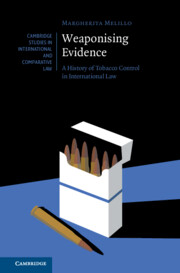
Weaponising Evidence provides the first analysis of the history of the international law on tobacco control. By relying on a vast set of empirical sources, it analyses the negotiation of the WHO Framework Convention on Tobacco Control (FCTC) and the tobacco control disputes lodged before the WTO and international investment tribunals (Philip Morris v Uruguay and Australia – Plain Packaging). The investigation focuses on two main threads: the instrumental use of international law in the warlike confrontation between the tobacco control advocates and the tobacco industry, and the use of evidence as a weapon in the conflict. The book unveils important lessons on the functioning of international organizations, the role of corporate actors and civil society organizations, and the importance and limits of science in law-making and litigation.
This Chapter examines the tobacco industry in Southern Rhodesia and Zimbabwe within the context of global tobacco control regime, public health debates and the changing production factors between 1953 and 2000s. It discusses the role of the state and the tobacco lobby in entrenching the interests of the tobacco industry against the global pressures to reduce tobacco demand and supply and how this has shaped the country’s articulation of tobacco control measures and policies. The chapter further explores transitions in tobacco farming landscapes in post-land reform Zimbabwe and the implications for livelihoods, natural resources, social institutions and agrarian development.
This chapter brings together the theory and topics discussed throughout the book and demonstrates how health promotion can be applied practically. Using a range of extended case studies, health promotion programs relating to tobacco control, community partnership and communication as an enabler are presented. The case studies are gathered from a number of international sources, with a particular focus on countries in the Asia Pacific and Global South.
Smokeless tobacco use among Indian women is increasing despite prevention efforts. Evolutionary theories suggest that reproductive-aged women should be more concerned about immediate threats to reproduction than threats to survival occurring late in life. This study therefore compared an anti-tobacco intervention that emphasized near-term reproductive harms to one involving general harms occurring later in life. Scheduled Tribal women (N = 92) from Karnataka, India participated in this study. At baseline, women reported tobacco use and knowledge of harms, provided a saliva sample to assess use, and randomly viewed either a general harms presentation (GHP) or reproductive harms presentation (RHP). At followup, women reported their use, knowledge of harms and intentions to quit, and provided another saliva sample. At baseline, participants were aware of general harms but not reproductive harms. Both interventions increased knowledge of harms. Women in the RHP condition did not list more harms than women in the GHP condition, however, and the RHP was not more effective in reducing tobacco use than the GHP. In the RHP condition fetal health was particularly salient. In the GHP condition, oral health was highly salient, aligning with the local disease ecology and research on tobacco use and attractiveness.
A household-level constant visual deterrent advocacy campaign to reduce tobacco intake was conducted in rural Bangladesh.
Aims
To evaluate smoking tobacco expenditure by campaign components.
Methods
We conducted a single-blind clustered randomized controlled trial on 630 adult male household heads from 16 chars (riverine islands) in rural northern Bangladesh, between November 2018 and January 2019. Intervention allotment was randomized at the char level to minimize spillovers, with 8 chars in treatment and control groups each. The intervention provided households in treatment chars (n = 323) with two visual warning posters, detailing the health effects of tobacco on oneself and external actors, to be hung inside the household for 4 weeks. Households in control chars (n = 307) received nothing. Reported daily smoking (log) tobacco expenditure values were the primary outcome of interest.
Results
Final analysis was conducted using 251 and 210 smokers in treatment and control chars respectively. The intervention reduced relative smoking tobacco expenditure by 12.8% (95% CI −31.45 to 5.81) but was not statistically significant (P-value = 0.163). Weak to moderate emotional reactions to the posters was identified as a reason for the statistical insignificance.
Conclusion
For a visual anti-tobacco intervention to have a substantial impact, it must induce strong emotional responses.
The duration of incoming quitline calls may serve as a crude proxy for the potential amount of reactive counseling provided.
Aims
To explore whether call duration may be useful for monitoring quitline capacity and service delivery.
Methods
Using data on the duration of incoming quitline calls to 1-800-QUIT-NOW from 2012 through 2015, we examined national trends and state-level variation in average call duration. We estimated a regression model of average call duration as a function of total incoming calls, nationally and by state, controlling for confounders.
Results
From 2012 through 2015, average call duration was 11.4 min, nationally, and was 10 min or longer in 33 states. Average call duration was significantly correlated with quitline service provider. Higher incoming call volume was significantly associated with lower average call duration in 32 states and higher average call duration in five states (P-value <0.05). The relationship between call volume and call duration was not correlated with quitline service provider.
Conclusions
Variation in average call duration across states likely reflects different service delivery models. Average call duration was associated with call volume in many states. Significant changes in call duration may highlight potential quitline capacity issues that warrant further investigation.
This study aims to assess the impact of a behavioural intervention, in the form of a self-monitoring record-keeping logbook, in reducing smoking tobacco expenditure amongst adult male household heads in rural Bangladesh.
Method
The experiment was designed as a single-blind clustered randomised controlled trial utilising two-stage random sampling. A total of 650 adult male household heads were sampled from 16 chars (riverine islands) from Gaibandha, Northern Bangladesh, with eight chars in treatment and control groups each, between November 2018 and January 2019. The intervention consisted of a logbook to record daily smoking tobacco intake for 4 weeks provided only to participants in treatment chars (n = 332) while households in control chars received nothing (n = 318).
Results
Final analysis was conducted using 222 and 210 households in the treatment and control chars respectively. The logbook intervention had a significant impact (P-value = 0.040) on reducing daily tobacco expenditure by 14% (α = 95%; CI: −0.273, −0.008) for the treatment group relative to the control group based on a difference-in-difference estimator. This is equivalent to a reduction of 20 cigarettes or 140 bidis smoked in a month.
Conclusion
Our minimal contact intervention successfully induced a reduction in smoking tobacco expenditure, which could effectively be incorporated with existing programs in the char regions of Bangladesh.
This article explores the internationalisation of tobacco control as a case study in the history of international health regulation. Contrary to the existing literature on the topic, it argues that the history of international anti-smoking efforts is longer and richer than the making of the World Health Organisation’s Framework Convention on Tobacco Control in the early twenty-first century. It thereby echoes the point made by other scholars about the importance of history when making sense of contemporary global health. Specifically, the article shows how the internationalisation of tobacco control started in the 1950s through informal contacts between scientists working on cancer research and how these initial interactions were followed by a growing number of more formal initiatives, from the World Conferences on Tobacco or Health to the Bloomberg Initiative to Reduce Tobacco Use. Rather than arranging these efforts in a linear narrative of progress culminating with the Framework Convention on Tobacco Control, we take anthropological claims about global health’s uneven terrain seriously and portray a history of international tobacco control marked by ruptures and discontinuities. Specifically, we identify three successive periods, with each of them characterised by specific understandings of international action, tobacco control expertise, advocacy networks and funding strategies.
This article forges a link between support for European integration and adoption of tobacco advertisement restrictions in Swiss cantons. Leaning on the policy diffusion literature, this article argues that the more voters support deeper European integration, the more likely cantonal governments are to restrict tobacco advertising. Policymakers use voters’ support for more European integration as a signal that they support regulatory policies that are strongly associated with the European Union (EU) in the political and media debate, such as tobacco advertisement bans. This effect ought to be especially strong in the absence of adverse economic interests, such as the presence of the tobacco industry. To buttress these claims, the present article uses statistical analysis, specifically event-history analysis. Apart from the insights about Swiss tobacco control policy, this article contributes to our understanding of indirect EU influence on cantonal policymaking and policy diffusion.