To save content items to your account,
please confirm that you agree to abide by our usage policies.
If this is the first time you use this feature, you will be asked to authorise Cambridge Core to connect with your account.
Find out more about saving content to .
To save content items to your Kindle, first ensure no-reply@cambridge.org
is added to your Approved Personal Document E-mail List under your Personal Document Settings
on the Manage Your Content and Devices page of your Amazon account. Then enter the ‘name’ part
of your Kindle email address below.
Find out more about saving to your Kindle.
Note you can select to save to either the @free.kindle.com or @kindle.com variations.
‘@free.kindle.com’ emails are free but can only be saved to your device when it is connected to wi-fi.
‘@kindle.com’ emails can be delivered even when you are not connected to wi-fi, but note that service fees apply.
Chapter 5 explores how Michelangelo’s gift-giving practice evolved during his self-imposed exile from Florence beginning in 1534. Considering the series of religious subjects he made for Vittoria Colonna in the later 1530s and a group of politically motivated gifts of both new and existing works, this chapter examines an overlooked aspect of Michelangelo’s late career, in which he continued to produced highly finished drawings as gifts but also created “authorized” copies of his work in partnership with other artists, and deployed his gifts as signs of political solidarity with members of the Florentine exile community in Rome.
A brief Introduction situates the book within the scholarship on Michelangelo and Cavalieri, Renaissance practices of gift exchange, patronage, copies and collaborative artworks, the history of celebrity, and Medicean cultural politics. It provides an overview of the methodological approach and summarizes the book’s chapters and chronological arc.
Chapter 1 focuses on the initiation of the relationship between Michelangelo and Cavalieri, reconstructing the timeline of Michelangelo’s gifts of drawings and poetry. This chapter places Michelangelo’s gifts to Cavalieri within the larger frame of the social protocols of Renaissance gift exchange and the rituals of Renaissance friendship, which allowed for eroticized attachments between men, but prohibited physical expressions of desire, acknowledging both the conventional nature of the relationship and its particular significance for Michelangelo at this moment.
Chapter 2 details a series of little-studied gifts of drawings, food, poetry, and musical compositions that were channeled to Cavalieri through Michelangelo’s network of friends in Rome. It uses Michelangelo’s correspondence to explore the artist’s social circle and its role in facilitating Michelangelo’s gift-giving, demonstrating that personal access to the artist had value in and of itself.
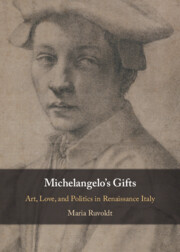
Michelangelo's Gifts tells the story of the artist's most intimate relationships and his deepest political commitments in the last decades of his life. The first study in over forty years of his relationship with his beloved, Tommaso de' Cavalieri, and the first in English, it is also the first comprehensive investigation of Michelangelo's gift-giving practices. Maria Ruvoldt here examines the evolution of Michelangelo's gift-giving strategies and their meanings from 1532, when Michelangelo's introduction to Cavalieri initiated his most extensive cycle of gifts of drawings and poetry, to the artist's death in 1564, which was preceded by a series of politically motivated gifts, including large-scale sculptures. Ruvoldt argues that Michelangelo's gift-giving was a response to the forces that shaped his career. She demonstrates that we can locate the origins of contemporary ideas about artistic autonomy, celebrity, and what constitutes an authentic work of art through the history of the creation and reception of Michelangelo's gifts.
Recommend this
Email your librarian or administrator to recommend adding this to your organisation's collection.