To save content items to your account,
please confirm that you agree to abide by our usage policies.
If this is the first time you use this feature, you will be asked to authorise Cambridge Core to connect with your account.
Find out more about saving content to .
To save content items to your Kindle, first ensure no-reply@cambridge.org
is added to your Approved Personal Document E-mail List under your Personal Document Settings
on the Manage Your Content and Devices page of your Amazon account. Then enter the ‘name’ part
of your Kindle email address below.
Find out more about saving to your Kindle.
Note you can select to save to either the @free.kindle.com or @kindle.com variations.
‘@free.kindle.com’ emails are free but can only be saved to your device when it is connected to wi-fi.
‘@kindle.com’ emails can be delivered even when you are not connected to wi-fi, but note that service fees apply.
This Element theorizes the emergence of the girl as the ideal subject of Western imperialist power. Feminist anti-imperialist scholars have long argued that imperialism operates through the global North's claim to be the savior of voiceless, victimized women and girls in the global South. However, during the global war on terrorism, the military and development organizations of the global North shifted their practices and rhetoric in response to the popularization of this feminist anti-imperialist critique. Focusing on this key historical shift, Theory of the Counterinsurgent Girl argues that hegemonic Western cultural and military strategies have moved away from 'saving' women to 'empowering' girls, in keeping with the neoliberal emphasis on individual resilience and agency. This Element traces the rise to dominance of the figure of the agential girl, analyzing how she has been incorporated into decision-making, securitizing, and policing operations as both a surveillance tool and a social justice goal.
Race has been a dominant theme in studies of US black art and politics in the 1910s and 1920s. This chapter shifts focus to imperial concerns during a period marked by US occupations in Haiti, Nicaragua, and the Dominican Republic, as well as the acquisition of the Danish Virgin Islands. It explores how the era’s print culture both revealed and obscured the expansion of a US Empire or Greater United States in the Caribbean. US governance in places like Haiti did not go unchallenged in leftist and race-conscious periodicals such as The Nation, The Crisis, and The Crusader. While non-fiction provoked anti-imperial analyses, fiction did not prompt the same responses. Assessing reviews and commentary of fiction, including Eugene O’Neill’s The Emperor Jones, Carl Van Vechten’s Nigger Heaven, Claude McKay’s Home to Harlem and Eric Walrond’s Tropic Death, this chapter examines why anti-imperial reading proved so elusive in this context.
This Element centers the 'Black Pacific' as a generative site for comparative and intersectional methodologies and transnational frameworks for thinking about racial formations, post-national literary forms, and cultural histories. At the end of the nineteenth century, US overseas expansion into the Pacific brought white supremacy and colonial rule into alignment. It also threw into greater relief the contradictions of US citizenship and national identity as legalized segregation and rising anti-Black violence foreclosed Reconstruction's possibilities. Race accrued dynamic new meanings in the age of new imperialism. Focusing on the earliest of African American literary magazines, the Boston-based Colored American Magazine (1900–09) and its southern rival, the Atlanta-based Voice of the Negro (1904–7), this Element examines the formative role of magazine and periodical writings in the development of early Black transpacific internationalism.
Scholars often view America’s ill-fated military intervention in Vietnam as emblematic of the broader triumph of Southeast Asian nationalism over western colonialism. However, this chapter shows that the persistence of Western imperialism in Southeast Asia is more characteristic of the region’s history when the Cold War intersected with decolonization. Anglo-American neo-colonial designs for preserving their influence largely dovetailed with the goals of conservative, Southeast Asian nationalists seeking either US or British assistance to suppress homegrown left-wing movements inspired and sponsored by Moscow or, above all, Beijing. Indeed, Britain, America, and their Southeast Asian partners shared an anti-communist worldview undergirded by similar fears that the millions-strong Chinese diaspora in the region would serve China’s expansionist agenda. Despite Washington’s failures in Vietnam, the melding of British and US neo-colonialism with Southeast Asian nationalism would usher the region from European-dominated formal colonialism into informal US Empire by the late 1960s.
Latinx children’s and young adult literature offers Latinx children opportunities to step into another world and also see themselves represented in what they read. By giving Latinx child readers, in particular, worlds unlike and like their own, authors like Lilliam Rivera, Edwidge Danticat, and Marcia Argueta Mickelson also challenge dominant national narratives about Latinx experiences in the United States. In the stories these writers tell, young protagonists are confronted by various symptoms of US imperialism, such as racism, xenophobia, and homophobia. The protagonists’ journey often includes learning more about the oppressions that plague them and their communities and finding ways to dismantle said oppressions. Recognizing the role that the United States had in the forced (im)migration of many people of Latin American descent allows for a narrative shift away from the “immigration story” to a story of US imperialism and its consequences. Examining race and empire in Latinx children’s literature creates possibilities for alternative ways of knowing and existing where Latinx children can step in and out of worlds unlike and like their own.
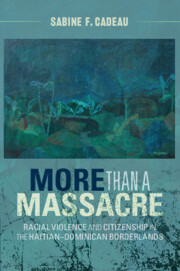
More than a Massacre is a history of race, citizenship, statelessness, and genocide from the perspective of ethnic Haitians in Dominican border provinces. Sabine F. Cadeau traces a successively worsening campaign of explicitly racialized anti-Haitian repression that began in 1919 under the American Occupiers, accelerated in 1930 with the rise of Trujillo, and culminated in 1937 with the slaughter of an estimated twenty thousand civilians. Relatively unknown by contrast with contemporary events in Europe, the Haitian-Dominican experience has yet to feature in the broader literature on genocide and statelessness in the twentieth century. Bringing to light the massacre from the perspective of the ethnic Haitian victims themselves, Cadeau combines official documents with oral sources to demonstrate how ethnic Haitians interpreted their changing legal status at the border, as well as their interpretation of the massacre and its aftermath, including the ongoing killing and land conflict along the post-massacre border.
Recommend this
Email your librarian or administrator to recommend adding this to your organisation's collection.