To save content items to your account,
please confirm that you agree to abide by our usage policies.
If this is the first time you use this feature, you will be asked to authorise Cambridge Core to connect with your account.
Find out more about saving content to .
To save content items to your Kindle, first ensure no-reply@cambridge.org
is added to your Approved Personal Document E-mail List under your Personal Document Settings
on the Manage Your Content and Devices page of your Amazon account. Then enter the ‘name’ part
of your Kindle email address below.
Find out more about saving to your Kindle.
Note you can select to save to either the @free.kindle.com or @kindle.com variations.
‘@free.kindle.com’ emails are free but can only be saved to your device when it is connected to wi-fi.
‘@kindle.com’ emails can be delivered even when you are not connected to wi-fi, but note that service fees apply.
This article critically assesses the popular nineteenth-century universal history textbook Elements of General History, Ancient and Modern, by Alexander Fraser Tytler. Educators on both sides of the Atlantic found the text to be a useful and authoritative source of universal history appropriate for secondary and tertiary students for decades, indicating a shared vision for human history centering Europe as the apotheosis of human civilization. Over time, publishers and educators creatively adapted the work by inserting new research, enhancing coverage of national history, and adding religious content. American educators retrofitted the work to provide an origin story for the United States in which America was the heir to European civilization. The sustained success of Tytler’s narrative in the United States demonstrates that Eurocentric world histories have been deeply entwined with American education since the emergence of history as a school subject, providing a civilizational framing that complemented the ideology of American exceptionalism.
Chapter 8 looks at some of the ways local historians represented their region’s or town’s history and the ways they crafted narratives that placed their local, idealised communities within the history of wider communities. The chapter looks in particular at the ways local historians discussed the historical topography of their regions and towns, the ways they dealt with non-Muslim and pre-Islamic history, and the master narratives they used to build their communities’ histories, in particular the ways in which those narratives differed from the ones often encountered in universal histories. One overarching argument of the book, brought to the fore in this chapter, is that local history-writing was, in the early Islamic centuries at least, not always as distinct from universal history-writing as we are sometimes led to think; and that where differences can be seen, they often concerned the conception of community and the role of elites as much as whether a given work covers the history of one region much more thoroughly than others.
The Introduction outlines the essential premises behind this book and the structure the book will take. It also offers some thoughts on the book’s approach to periodisation.
Part II of the book turns to the field of history-writing more specifically and includes three chapters that approach the categorisation of history as universal or local in three different ways. Chapter 4 introduces early Islamic universal history-writing and the key concerns and interests of authors and compilers of such works down to the end of the fifth/eleventh century. It begins with a discussion of what a universal history was in the early Islamic world and moves on to look at the contexts and purposes of universal history-writing. The chapter ends with some consideration of whether universal histories are really any less parochial than local histories in their concerns.
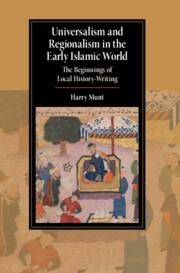
What was the role of local history-writing in the early Islamic World, and why was it such a popular way of thinking about the past? In this innovative study, Harry Munt explores this understudied phenomenon. Examining primary sources in both Arabic and Persian, Munt argues that local history-writing must be situated within its appropriate historical contexts to explain why it was such a popular way of thinking about the past, more popular than most other contemporary forms of history-writing. The period until the end of the eleventh century CE saw many significant developments in ideas about community, about elite groups and about social authority. This study demonstrates how local history-writing played a key role in these developments, forming part of the way that Muslim scholars negotiated the dialogues between more universalist and more particularist approaches to the understanding of communities. Munt further demonstrates that local historians were participating in debates that ranged into disciplines far beyond history-writing.
In light of the conclusions reached in the previous chapters and the knowledge gained through the fragments, the author addresses the issue of Ephorus’ universality. He tries to understand which reasons led Polybius to mention Ephorus as his only predecessor; and he sets Ephorus’ universality in the context of the historiographical thought of the fourth century BC, to better appreciate its novelty.
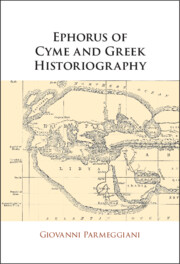
Ephorus of Cyme, who lived in the fourth century BC, is one of the most important historians of antiquity whose work has not survived and, according to Polybius, was the first to have written a universal history. His lost Histories are known from numerous 'fragments', that is, quotations by later authors such as Polybius, Diodorus, Strabo and Plutarch, among others. Through a study of these 'fragments' within their broader context, Giovanni Parmeggiani throws new light on the methodology of Ephorus and both the contents and the purpose of his work. By changing our perspective on a major Greek historian between Thucydides and Polybius, this book fills a significant gap in the field, and sets the basis for a new conception of the history of ancient Greek historiography and the Greek intellectual development in general.
Big History is a seemingly novel approach that seeks to situate human history within a grand cosmic story of life. It claims to do so by uniting the historical sciences in order to construct a linear and accurate timeline of 'threshold moments' beginning with the Big Bang and ending with the present and future development of humanity itself. As well as examining the theory and practice of Big History, this Element considers Big History alongside previous largescale attempts to unite human and natural history, and includes comparative discussions of the practices of chronology, universal history, and the evolutionary epic.
A rich and varied corpus of written material has survived from medieval Ireland, much of it concerned with providing an extended account of Ireland’s past. Through the technology of writing, a constructed history was created in which the art of writing itself functioned as process and as theme. Inscriptions and manuscripts bear witness to the mechanics of writing, while the development of letters and language is explored in origin-stories in significant ways. The power of the word was important, but so was control of the landscape, ordering society, taming space. Land-clearing, building settlements, and refining tools form a prominent strand in the account of Ireland’s beginnings, particularly in medieval Irish narratives of place; how fire was mastered; when and why were mills introduced. In explaining the past and so shaping the present, the technology of writing presented a story of technologies of other kinds, a selection of which is presented in this chapter on technology, writing, and place in medieval Irish literature.
Chapter 8 examines and partially defends Durkheim's functionalism as practiced in The Division of Labor in Society. His position is reconstructed with an eye to determining which aspects are worth retaining for a contemporary theory of social pathology, including the functionally organized nature of society. Focusing on claims regarding the moral function of the division of labor, it examines epistemological issues bound up with ascribing functions to features of society, including the relation between functional explanation and functional analysis and the role played by historical narratives. Durkheim's method is a complex holism whose claims depend less on single facts and individual arguments than on the plausibility of the whole picture that emerges from mutually reinforcing arguments, empirical facts, interpretive suggestions, and analogies. Thus, Durkheim's method for ascribing functions to social phenomena bears similarities to other interpretive enterprises, from the reading of texts to the construction of theories in the natural sciences.
Chapter 10 reconstructs Durkheim's conception of sociology as a science of morality, which includes three tasks: orienting our conduct via an account of a morally healthy society; illuminating the connection between social functioning and morality (explaining why moral and social health are the same; and explaining why the moral ideals animating a given society do so and how they vary with changing social conditions. Durkheim's science of morality is similar to Marx's historical materialist account of morality, although the former leaves the moral authority of the rules it explains largely intact. While Durkheim's accounts of specific pathologies imply a critique of certain social rules, they do not discredit the fundamental norms at work in the societies he studies. The chapter concludes that Durkheim does not adequately explain how historically specific moral systems can claim a moral authority irreducible to the narrowly functional value they have for social reproduction.
Chapter 7 treats two philosophers who directly influenced Durkheim: Auguste Comte and Herbert Spencer. Looking at their use of the society–organism analogy, their versions of functional explanation and functional analysis, and their conceptions of what a scientific sociology must be like helps one to understand both the content of Durkheim's positions and why he held them. Three types of functional explanation employed by Comte are relevant: two forms of existential functional explanation as well as functional analysis, which makes no claims regarding the existence of what it analyzes but "explains" what it is by specifying the function it serves and showing how its features are suited to accomplishing that purpose without implying anything about how it originated or why it persists. The chapter argues that Comte and Spencer rely too heavily on the society–organism analogy, leading to an overly biologistic understanding of normative critique available to social pathologists.
This chapter examines J. S. Mill’s writings on universal history, beginning with his reviews of Jules Michelet, François Guizot, and Henry Buckle, and ending with Alexis de Tocqueville’s prophetic account of democracy and Mill’s timely socialism. Barrell argues that we must take seriously the two historical perspectives from which Mill theorised politics: the first looked to the special causes which determined the timeliness or untimeliness of a given doctrine, reform, or phenomenon, while the latter looked to general causes and the region of ultimate aims. The first depended logically on the second. Any attempt to historicise the study of politics – by making laws relative to time and place, for example – must reckon with civilisation’s provisional trends. The debate surrounding Mill’s universalism and relativism, Barrell concludes, can be helpfully understood in these terms. While Mill’s argument is difficult to credulously follow, his intentions were clear: general and special circumstances always coexisted, and because they coexisted the past was both irreducibly distinct and uniform in its development. One consequence of this intellectual remapping might be to re-establish continuities between the eighteenth and nineteenth centuries, in keeping with Mill’s self-professed eclecticism.
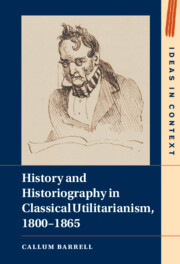
This first comprehensive account of the utilitarians' historical thought intellectually resituates their conceptions of philosophy and politics, at a time when the past acquired new significances as both a means and object of study. Drawing on published and unpublished writings - and set against the intellectual backdrops of Scottish philosophical history, German and French historicism, romanticism, positivism, and the rise of social science and scientific history - Callum Barrell recovers the depth with which Jeremy Bentham, James Mill, George Grote, and John Stuart Mill thought about history as a site of philosophy and politics. He argues that the utilitarians, contrary to their reputations as ahistorical and even antihistorical thinkers, developed complex frameworks in which to learn from and negotiate the past, inviting us to rethink the foundations of their ideas, as well as their place in - and relationship to - nineteenth-century philosophy and political thought.
Monastic writers have long been considered the prototypical writers of history in the Middle Ages. This essay asks just how writing about the past related to the monastic life, in the myriad ways that nuns and monks practiced it in Ireland and Britain in the Middle Ages, and how history-writing was part of a broad array of memorial practices over the whole period. The concept of memory offers a practical context for considering the full range of historical production in monastic archives: romances, lais, sagas, and letters alongside chronicles, saints’ lives and cartularies. Since memory was also a major means of interaction between monastics and seculars, memory also clarifies the fluid boundaries between so-called monastic and secular forms of history.
To understand fully English medieval history writing, it is necessary to recognize the ways in which Christians interpreted universal history as teleological, as ranging from creation to doomsday, and as including both past events and future expectations of the Last Days. This essay surveys the apocalyptic nature of universal history based on four scriptural structures: the two dispensations encapsulated in the Christian Bible and symbolized by Synagoga and Ecclesia; the Pauline Three Laws (ante legem, sub lege, and sub gratia); the visions of Daniel interpreted as prophesies of four sequential kingdoms concluding with Rome; and creation week considered as an analogy for Six Ages of the World. The essay then examines in greater depth the intertwining of history and apocalyptic prophecy in two English manuscripts: the thirteenth-century Gulbenkian Apocalypse illustrating the Latin commentary on Revelation by Berengaudus; and a fifteenth-century Carthusian miscellany depicting the Middle English Revelations of Pseudo-Methodius.
Geography is the primary organising principle of meaning in Australian Indigenous histories, meaning that it is quite possible for figures from different times to connect with one another as if they were contemporaries. In his Histories, Herodotus delimited the military and political history of the Greeks in part by discrimination from barbarian 'others', and thus established the link between world history writing and actual and desired world order. The growth of intellectual, economic and socio-political networks of exchange in the paleolithic and agrarian eras prompted the defence, augmentation and revision of universal and later world historical views. From the eighteenth century, existing ideas about universal history came to be seen as increasingly out of step with the specialised national research that accompanied the professionalisation of history teaching, research and writing. A more optimistic assessment of 'modern' or 'Western' civilisation was also offered in the works of modernisation scholars. Postcolonial scholars also adapted dependency and world system theory.
This article offers a comparative analysis of the historiographical implications of state conflict and expansion in two key regions of ancient Afro-Eurasia, the Mediterranean Basin and East Asia. The Mediterranean-wide conflict known as the Punic Wars, and the protracted struggle between Han China and her militarized steppe nomadic neighbours in a theatre that spanned much of eastern Inner Eurasia, helped shape the direction of subsequent world history. These conflicts also shaped the methodology and approach of three historians in these two regions: Polybius, Diodorus, and Sima Qian. All three wove detailed descriptions of these processes into complex narratives that synthesized events into an organic whole. The result was a universal conception of history that added up to something much more than a mere recounting of events.
Recommend this
Email your librarian or administrator to recommend adding this to your organisation's collection.