To save content items to your account,
please confirm that you agree to abide by our usage policies.
If this is the first time you use this feature, you will be asked to authorise Cambridge Core to connect with your account.
Find out more about saving content to .
To save content items to your Kindle, first ensure no-reply@cambridge.org
is added to your Approved Personal Document E-mail List under your Personal Document Settings
on the Manage Your Content and Devices page of your Amazon account. Then enter the ‘name’ part
of your Kindle email address below.
Find out more about saving to your Kindle.
Note you can select to save to either the @free.kindle.com or @kindle.com variations.
‘@free.kindle.com’ emails are free but can only be saved to your device when it is connected to wi-fi.
‘@kindle.com’ emails can be delivered even when you are not connected to wi-fi, but note that service fees apply.
This chapter examines George MacDonald’s lifelong, multifaceted engagement with the fairy tale, arguing that he utilised the genre as a uniquely ‘liminal’ form capable of mediating spiritual truth. The chapter first establishes liminality – the ambiguous, transitional state in a rite of passage – as its primary analytical framework. It then explores the surprising, liminal places fairy tales occupied in MacDonald’s life: as medicine for the dying, as unorthodox lectures, and as a preparation for the message of Christ. Situating MacDonald’s work within the Victorian debate between didactic moralists like George Cruikshank and whimsical aesthetes like Lewis Carroll, the chapter argues MacDonald forged a third path, as articulated in his seminal essay ‘The Fantastic Imagination’. This theoretical foundation is then used to analyse MacDonald’s fairy tales (such as ‘The Golden Key’ and ‘The Light Princess’) as intentionally crafted liminal entities. His fairy tales are not vehicles for simple morals but literary rites of passage, designed to strip characters and readers of commonplace certainties and guide them across thresholds into deeper spiritual and psychological awareness.
Tracey Rowland has recently written a chapter on Ratzinger’s view of Wittgenstein and notes that he interprets Wittgenstein as a logical positivist whose philosophy fails to seek truth itself. This reading of Wittgenstein lacks a serious engagement with the English Dominicans’ reception of him. If Ratzinger had interacted more with them, he might have had a different picture of Wittgenstein and recognized the ways in which his work encourages humanity to live in a state of wonder flowing from its creaturely existence. In particular, Fergus Kerr and others offer a compelling account of how Wittgenstein’s philosophy creates this sense of wonder and, by implication, reveal the areas of continuity between him and Ratzinger. This fact is concretized by identifying the way Ratzinger’s understanding of the clarity of scriptural and dogmatic language is enhanced by Wittgenstein’s grammatical analysis. Ultimately, this essay provides an example of how Wittgenstein and Ratzinger can be placed in fruitful dialog with one another.
Chapter 8 looks at what happens when there is too much sense, instead of too little, when there is an absolute clarity and a certainty in the face of apparent chaos or confusion. Wonder is the primary trope of this chapter, and it traverses various analytical keys including the physics of superposition, which provides the background for the “lightning strikes” that can be seen as the wonder element, or absolute certainty. These arguments are articulated with ethnography from Cuba, where spontaneous oracular emissions produce coincidences and synchronicities that sculpt destinies, as well as from post-dictatorship Chile and Argentina, where time must be reconceptualized in relation to the myriad disappearances of political opponents that family members must still contend with, and where spectrality is timeless and “timefull” at once. We end this chapter with an argument that proposes the decolonization of time.
Mycenae’s LH IIIA2-IIIB palatial stonework was spectacular, and attention is given here to the innovative construction processes and specialized stonecutting tools that elicited awe. A fresh look at Mycenae’s final three tholoi illustrates the strategy of conveying power through stonework. The chapter also assesses the semiotics of the site’s architectural sculpture.
The final chapter serves to draw the various strands of the book together, surveying what has been discovered, and expanding on the fundamental arguments of the book. It therefore begins with an analysis of Pinterest, which stands as an emblem of all that literacy means in postdigital times, whether that be sophisticated multimodal practices, durational time, or algorithmic logic. Looking back over the screen lives discussed in the book, including those of the crescent voices and of Samuel Sandor, this chapter crystallizes the personal take on screen lives that the book offers, reiterating the need to ‘undo the digital’ and find the human in, on, with, at, and against screens. It also presents some of the problems scholarship must meet, such as digital inequalities, whether that be in terms of time, awareness, or skill with technology. However, despite the considerable negative forces at work in screen lives which the book has taken care to unravel, this concluding chapter advocates ‘taking the higher ground’ and enacting wonder in interactions with screens.
Ancient wilderness mythologies have been criticised for their role in forming anthropocentric outlooks on the natural world, and idealising human separateness from the rest of the living world. Laura Feldt here challenges these ideas and presents a new approach to the question of the formative role of ancient wilderness mythologies. Analysing seminal ancient myths from Mesopotamia and ancient Jewish and Christian texts, she argues that these narratives do not idealise the destruction of and dominion over wildlands. Instead, they kindle emotions like awe and wonder at the wild powers of nature. They also provide a critical perspective on human societies and power and help form identities and experiences that resonate with the more-than-human world. Feldt also demonstrates how ancient wilderness mythologies played a decisive role in shaping the history of religions. As a sphere of intense emotion and total devotion, wilderness generates tendencies towards the individualisation and interiorisation of religion.
Many theorists note the important role that wonder can play in our lives. Yet, little attention has been given to the associated character virtue; characterizations of it do not go much further than basic sketches that draw on Aristotle’s view about emotional dispositions that are proper to virtue. This paper fleshes out such sketches, which helps us understand what type of virtue this trait is. The account of virtuous wonder I develop here vindicates brief suggestions in the literature that this trait is an intellectual and aesthetic virtue and reveals in what sense it is a moral and environmental virtue.
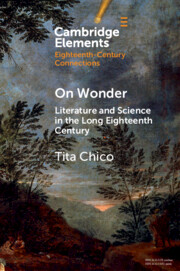
This is an Element about wonder − as an object, as a feeling, as an invitation to study, and as a way of thinking in both literary and scientific texts of the long eighteenth century. Wonder is at the heart of natural philosophical inquiry in the long eighteenth century, its inaugural provocation, its long-standing problematic. Yet wonder requires observation and imagination, operating together, if uneasily, to give shape to forms of scientific, literary, and social knowledge, shaping how thinking works − and who can do it. Studying wonder in the long eighteenth century helps us to understand our current disciplinary configurations, and also how wonder itself embodies the potential for a more capacious critical practice. Studying wonder as an epistemology, praxis, and thematic in the long eighteenth century also carries the promise of invigorating and reimagining our own critical, creative endeavors.
In his search for publishing the Tractatus, Wittgenstein wrote a letter to Ludwig von Ficker while trying to explain the deeper meaning of his work, which he considered to be an “Ethical one”. Whereas other philosophers would establish theories about ethical and religious matters, Wittgenstein emphasized his decision to keep silent about the sphere transcending the world of language and of science. In this chapter, I discuss the limits of language and of science, the significance of silence, the view sub specie aeternitatis, the dimension of wonder, the difference between what can be said and what can only be shown, and Wittgenstein’s mystical approach toward the ineffable.
In this article I show how David Hume's works provide the ingredients for a conception of religiosity understood as a feeling of wonder concerning nature or existence, accompanied by a playful attitude regarding the imaginative shapes that can be given to this emotion. Hume serves as an inspiration rather than an object of study: I respect the spirit and values of his work, while going beyond his own explicit points. My reading accounts for Hume's aversion to traditional religions (‘superstition’), and for his acknowledgement of the universal attraction of the idea of invisible intelligent power and his own fascination with it. I argue first that superstition is a natural reaction to existential uncertainty. Second, I argue that uncertainty fuels activity, creativity and morality, and thus may be left untended. Though it always involves a measure of pain, too, human happiness is found in challenge and activity. Traditional monotheist religions respond to this need by generating experiences of wonder, thus, however, stimulating passive devotion and dogmatism. Opposing this, the suggestion of Hume's works is to respect the mystery of nature rather than shrouding it in unfounded convictions. The fictional character Philo illustrates how the longing for an answer by is itself can already be a profoundly religious feeling. Hume's descriptions of ancient polytheism and Philo show how this can be accompanied by a playful, imaginative interaction with the world.
This chapter analyzes the advantages and disadvantages of democracies over nondemocracies when it comes to responding adequately to climate change in order to reflect on their implications for democratic education, understood as an ideal of education in which those educated come to a personal, informed awareness of the nature of political reality and a personal and informed understanding and assessment of the value of the two main components of the ideal of democracy: popular sovereignty and the recognition of human beings’ fundamental equality. The chapter offers three conclusions. First, we have reason to invest in democratic education – not just climate education. Second, radical (or agonistic) democratic education can be considered an important corrective and supplement to other approaches. Third, the primary value of democratic education, in the face of climate change, lies in responsibilizing students – fostering serious personal engagement with the issue.
Focusing on the Middle English poem, Pearl (with evidence from other literary works), this essay considers how the initial situation of the Dreamer explores a half-dozen principles for literary invention that are distinctively medieval, including personal displacement and feelings of anxiety, bewilderment and marvelling. These qualities define the initial state of mind which enables the Dreamer’s visions to occur and develop. Aristotle wrote in his Metaphysics (I. 2) that philosophising begins with wondering and questioning, a principle revered throughout the Middle Ages. Though all these elements of what we now call ‘creativity’ have their roots in practices of invention and argumentation described in ancient philosophy and rhetoric, the particular shapes that these classical principles assume by the late Middle Ages derive from long-established traditions of monastic meditation and contemplative envisioning more than from academic rhetoric and logic. Bonaventure’s opening to his Itinerarium mentis ad Deum recounts the marvel of Francis of Assisi’s seraphic vision, adapting it as a general method for meditation; Chaucer’s Squire’s Tale turns the marvels of the flying horse and visionary mirror into problems in optics and engineering. Pearl turns the dreamer’s initial wondering within a brilliant fantasy to the means for understanding his own human condition.
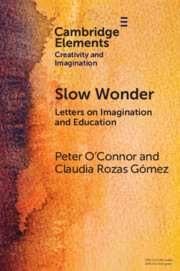
Slow wonder bears witness to the possibilities of the imagination. In a series of letters the authors playfully imagine alternatives to current orthodoxies that privilege technocratic approaches to education that have strangled discussion about what it might mean to make education good and right, or even beautiful. The authors position the imagination as a powerful site of resistance within education and academic life. They unpack their philosophical positionings through vignettes of their teaching practice, poetry written as reflective musings and discursive theoretical pieces, including letters they have written to others. They attempt to marry the poetic and the academic, the rational and the affective, to model a slow approach to wondering about the joy, beauty and possibilities of life. In this spirit, they contemplate new ways to think and live in education.
The concepts of the sublime and wonder have a long and significant history in philosophy, literature and the arts, religion, and the history of science. These concepts identify kinds of human attitudes and responses to the natural world and to cultural practices and artifacts. This chapter will focus on the contemporary relevance of the sublime and wonder to questions and issues within the context of nature, environment, aesthetics, and religion. I begin with a brief, recent history of sublimity before examining the contemporary sublime in relation to environmental thought and “other-regarding attitudes” toward nature. I then consider recent cross-disciplinary discussions of the varieties of wonder and show how this attitude invites receptivity in relation to the more-than-human world. In the concluding section, I offer a comparison of the sublime and wonder to show, further, the different ways in which they may support sympathetic, ethical attitudes toward nature.
Chapter 8 treats books XIX–XXII, the final segment of The City of God, focusing on the last end or summum bonum. In these key books, the antidote to pride, flowing from humility, emerges in Augustine’s narrative as “participation” – free and willing partaking by creatures in God’s being, wisdom, and love. Crucial to this participation, and the genuine community or res publica it makes possible, are recognition of humanity’s creaturely status and the rejection of the pull toward autarchy or a false sense of self-sufficiency.
This chapter considers the “globalization” of magical realism in the 1980s and its relationship to the consolidation of postcolonial literary studies in the same moment. Even as Latin America was being progressively marginalized in favor of taxonomic accounts of magical realism as a signature postcolonial style, Salman Rushdie and other South Asian authors became “pilgrims.” They use textual journeys to Latin America to declare the centrality of that tradition to their own forays into literary magic. Through references to Alejo Carpentier, Gabriel García Márquez, and others, Rushdie and Zulfikar Ghose pose Latin America as a funhouse mirror that reflects back a hyperbolically distorted but ultimately referential image of postcolonial political life. Ghose is joined by Anita Desai in his approach to Latin America as a concave mirror, one that allows inverting the implied political meaning of institutional affiliation in “America” by redirecting their attachment southward. Finally, Sunny Singh interrogates the postcolonial critical desire for magical realism to act as a transparent window onto traditions of home, framing it instead as a looking glass – both opposite and identical.
Roslyn Jolly’s chapter discusses the particular burden carried by the prose of the travel writer. Travel writing faces such potentially opposing tasks as to render a foreign scene strange and exotic while bestowing it with an air of authenticity and verisimilitude, and in doing so makes it appeal to the senses and exercises telling control or choice of narrative perspective. These various pressures and strategies appear fairly consistently throughout the long history of travel writing, which takes in Lady Mary Wortley Montagu, Henry James, Robert Louis Stevenson, George Orwell and Jonathan Raban. They also cross into prose fiction, where it is influenced by the travel memoir or tourist guide.
This introductory chapter examines the scope and range of wonder and the marvellous between Homer and the Hellenistic period, explores the significance of ancient conceptions of wonder in the modern literary critical tradition and outlines this book’s theoretical underpinnings and the scope and content of the subsequent chapters.
This chapter examines the significance of wonder in ancient conceptions of music, choral song and dance. The essential role of wonder in ancient religious thought as an effect which often accompanies epiphanic encounters between gods and humans and which naturally arises within the ritual space created by song performance is explored. The Homeric Hymn to Hermes is examined as a case study in which the rich relationship between music, semata (signs) and thauma in the Greek imagination is particularly evident. This chapter also discusses the Homeric Hymn to Apollo, the Odyssey and the story of Arion in Herodotus’ Histories.
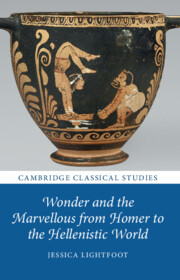
Wonder and wonders constituted a central theme in ancient Greek culture. In this book, Jessica Lightfoot provides the first full-length examination of its significance from Homer to the Hellenistic period. She demonstrates that wonder was an important term of aesthetic response and occupied a central position in concepts of what philosophy and literature are and do. She also argues that it became a means of expressing the manner in which the realms of the human and the divine interrelate with one another; and that it was central to the articulation of the ways in which the relationships between self and other, near and far, and familiar and unfamiliar were conceived. The book provides a much-needed starting point for re-assessments of the impact of wonder as a literary critical and cultural concept both in antiquity and in later periods. This title is available as Open Access on Cambridge Core.