To save content items to your account,
please confirm that you agree to abide by our usage policies.
If this is the first time you use this feature, you will be asked to authorise Cambridge Core to connect with your account.
Find out more about saving content to .
To save content items to your Kindle, first ensure no-reply@cambridge.org
is added to your Approved Personal Document E-mail List under your Personal Document Settings
on the Manage Your Content and Devices page of your Amazon account. Then enter the ‘name’ part
of your Kindle email address below.
Find out more about saving to your Kindle.
Note you can select to save to either the @free.kindle.com or @kindle.com variations.
‘@free.kindle.com’ emails are free but can only be saved to your device when it is connected to wi-fi.
‘@kindle.com’ emails can be delivered even when you are not connected to wi-fi, but note that service fees apply.
The Book of Numbers is an enigmatic Old Testament text, as it challenges traditional notions of theological interpretation. In this volume, Josef Forsling offers a fresh approach to the study of this Biblical book. Bringing a narrative perspective in dialogue with historical research to his study, he analyzes Numbers as a narrative anthology composed of laws, rules, poems, and prophecy. Considering its setting in the desert and the plot of the 40-year wandering, he highlights its themes and motifs regarding generational change, sin, disobedience, maturity, and blessing. Forsling also examines the characters of Numbers and explores its theology of purity and holiness via insights from recent research on emotions. Importantly, his volume also provides an overview of the reception history of Numbers. Written in a non-technical and accessible style, The Theology of Numbers serves as an ideal introduction to one of the most important challenging books of the Hebrew Bible.
This chapter explores the development of territorial jurisdiction and border concepts in ancient West Asia from the third to the first millennium BC. Drawing on treaties, letters, edicts and legal documents, it examines how borders were defined, contested and maintained among major powers, such as the Hittites, Assyrians, Babylonians and Egyptians. The study distinguishes between borders, boundaries and frontiers, and highlights the role of natural features, divine authority and political agreements in shaping territorial claims. It discusses the principle of status quo in resolving disputes, the use of demilitarized zones, and the material marking of borders through stelae. The chapter also addresses maritime control, land grants and the exchange or purchase of territories, emphasizing the fluid and pragmatic nature of ancient territorial governance. Through detailed case studies, it reveals how power dynamics, diplomacy, and strategic interests influenced the legal and practical management of space in the ancient Near East.
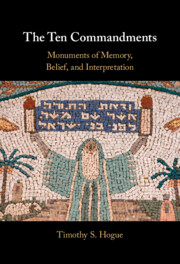
The Decalogue, commonly known as the Ten Commandments, is usually analysed as a text. Within the Hebrew Bible, however, it is depicted as a monument– an artifact embedded in rituals that a community uses to define itself. Indeed, the phraseology, visual representations, and ritual practices of contemporary monuments used to describe the Ten Commandments imbue them with authority. In this volume, Timothy Hogue, presents a new translation, commentary, and literary analysis of the Decalogue through a comparative study of the commandments with inscribed monuments in the ancient Levant. Drawing on archaeological and art historical studies of monumentality, he grounds the Decalogue's composition and redaction in the material culture and political history of ancient Israel and ancient West Asia. Presenting a new inner-biblical reception history of the text, Hogue's book also provides a new model for dating biblical texts that is based on archaeological and historical evidence, rather than purely literary critical methods.
Recommend this
Email your librarian or administrator to recommend adding this to your organisation's collection.