To save content items to your account,
please confirm that you agree to abide by our usage policies.
If this is the first time you use this feature, you will be asked to authorise Cambridge Core to connect with your account.
Find out more about saving content to .
To save content items to your Kindle, first ensure no-reply@cambridge.org
is added to your Approved Personal Document E-mail List under your Personal Document Settings
on the Manage Your Content and Devices page of your Amazon account. Then enter the ‘name’ part
of your Kindle email address below.
Find out more about saving to your Kindle.
Note you can select to save to either the @free.kindle.com or @kindle.com variations.
‘@free.kindle.com’ emails are free but can only be saved to your device when it is connected to wi-fi.
‘@kindle.com’ emails can be delivered even when you are not connected to wi-fi, but note that service fees apply.
This chapter argues that throughout his prose works, Wilde demonstrates ambivalence regarding the significance of fashion in relation to flesh, and this chapter traces that ambivalence through texts including The Picture of Dorian Gray, De Profundis, and “The Birthday of the Infanta.” Treating ugliness and beauty, monstrosity and martyrdom, this chapter demonstrates Oscar Wilde’s continued fascination with beautiful flesh that is betrayed as such flesh decays, rots, and becomes loose and baggy, like an ill-fitting garment. Wilde writes against the backdrop of eugenicist discourse, which proves a foil to his aesthetic project while simultaneously animating his response to criminal charges against him for gross indecency. But Wilde also looks to an earlier precedent to work out questions of flesh and fashion, particularly that of baroque painting and sculpture by artists such as Guido Reni and Gianlorenzo Bernini in their representations of the flesh of martyrs. The world remains unsure whether Wilde was a monster or a martyr; this chapter shows that Wilde himself shared those concerns.
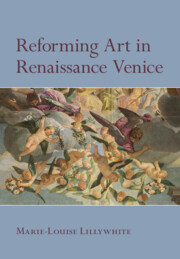
The spiritual turmoil of the sixteenth century had a profound impact on religious life throughout Italy. Art and architecture were directly implicated in the seismic historical events of the age, as the Catholic Church countered Protestant iconoclasm through the embrace of sacred images as decreed by the Council of Trent in 1563. In this volume, Marie-Louise Lillywhite considers the impact of religious reform on the devotional art and architecture of sixteenth-century Venice. Interrogating early modern censorship, artistic liberty, notions of decorum tied to depictions of the body, and the role of sacred images in the shaping of local identity, she shows how Venice, a crossroads city exposed to a rich gamut of religious and artistic currents, serves as a fascinating case study through which to explore these themes. Her study reconstructs the conditions that enabled artistic invention to prevail and how artists became interpreters of spiritual values.