To save content items to your account,
please confirm that you agree to abide by our usage policies.
If this is the first time you use this feature, you will be asked to authorise Cambridge Core to connect with your account.
Find out more about saving content to .
To save content items to your Kindle, first ensure no-reply@cambridge.org
is added to your Approved Personal Document E-mail List under your Personal Document Settings
on the Manage Your Content and Devices page of your Amazon account. Then enter the ‘name’ part
of your Kindle email address below.
Find out more about saving to your Kindle.
Note you can select to save to either the @free.kindle.com or @kindle.com variations.
‘@free.kindle.com’ emails are free but can only be saved to your device when it is connected to wi-fi.
‘@kindle.com’ emails can be delivered even when you are not connected to wi-fi, but note that service fees apply.
Steeped in African American traditions, jazz frequently invites conversations about race, Black artistry, and White commercialization of Black culture. To illustrate jazz’s slippage between art and the popular, this chapter considers jazz’s characterization and definition in advertising, movies, and popular music. These categories represent jazz as a cultural form through the embodiment and performance of jazz musicians. Companies like Nike, Honda, and Apple Computers intertwined a cultural aura around jazz with their merchandise. Hollywood movies in the post-World War II era conferred new authority on White swing musicians and erased anxiety about appropriation of Black culture by offering both White and Black jazz musicians’ performances. Late twentieth-century musicians — Steely Dan, Sting, Joni Mitchell — explicitly engaged jazz and jazz musicians for albums that aspired to artistic status rather than that of pop music. Throughout, definitions and separations between jazz as art and as the popular get blurred and remade.
This essay aims to expand the geographic and cultural understanding of jazz history by exploring how the after-hours jam sessions in the homes of Alma Scott, Mary Lou Williams, and Alice Coltrane were vital to the progression of jazz. During the height of the Harlem Renaissance, the home of Scott in Harlem became an important meeting space for a circle of Black musicians, who were significant in shaping the musical language of American musical theater, swing, and the vaudeville blues. In the mid-1940s and early 1950s, Williams’s Hamilton Terrace apartment attracted a collective of young musicians who would create the modern jazz aesthetic. More than two decades later, a basement recording studio in Coltrane’s Dix Hills home played a similar role, providing a space that fostered a new wave of avant-garde jazz in the late 1960s and early 1970s.
The core of this chapter is the general acceptance that Ellington's appearance at Newport in 1956 somehow 'relaunched' the Ellington band. With contributions from those who were there, Shipton re-explores both the Newport myth and re-examines the early 1950s output of the band. He looks at its Carnegie Hall concerts, discusses the line up when Willie Smith, Juan Tizol and Louis Bellson joined from Harry James, and gives detailed examples of the music the band produced in its alleged 'shallow' period, prompting a re-examination of the clains made for the Newport appearance by producer George Avakian.
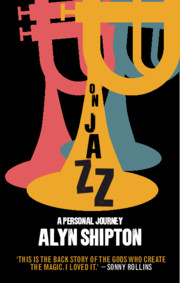
Few musical genres inspire the passionate devotion of jazz. Its mystique goes far beyond the melodies and rhythms, with its key players and singers discussed by aficionados with a respect that borders on reverence. Some books on jazz offer little more than theory or dry facts, thereby relinquishing the 'essence' of the music. This book is different. One of the most influential and internationally known writers on the subject describes, through vivid personal contacts, reminiscences and zesty anecdotes, his life in jazz as a player, broadcaster and observer. Alyn Shipton recalls friendships with legendary musicians, while revealing fresh discoveries about such luminaries as Fats Waller, Louis Armstrong, Count Basie, Duke Ellington, Charlie Parker, Abbey Lincoln and Geri Allen. On Jazz powerfully evokes the atmosphere of clubs and dancehalls, and takes us behind the scenes and up onto the stage, so that this electrifying world is unforgettably spotlighted as never before.
In his essay “The Golden Age: Time Past,” Ralph Ellison does not disguise his distaste either for bebop music or for “the sharp, ugly…rebellion” bop’s pioneers were waging against the formal conventions of folk jazz and the Blues. Rather than conclude, as Robert O’Meally does, that Ellison was “deaf to virtually all jazz beyond Basie and Ellington,” this chapter re-contextualizes Ellison’s criticism of bebop an extension of his philosophy of temporality. Ellison believed that one’s experience of time determined one’s understanding of history, and bebop, which formalizes a discontinuous sense of time, clashed with his durational view of the past and its bearing on the present.
Recommend this
Email your librarian or administrator to recommend adding this to your organisation's collection.