To save content items to your account,
please confirm that you agree to abide by our usage policies.
If this is the first time you use this feature, you will be asked to authorise Cambridge Core to connect with your account.
Find out more about saving content to .
To save content items to your Kindle, first ensure no-reply@cambridge.org
is added to your Approved Personal Document E-mail List under your Personal Document Settings
on the Manage Your Content and Devices page of your Amazon account. Then enter the ‘name’ part
of your Kindle email address below.
Find out more about saving to your Kindle.
Note you can select to save to either the @free.kindle.com or @kindle.com variations.
‘@free.kindle.com’ emails are free but can only be saved to your device when it is connected to wi-fi.
‘@kindle.com’ emails can be delivered even when you are not connected to wi-fi, but note that service fees apply.
‘Sexuality and the Irish Novel’ situates the work of Irish writers addressing sexuality in Irish fiction after about 1960 in the context of the final years of literary censorship in the Irish Republic. Around the time of Edna O’Brien’s Country Girls Trilogy (1960–4), a series of novels, including J. P. Donleavy’s The Ginger Man (1955), Anthony Cronin’s The Life of Riley (1964), and later John McGahern’s The Pornographer (1979), combine explorations of sexuality with experiments in literary form. In the case of Anthony C. West’s The Ferret Fancier (1963) and Julia O’Faolain’s Women in the Wall (1975), the exploration of sexuality involves combining the historical novel with the Bildungsroman, while Leland Bardwell’s Girl on a Bicycle (1977) strives for an embodied feminine consciousness. In each case, these novels explore sexual repression as a symptom not only of a postcolonial condition but also of the alienating tendencies of capitalist modernity.
Chapter 2 examines psychopathy in Richard Wright’s Native Son and Ralph Ellison’s Invisible Man against debates about naturalism and symbolism. Representing the development of black male subjectivity – marked as a perpetual state of childhood emblematized by the term “boy” – these mid-century bildungsromane became the focus of debate about the adequacy of naturalism and symbolism to representing black male subjectivity at mid-century. Critics discussed the adequacy of literary form to ideological content via the place each novel assigned pathology. For Wright’s champions, naturalism exposed the systemic roots of social injustice. For his detractors, it was a mode of political propaganda inadequate to the complexity of human characters. For Ellison’s admirers, the chaotic consciousness of his narrator mirrored the absurdity of race relations, while his opponents viewed it as avant-garde experimentalism in retreat from the politics of race. However, the formal features of these novels – type and omniscient narration in Native Son, symbol and first-person narration in Invisible Man – encode more than shifting fashions concerning literary technique. Both attempt to wrestle – from different vantages but with the same aim – with constraints placed on black male subjectivity by the race system and encoded in the purportedly unraced genre of the bildungsroman.
This chapter begins by discussing the quasi-fictional medieval poet known as Afterdingen or Ofterdingen, who inspired the novel’s title, and the early thirteenth-century historical context. It distinguishes the novel’s genre from the traditional romance and coming-of-age novel or Bildungsroman. Lastly, the chapter clarifies the novel’s two parts (“The Expectation” of Part I and the “The Fulfillment” of Part II) in terms of a principle of typology common to Biblical criticism. For Novalis, typology is a method of foreshadowing: later characters and events in the story reveal, as postfigurations, what earlier characters and events conceal, as prefigurations.
This chapter summarizes the debate on literary climate realism before arguing that existing ecocritical research on scalar mismatches should be complemented by a sustained reflection on political realism and climate activism. That such a shift can be productive is illustrated via a two-part analysis of Rachel Kushner’s novel Creation Lake, an example of Polemocene or planetary protest fiction. As the chapter details, Kushner’s text exhibits typical features of climate fiction yet it also mixes features of multiple realist subgenres to stress the impact of extractivist practices on rural and underground settings. It is a peculiar activist novel too, seeing that it does not celebrate communal protest but foregrounds an apparently cynical narrator tasked with undermining an insurgent group. Yet the story of this anti-environmental spy performs valuable cultural work, as it hints at unexpected alliances, trains readers to mistrust seductive storytellers, and to resist interpreting individual characters as generalizable models of behavior. Climate scholars should not dismiss realist fiction too quickly, this chapter shows, nor should we overlook the urgent question of political realism.
Elizabeth Bowen’s fiction is full of girls; in nearly all her work, she focuses on the act of maturing through adolescence to early adulthood. The experience of girlhood among Bowen’s characters maps onto the generic characteristics of her truncated, ambiguous Bildungsromane, all of which subvert expectations and resist satisfying maturation. Her novels focus on figures experiencing historical and emotional arrest, and her adolescent girls often remain in moments of developmental or social suspension. This essay traces girlhood and adolescence in abeyance in Bowen’s short fiction, and in novels ranging from The Hotel to The Death of the Heart to The Little Girls.
This chapter offers a survey of published and unpublished autobiographies by writers born in the period 1790–1901 that tell the story of the ‘sailor in the family’. It identifies a set of common narrative motifs within these ‘maritime memoirs’ that cluster around the figure of the family sailor – including tales of travel, separation, dispersal, orphanhood, vanishings, reinventions, and improbable returns. Interweaving readings of autobiographies and family myths, alongside the broader literary forms of the Bildungsroman, adventure fiction, fairy tale and waif stories, the chapter shows how global maritime experience shaped the composition of ordinary families and the stories they told about themselves. The maritime relations of this chapter also reveal alternative family structures, beyond the nuclear family order, that were flexibly adapted and shaped to the various realities of mobility, risk and opportunity.
James’s modernism is based directly on the psychology he founded, and specifically on his recognition that the self is malleable (or “plastic”), aggregate, distributed, and capable of mental reform. Yet James’s outspoken critique of US imperialism and the lynching of African Americans reflected his understanding of the dangerous potential of conversion – namely, that revolutions in belief carry a measure of uncertainty and risk, not just to individual believers but to the very fabric of democratic thought. Jamesean conversion therefore dramatizes the processes by which consent is staged from within and from without. The self enacts the drama in the form of an internal dialogue in which one imagines one’s “self” inhabiting a particular temporo-spatial location, as if fulfilling the role of a protagonist in a work of fiction. Against that background, Henry James’s What Maisie Knew and Harold Frederic’s The Damnation of Theron Ware dramatize the processes through which individuals become plastically transformed under the manipulations of powerful “pattern-setters” of public opinion. By fracturing and fragmenting imperial forms of selfhood, these psychological Bildungsromane inaugurate a reform modernism that registers dissent from the imperial sway of groups, demonstrating the strenuous effort required by individuals to transform oppressive systems from within.
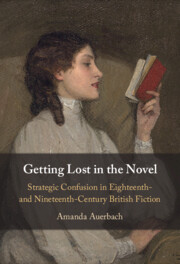
This chapter explains how the emotionally expressive motions of characters can reveal their unmet psychological needs, which cultural and economic conditions do not allow them to fully acknowledge. These movements and the environments in which they unfold evoke subgenres of the eighteenth- and nineteenth-century British novel including the marriage plot, the Gothic novel, the Victorian bildungsroman, and the sensation novel. These episodes featuring characters’ emotionally expressive motions invite us to understand these subgenres in a new light, as narratives that depict characters’ unfulfilled needs and respond to those of anticipated readers. The introduction situates this approach both with respect to recent work in novel studies and the earlier approaches of reader response theorists. The chapter also offers an extended interpretation of Samuel Richardson’s Clarissa, oriented around Clarissa’s expressive motions as she runs away from her family with Lovelace. This moment can be seen as the origin of episodes of getting lost.
This chapter on the Victorian bildungsroman focuses on moments when a heroine pleasurably and passively flies, floats, or is carried into a larger social world. It focuses on episodes from Elizabeth Gaskell’s North and South and George Eliot’s The Mill on the Floss. Rather than developing a life that establishes her individuality, I argue that the heroine of the bildungsroman gets swept up in an emotion that unites her with a social ingroup. This emotion deeply fulfills the heroine, meeting ordinarily unmet needs for social relatedness and self-esteem. After analyzing the novels, the chapter describes acts of reading through which women and working-class readers affiliate with like-minded others. These include readers who see themselves as part of a group of ardent Dorothea Brookes or fiery Jane Eyres and also working-class readers who felt transported by books that connected them to other book-lovers.
Instances abound in eighteenth- and nineteenth-century novels where characters, particularly female characters, become lost, often moved by overwhelming emotion. Amanda Auerbach delves into the impact of these scenes on the character and the reader. On one level, 'getting lost' can realign a character's and our own sense of self and of social situation, while more broadly these instances reflect arcs within the overall narrative, highlighting easily-missed elements, sometimes even reflecting on our own experiences while reading. The emotions that move characters most powerfully often relate to their psychological needs, which the social conditions of their lives prevent them from meeting or fully acknowledging. These episodes appear across multiple novels in multiple subgenres, including the marriage plot, the gothic novel, the Victorian bildungsroman, and the sensation novel. These episodes collectively reveal how eighteenth- and nineteenth-century British novelistic subgenres developed to help women and working-class readers covertly satisfy their psychological needs.
This chapter completes the book’s examination of the impossible narrative position faced by refugee applicants by examining how specific genres enter the hearing room and further determine the ‘authentic’ refugee that states are willing to accept. Drawing on Joseph R Slaughter’s engagement with the genre of human rights discourse, it argues that like the protagonist of the classic Bildungsroman and human rights narratives, refugee applicants are expected to narrate a linear progression from a non-citizen ‘outsider’ towards full civic incorporation through the seeking of protection and the resolution of refugee status. In this generic mode, refugee applicants were expected to present evidence as omniscient narrators with sovereignty over self and others, and the ability to account not only for their own actions but also the decisions and interior worlds of others. Crucially, the ‘good’ refugee’s story moves steadily towards complete resolution that is the determination of refugee status and the realisation of a liberal personhood, marked by self-possession and autonomy, and readiness to become a refugee-citizen.
In the late 1930s, the studio system and its ancillary institutions (museums, newspapers, and trade journals) engaged in a concerted effort to narrate the industry’s maturation. This tendency manifested onscreen in the emergence of the historiographical backstudio picture, led by David Selznick’s A Star is Born (1937) and followed by Warners’ Boy Meets Girl (1938) and Fox’s Hollywood Cavalcade (1939). The belief in Hollywood’s coming-of-age gave rise to a countervailing sense that the Hollywood novel had become exhausted. Writers as different as Cedric Belfrage (Promised Land, 1938), Horace McCoy (I Should Have Stayed Home, 1938), and Patsy Ruth Miller (That Flannigan Girl, 1939), among others, used this heightened historical sense to renovate the genre. No renovator was more successful or less understood than Nathanael West. In The Day of the Locust (1939), West contributed to American modernist inscrutability in his occult bildungsroman of painter Tod Hackett. West dared readers to see Tod’s monstrous coming of age alongside the studio system’s own in Tod’s submissions to the order of Hollywood’s aesthetics and the law of the police that rescue him in the novel’s concluding riot.
Recent work on crime fiction has highlighted the genre’s increasingly transnational focus and the growing number of migrant detectives. Matsotsi, a little-known Nyanja text published in Zambia in the early 1960s, provides a much earlier example of this figure in Sergeant Balala, an Angolan detective fighting to contain the tsotsi menace in Johannesburg, South Africa. Matsotsi, however, does more than point to cross-border detection as a means of elucidating transnational relationships. Shonga and Zulu’s text manipulates the genres of the detective novel and the bildungsroman to tell a story about the relationships among the individual, the state, and the wider region at a key moment in southern African history, when Zambia and Malawi were on the cusp of independence. Although African language writing has often been considered too localized to be used for nationalist purposes, here it is mobilized for the purpose of state-making in a transnational context.
Kazuo Ishiguro’s Never Let Me Go, a biodystopia in which clones are raised to supply organs for donation to strangers, takes the form of a poignant bildungsroman. The novel is representative of recent fiction that uses the conceit of cloning to challenge readers to think about what makes us human. In the manner of canonical realist fiction, Ishiguro’s story provokes ethical reflection and deep emotion in its readers, a stark contrast with the more than 150 science fiction films featuring clones, which typically exploit clones as a source of horror, violent action, or laughter. If, as we saw in Chapters 6 through 8, the imaginative world building of science fiction can inform public policy through its challenging thought experiments, realist genres invite sympathetic identification and attention to the moral complexities of policy decisions. Never Let Me Go helps one understand the influences that shape organ transplant policies, which can ask a patient to choose between the time one has to live and the life one wants to live in time.
Colonial adventure fiction provided settler Australia with many of its foundational narratives, but they weren’t always about triumph and domination, and the energies they released into the colonies could be unruly and difficult to contain. Restlessness and movement become important here: colonial adventure novels are what Barbara Fuchs has called ‘itinerant texts’. This chapter begins with bushrangers, from the early feral bushranger narrative Michael Howe (1819) to Rolf Boldrewood’s Robbery Under Arms (1882–3) – where the protagonist’s rejection of a settled working life is almost pathological. Convict adventure novels such as James Tucker’s extraordinary Ralph Rashleigh (c.1845) and Marcus Clarke’s epic transportation melodrama His Natural Life (1874) take their characters on a gruelling detour into the Global South from which they never return. We then look at the challenges of the kangaroo hunt novel, from early Bildungsromans like Sarah Porter’s Alfred Dudley (1830) to Alfred Ferres’s His First Kangaroo (1896). These are picaresque narratives, chronicling a sequence of adventures that end only when settlement is finally achieved. Settlement is also the final destination of the squatter novel, where colonial adventure is built around speculation and the often violent business of land acquisition: from Thomas McCombie’s hallucinatory Adventures of a Colonist (1845) to the rambling squatter novels of Boldrewood and Henry Kingsley. Finally, this chapter examines some explorer narratives, looking at early examples of this genre and then turning to the wild travels undertaken in Lemurian adventure novels at the end of the nineteenth century, such as J. D. Hennessey’s An Australian Bush Track (1896). By this time, Australia is the last destination for a genre of colonial adventure that seems to have exhausted its potential elsewhere.
Chapter 2 examines the silver-fork novels resistance to the growing influence of the Bildungsroman in nineteenth-century fiction. Reading Edward Bulwer-Lytton’s Pelham (1828) and Catherine Gore’s Cecil (1841), this chapter contends that silver-fork novelists turn to the older form of the picaresque to keep their focus on an urban panorama in which individuals are accorded no greater priority than the social landscapes through which they move. I argue that silver-fork novelists use the picaresque to represent the chaotic surface of metropolitan life. Into this fast-changing, diverse landscape, they set a dandiacal protagonist whose skills at observation and adaptability make him uniquely qualified to navigate the contemporary world. The dandy occupies a position analogous to that of the commodities with which his society teems: he functions as an object in circulation, defined less by internal traits than by the situations and sets of relations through which he moves.
This essay traces the anti-Bildungsroman tradition under the influence of surrealism, in Georges Bataille’s Story of the Eye (1928) and Kathy Acker’s Great Expectations (1982). While Acker inherits Bataille’s fascination with violence and transgression, these themes are formally developed through the prism of punk and feminist conceptual art and performance. The recent resurgence of critical interest in Acker’s work prompts us to further consider her relationship to surrealism and the modernist avant-garde. While Acker’s homage to Bataille in the early novels signals a brazen ’theft’ of the male avant-garde tradition for feminist subversive ends, Great Expectations experiments with form and language in order to evacuate the Bildungsroman of its bourgeois (gendered) claims to moral authority and insight. While extreme experience in Bataille’s literary work holds out the promise of an affirmation of sorts, the excoriating emotional masochism of Acker’s characters tilts towards nihilism. And yet both Bataille and Acker draw on the Bildungsroman even as they decondition the humanist subject that lies at its very core, straining at the limits of language to represent the vertiginous intensity of affective life and the dissolution of desire into abjection.
Three Anglo–German Edwardian novels of Elizabeth von Arnim, Adventures of Elizabeth in Rügen (1904), Princess Priscilla’s Fortnight (1905), and Fräulein Schmidt and Mr Anstruther (1907), perform expatriate identity as theorised by Edward Said. Elizabeth and Her German Garden (1898), in contrast, is the most English of early novels by English-born German citizen von Arnim. The restlessness and contrapuntal perspectives of expatriate consciousness generate humour in the 1904 and 1905 novels, and in-depth adoption of an alternate German–Anglo subjectivity in Rose-Marie Schmidt. Fräulein Schmidt, von Arnim’s most sophisticated novel to that point, adopts the first-person epistolary narrative of a German professor’s daughter reared in a lower-middle-class home as she finds independence, self-respect, and a writer’s voice after being proposed to, then jilted, by a young Englishman. A subliminal narrative coursing beneath the surface of Rose-Marie’s letters limn the protagonist’s underlying psychological processes.
The third chapter shows that Vladimir Nabokov, seeking to replace the superannuated form of national allegory, constructs a figure of supranational metonymy through chess. Critics have explained that the Bildungsroman is a novel of socialization that displays how an individual finds his place in a social world and projects a trajectory of collective progress. Like Beckett, though, Nabokov was a post-revolutionary expatriate who made his career in another language. One of Nabokov’s targets was the notion that novels offer national allegories. Reading Nabokov’s early novels, which feature Russian exiles who rove across the continent as if across a chessboard, I reveal the writer’s interest in crafting a “personal world” that travels well across borders. The figure of metonymy presents advantages over metaphor. First, elastic in scale, metonymy represents spaces smaller or larger than the nation. Second, where national allegories had to install generic template protagonists at their narrative centers, supranational metonymies stress individual idiosyncrasy, accommodating abnormalities; they reject the premise that there can be such a thing as a generic national character.
Chapter 3 examines post-1873 depression-era Ottoman novels and plays that articulate a language of difference by juxtaposing the success of industrious heroes against the failure of consumerist dandy anti-heroes. The representation of industrious and dandy characters in fin-de-siècle Istanbul shows the interconnectedness and interdependence between novels and the discourses and practices of productivity, in sharing the same new moral universe. Differing from the normative and distant language of the morality authors, or the authoritative and punitive language of the bureaucratic reforms explored in Chapters 1 and 2, the playful voices of novelists displayed dynamic and at times ambivalent representations of the idle and dandy, as an alternate, yet socially undesirable form of self-fashioning. By pitting a hardworking and upwardly mobile hero against the dandy anti-hero, novels thematized the period’s concern with valuing work as a constitutive element of character and nation-building, and also drew boundaries that defined who was and was not included in the nation. As a forum in which citizenship was debated, fiction established difference using ridicule, marginalization, and even criminalization as a social intervention.