To save content items to your account,
please confirm that you agree to abide by our usage policies.
If this is the first time you use this feature, you will be asked to authorise Cambridge Core to connect with your account.
Find out more about saving content to .
To save content items to your Kindle, first ensure no-reply@cambridge.org
is added to your Approved Personal Document E-mail List under your Personal Document Settings
on the Manage Your Content and Devices page of your Amazon account. Then enter the ‘name’ part
of your Kindle email address below.
Find out more about saving to your Kindle.
Note you can select to save to either the @free.kindle.com or @kindle.com variations.
‘@free.kindle.com’ emails are free but can only be saved to your device when it is connected to wi-fi.
‘@kindle.com’ emails can be delivered even when you are not connected to wi-fi, but note that service fees apply.
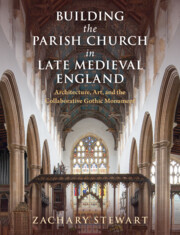
Building the Parish Church in Late Medieval England investigates the architectural, artistic, and cultural significance of local places of worship between the Black Death and the Reformation. Zachary Stewart provides the first systematic account of an exceptional type of parish church distinguished by the absence of any structural division between nave and chancel. Tracking its development across time, place, and setting, he explores how the type's integrated format not only expressed but also reinforced and reproduced collective processes related to the conception, construction, and customization of parochial space. The result, he argues, was nothing less than a new kind of public monument to collaborative action. Informed by a wealth of archival, archaeological, and architectural research, with special attention to East Anglia, Stewart's study demonstrates the importance of the parish church as a center for innovative material production in late medieval England. It also reveals how non-elite social arrangements shaped local life on the eve of the modern era.
A brief review of Luther’s confessional summation of the central indisputable articles of faith for the reformed Christian religion; Luther’s practical reformation agendas are interpreted, noting the tensions regarding sacramental theology and teachings on marriage and sexuality.
Protection at the Margins is a ground-breaking account of how and why religious actors protect local communities from state-driven populist violence. Focusing on Philippine president Rodrigo Duterte's notorious 'Drug War,' the book provides an intricate view of how religion, populism, and political violence interact on the ground. Drawing on original surveys of Catholic clergy, experiments with members of the Philippine National Police, spatial data on thousands of drug killings, and dozens of field interviews in these neighborhoods, the book shows how Catholic elites used moral commitment and institutional capacity to influence street-level bureaucrats with discretion over violence, work with secular partners, and challenge populist dehumanization. It also highlights obstacles to protection, in the Philippines as well as Brazil and the United States. Amidst rising global concern about populism and violence, Protection at the Margins generates new insights into how religious actors shielded communities in one of the world's largest mega-cities.
This essay argues that understanding religion and the history of religion in the United States can help scholars, students, and the American public be more aware of the dynamics around war and wiser in the conclusions they reach about experiences of war and their relationship to American society. Put differently, when those who study war and society in America keep religion out of their stories, they remove from consideration not only some of the nation’s most influential institutions and voices, but also many of the ideas, stories, and symbols that help women and men find meaning and purpose in the uncertainty, the suffering, and the loss that go along with war.
In this chapter, religion’s role in conflict and violence is examined, covering the decades from c. 1603 until shortly before the outbreak of rebellion in October 1641. The chapter traces how it was increasingly religious flashpoints – sacred objects, churches and churchyards, and rituals such as the Mass among others – that generated tension, unrest and even violence in seventeenth-century Ireland. As Protestant settlers sought to implement the work of ‘converting and civilising’, Irish Catholics pushed back against what they viewed as heretical incursions. They reveal battles over ideas of possession, heritage, power and the nature of the sacred itself, and how religious symbols and language were growing ever more important in how Irish and British, Catholic and Protestant viewed and lived alongside one another. Intra-confessional conflict is also addressed, through examining the eruption of violence by Scottish settlers against the Church of Ireland in the wake of the National Covenant and ensuing unrest in Scotland. It indicates religion’s potent ability to motivate and mobilise resistance, even unto violence, as crisis Unfolded across the Three Kingdoms.
The clergy – both Catholic priests and Protestant ministers – are the subject of this chapter. They were both targets for violence and could be among its perpetrators. A core argument here is that Protestant ministers were subjected to violence in large part because of their profession, as against motives such as moneylending that were emphasised in previous scholarship. As leading Protestant figures, they were both symbols of and key actors within Protestant ‘civilising and converting’ that was so central to the decades before the rebellion, helping to explain Irish Catholic hostility towards them. Similarly, violence against Catholic priests drew from longstanding patterns that viewed priests as seditious, troublesome and violent, thus justifying their persecution and even killing. Examining the clergy as symbols as well as people, alongside the study of violence against sacred objects and spaces, reinforces the strong religious character of violence during the rebellion and its continuation in the decade of conflict that followed.
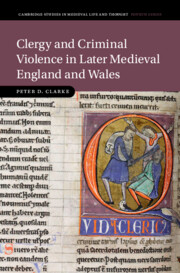
Clergy formed a distinct and privileged group in later medieval society as regarded violent crime. Church law was intended to protect them from it, induce them to avoid it, and exempt them from secular justice following it. But in practice, were the clergy so separate from the violent culture around them and different from the laymen who dominated it? In the first full-length study of this subject in the later medieval period, Peter Clarke shows that clergy accused of violent and other crimes increasingly submitted to secular justice like laymen, seeking clerical immunity only as a last resort. It reveals that church authorities, in providing legal redress for clerical victims of lay violence, sought to heal divisions between laity and clergy, not to deepen them. Additionally, it explores the motives and contexts behind clerical involvement in violent crime, both as perpetrators and victims, revealing that clergy often acted similarly to laymen.
In theory, major differences separated clergy from laity by the twelfth century, especially regarding violence: clergy were subject only to church courts for violent crimes; they enjoyed special papal protection from violent assault; they were to renounce violent behaviour and even sexual relations; and were subject to a different system of law and clemency from laity regarding homicide. In practice, these differences were fading by the fifteenth century. Increasingly, fewer men charged with crimes before lay courts pleaded clergy and sought transfer before church courts for fear of long detention in episcopal gaols awaiting a church trial. English application of papal protection from anti-clerical violence increasingly stressed reconciliation between clerical victims and lay assailants rather than social division. Clergy became subject to lay violence not for being different from laity but too similar to them, especially in pursuing sex and violence and other deviance from ideal priestly standards. Finally, common law on homicide, especially self-defence, increasingly resembled canon law, which explains why clergy accepted lay justice and clemency when facing homicide charges.
The first of the three topics that occupied censors across the regimes was ‘religion’, which predominantly meant Catholicism. This chapter traces examples of self- and bureaucratic censorship under the Ancien Régime, when the king was in power through divine right, through the Revolution, where plays criticizing the Church exploded, and onto the Empire and the Restoration, both of which had an uneasy relationship with biblical and Catholic material for the theatre, especially on secondary stages like the Vaudeville. Generally, the larger the role the Catholic Church played at the time, the more difficult the representation of religious material became. However, when such material did make it to the boards, lateral censorship meant that religion could quickly act as an ersatz vehicle to discuss the ruling regime. Religion was an even tricker subject as reactions were far from homogenous: context was key, and whilst a play might be acceptable to one audience, another could boil over into violence in its quest to promote or silence specific worldviews.
This chapter explains the origins of the Estates General, in practice from the 1484 meeting, and how deputies were chosen, how the meetings of the Estate General operated, and why kings convoked them in its 1560, 1561, 1576, 1588–1589, and 1614 meetings. It also explains the differences between the Estates General and meetings of provincial estates and bailiwick assemblies.
For over a hundred years scholars have written about late medieval kingship, and a vast body of published work now exists on the subject. However, in all this rich coverage, no accessible introduction to the subject exists. The Cambridge Companion to Late Medieval Kingship addresses this need by bringing together, within a single volume, a series of themed chapters which consider key aspects of the workings of the English monarchy between 1200 and 1500. Featuring leading experts in the field, each chapter provides a concise and accessible guide, offering insights, synthesis and explanation to help readers understand not only how kings ruled, but also what made their rule more – or less – effective. By adopting a holistic approach to kingship, the contributors also consider how kingship impacted on the king's subjects, thereby illuminating the complex interplay of cooperation and conflict that shaped both the monarchy and the wider polity in late medieval England.
This chapter examines the role religion played in the prosecution of the American Revolution. It explains the way that Revolutionary leaders often utilized religious language in their public appeals, translating justifications for rebellion from terms of Enlightenment reason and international law to religious terms. This chapter also demonstrates how the Continental Congress coopted hundreds of American clergymen as spokesmen for the independence. Finally, it demonstrates how religious beliefs – and religious identities – were affected by the Revolution, including conflicts over liturgy and fractures within religious communities over politicized public rituals such as days of fasting and prayer. Although Protestant Christian denominations were the most numerous in the colonies at the time of the Revolution, this chapter considers the experiences of American Catholics and Jews as well.
Using data from the 2018–2019 National Congregations Study, I explore the relationship between women’s descriptive and substantive representation in American religious congregations. In particular, I examine the relationship between the presence of clergywomen or gender inclusive leadership policies (i.e., congregational policies allowing women to serve as the head pastor or priest) and a congregation’s participation in “women’s issues” political activism. Statistical analysis reveals partial support for my hypotheses. Collective gender representation, as demonstrated through the presence of gender inclusive leadership policies within a congregation, predicts pro-LGBT activism and the number of “women’s issues” a congregation pursues. This project serves to extend understanding of 1) how descriptive gender representation relates to the substantive representation of women’s interests in religious congregations and 2) the comparability of women’s leadership across political and religious contexts.
This article examines the role of English Catholics in 1560s Counter-Reformation Rome. Working with the methodologies of micro-history, it focuses on their feast of St Thomas of Canterbury, celebrated at the English Hospice in the city in December 1569. It brings together diverse strands of social and cultural enquiry—on inventory records, the urban environment and culinary history—to highlight the interconnections between the feast and the faith-based practices of this influential group of men, at a crisis moment in relations between England and the Holy See. This examination highlights how the material and spiritual practices associated with contemporary food cultures shaped post-Reformation English Catholic piety. Two different celebrations were invoked at the dinner commemorating St Thomas’s martyrdom: one was a secular hybrid meal of English and Mediterranean cultures, the other the sacred, but now disputed commemoration of the eucharist, as it was contested by Protestants. The article argues that these forms of lived religion had political consequences, by tracing a number of the celebrants beyond the meal itself and into the papal deliberations that resulted in Elizabeth I’s excommunication.
Houses of worship are often shelters after the storm. Yet, as climate change fuels natural disasters and communities increasingly rely on congregations during disaster recovery, are houses of worship ready to be houses of refuge? Examining clergy influence, does a higher concern about climate change by clergy result in improved congregational disaster readiness? Data for the study come from a 2019 nationwide survey of clergy. The survey includes measures of congregational disaster preparedness along with one of the first applications of the SASSY climate concern measure to clergy. Results show that clergy have mixed opinions about climate change and that congregations led by high climate-concern clergy are no more prepared for disasters than those led by unconcerned clergy. While seemingly a null result, understanding the relationship between leaders, climate change, and disaster preparedness benefits the study of leader influence on organizations, religion and climate change, and the politics of disaster resilience.
At an early time, the role of the laity in the Roman Church diminished as a body of clergy under the authority of a bishop became established as a separate caste. Its members resembled civil servants, as was implied by the word used for the procedure by which one joined them, “ordination,” that was familiar from Roman secular life. They manifested some of the characteristics of the members of a bureaucracy, in being prepared to pay for an office, a practice known as simony, and in being concerned for promotion. The clergy were divided into two streams with separate promotion structures, one of subdeacons, deacons, and archdeacons, and the other of acolytes, priests, and archpriests. Of these the former was more prestigious, and more likely to culminate in the office of pope, the bishop who exercised control over the other clergy. The body of clergy was by no means harmonious, and there were frequently tensions within it. While laypeople were excluded from the prominent position they had held when the church was established in Rome, the clergy continued to be connected from the families from which they came.
Attitude towards assisted dying was assessed among 3,230 people who took part in the Church 2024 survey. Asked to respond to the statement ‘I am in favour of allowing assisted dying’, 51% disagreed, 28% agreed and 21% were uncertain, suggesting a sizable minority were either in favour of changing the law or undecided. Those against changing the law tended to agree that it is wrong for someone to take their own life, that only God can give and take life and that the risks of abusing any process are too great. Opinion varied across various groups, with women more in favour than men, the old more in favour than the young, laity more in favour than clergy and Anglo-Catholics or Broad Church more in favour than Evangelicals. Personal and psychological disposition predicted some variations in attitude towards assisted dying, probably because they predisposed individuals to taking more general liberal or conservative stances. The patterns are similar to those seen in several different moral issues debated in the Church of England in the last three decades, suggesting assisted dying might follow a similar trajectory in years to come.
Even amidst a decline in religious affiliation, nearly half of the U.S. population still attends religious services at least once a month, and congregations remain the single largest non-profit organizational type across the nation. Therefore, congregational influence on political attitudes and behavior is a crucial line of inquiry. We analyze interviews of 94 congregational leaders to better understand why they address or avoid political issues when preaching. Our research reveals that clergy use theological and pragmatic reasoning to determine whether they explicitly include political discourse in their sermons. Our findings are noteworthy in that clergy from a wide range of religious traditions use similar reasoning, and the same rationale can lead different clergy to adopt contrasting approaches to political content in sermons. Thus, this paper provides nuanced insight into the relationship between religion and politics and may help foster greater mutual understanding in a deeply divided political and social climate.
This chapter shows how Enlightenment theology moved beyond its academic and ecclesiastical contexts to become part of a larger campaign for reform. Advocates of a new system of educating and training clergymen turned to the public sphere and cast their project as a continuation of the Reformation. Intended as a rhetorical strategy to solidify support among a Protestant public that was open to a less stringent and dogmatic Christianity than that of Lutheran Orthodoxy or Pietism, Enlightenment theologians paved the way for a fruitful reinterpretation of the Protestant past. The chapter provides an overview of the theological innovations of Halle theologian Johann Salomo Semler (1725–1791), which formed the backbone of much of Enlightenment theology (or “Neology” as it is frequently labeled). The chapter shows how public controversies about binding doctrines led to a series of public assertions that had the rhetorical effect of recasting the historical understanding of the Reformation.
Chapter 1 provides the broad context of Nicene–Homoian interactions in Africa, including those that preceded the Vandal conquest. It examines the involvement of the African church in the Trinitarian controversy of the fourth century and its intertwining with the Donatist crisis as these experiences explain the later attitude of the African clergy toward Vandal Homoianism.