To save content items to your account,
please confirm that you agree to abide by our usage policies.
If this is the first time you use this feature, you will be asked to authorise Cambridge Core to connect with your account.
Find out more about saving content to .
To save content items to your Kindle, first ensure no-reply@cambridge.org
is added to your Approved Personal Document E-mail List under your Personal Document Settings
on the Manage Your Content and Devices page of your Amazon account. Then enter the ‘name’ part
of your Kindle email address below.
Find out more about saving to your Kindle.
Note you can select to save to either the @free.kindle.com or @kindle.com variations.
‘@free.kindle.com’ emails are free but can only be saved to your device when it is connected to wi-fi.
‘@kindle.com’ emails can be delivered even when you are not connected to wi-fi, but note that service fees apply.
Following the Black Arts Movement, emerging Black cosmopolitan poets such as Rita Dove and Yusef Komunyakaa published poetry that appeared to be quite different than poetry of the 1960s and 1970s. Both poets took pains in their writing to assert both racial affiliation and a world citizen identity. While early cosmopolitan theory struggled to accommodate race, more recent scholarship by Ifeoma Kiddoe Nwankwo (Black cosmopolitanism) and Susan Koshy (minority cosmopolitanism) provides useful conceptual frames that explain why a contemporary Black poet might pursue a cosmopolitan poetic and show how it works in actual poems. Readings of selected poems across both poets’ œuvres demonstrate their deepening cosmopolitan sensibility over time, revealing how they position themselves and their work within a frame inclusive of both Black identity and a relatively privileged, global perspective. Having established the features of a Black cosmopolitan poetics in the work of two major poets of this generation, a question arises. Does the poetry of the current generation of Black poets, those following Komunyakaa and Dove, perhaps exhibit a post-cosmopolitan perspective?
This chapter introduces the book’s main objectives and scope. After introducing modernism, the period that preceded the poetry under consideration in this book, this chapter provides an overview of the main features of post-1945 American poetry, explores poetry’s continuing relevance and cultural role in our current moment, and discusses three central, overlapping themes and issues that this book argues are at the center of contemporary poetry: self, language, and culture.
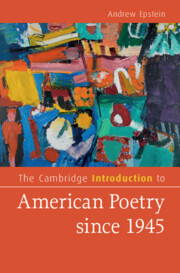
Contemporary American poetry can often seem intimidating and daunting in its variety and complexity. This engaging and accessible book provides the first comprehensive introduction to the rich body of American poetry that has flourished since 1945 and offers a useful map to its current landscape. By exploring the major poets, movements, and landmark poems at the heart of this era, this book presents a compelling new version of the history of American poetry that takes into account its variety and breadth, its recent evolution in the new millennium, its ever-increasing diversity, and its ongoing engagement with politics and culture. Combining illuminating close readings of a wide range of representative poems with detailed discussion of historical, political, and aesthetic contexts, this book examines how poets have tirelessly invented new forms and styles to respond to the complex realities of American life and culture.
Recommend this
Email your librarian or administrator to recommend adding this to your organisation's collection.