To save content items to your account,
please confirm that you agree to abide by our usage policies.
If this is the first time you use this feature, you will be asked to authorise Cambridge Core to connect with your account.
Find out more about saving content to .
To save content items to your Kindle, first ensure no-reply@cambridge.org
is added to your Approved Personal Document E-mail List under your Personal Document Settings
on the Manage Your Content and Devices page of your Amazon account. Then enter the ‘name’ part
of your Kindle email address below.
Find out more about saving to your Kindle.
Note you can select to save to either the @free.kindle.com or @kindle.com variations.
‘@free.kindle.com’ emails are free but can only be saved to your device when it is connected to wi-fi.
‘@kindle.com’ emails can be delivered even when you are not connected to wi-fi, but note that service fees apply.
As part of his long-standing work on the ‘Oriens pontificius’, the edition of the papal charters issued before 1198 in favour of the Latin churches and religious institutions founded in medieval Syria and Palestine in the aftermath of the First Crusade, Rudolf Hiestand has repeatedly stressed the extensive loss of source material pertaining to the history of the ecclesiastical establishments of the Latin Levant. Because of the Muslim reconquest of the so-called Crusader States and the concomitant destruction or complicated transfer of archives to Cyprus, Apulia, Sicily or France, scholars of the crusades and the Latin East are in many respects lacking the diversity and quantity of documentation generally produced by the Church in Western Europe during the Central Middle Ages. No monastic annals, no episcopal chronicles and hardly any hagiographical texts, theological treatises or sermons from Outremer have come down to us, with only very few exceptions such as the inventio narrating the discovery of the relics of the Patriarchs Abraham, Isaac and Jacob in Hebron, the poems revolving around the history of the Temple by Prior Achard and Abbot Geoffrey of the Templum Domini, the descriptions of the Holy Land by Rorgo Fretellus of Nazareth/Antioch and the writings of Gerard of Nazareth, bishop of Laodicea.
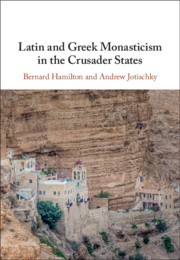
Monasticism was the dominant form of religious life both in the medieval West and in the Byzantine world. Latin and Greek Monasticism in the Crusader States explores the parallel histories of monasticism in western and Byzantine traditions in the Near East in the period c.1050-1300. Bernard Hamilton and Andrew Jotischky follow the parallel histories of new Latin foundations alongside the survival and revival of Greek Orthodox monastic life under Crusader rule. Examining the involvement of monasteries in the newly founded Crusader States, the institutional organization of monasteries, the role of monastic life in shaping expressions of piety, and the literary and cultural products of monasteries, this meticulously researched survey will facilitate a new understanding of indigenous religious institutions and culture in the Crusader states.
Under John II and Manuel I Byzantium remained a wealthy and expansionist power, maintaining the internal structures and external initiatives which were necessary to sustain a traditional imperial identity in a changing Mediterranean world of crusaders, Turks and Italian merchants. The revival of imperial interest in the crusader states had permanent consequences in that it led to a renewal of Byzantine links with Western Europe. Yet the period following Manuel's death and the overthrow of the regency government of Alexios II saw reversion to something like the isolationism of John II's early years. The Byzantine state was one of the most centralized in the medieval world, and never more so than in the period 1081-1180, when the loss of central and eastern Anatolia forced the empire's military elite, as well as its bureaucratic elite, to identify with the capital as never before. Under the successors of Manuel I, the Comnenian system, centred on Constantinople, was programmed for self-destruction.
At first sight it may seem surprising that the truncated and war-ravaged remnants of the crusader states should have lasted as long as they did. Directly after the Third Crusade there were few places in the Latin Kingdom other than Tyre and Acre that could have held out against full-scale assault. It is difficult to estimate the military resources at the disposal of the rulers of kingdom of Jerusalem in the thirteenth century. The ability of the military Orders to build and garrison substantial fortresses, take a share in the defence of the cities. The ports of the Latin east thus became the entrepots in what was evidently a most lucrative commerce. Trade and the wealth generated by trade were of the utmost importance to the rulers of Latin Syria. In the decades immediately following the Third Crusade the chief theatre of conflict in the east was Antioch.
Recommend this
Email your librarian or administrator to recommend adding this to your organisation's collection.