To save content items to your account,
please confirm that you agree to abide by our usage policies.
If this is the first time you use this feature, you will be asked to authorise Cambridge Core to connect with your account.
Find out more about saving content to .
To save content items to your Kindle, first ensure no-reply@cambridge.org
is added to your Approved Personal Document E-mail List under your Personal Document Settings
on the Manage Your Content and Devices page of your Amazon account. Then enter the ‘name’ part
of your Kindle email address below.
Find out more about saving to your Kindle.
Note you can select to save to either the @free.kindle.com or @kindle.com variations.
‘@free.kindle.com’ emails are free but can only be saved to your device when it is connected to wi-fi.
‘@kindle.com’ emails can be delivered even when you are not connected to wi-fi, but note that service fees apply.
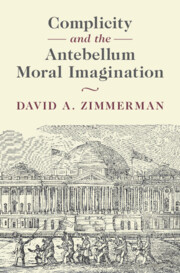
By what routes and on what grounds do moral blame and shame for social wrongs fall on individuals, groups, and institutions? To answer this question is necessarily to excite the moral imagination, to envision our moral connection to social, economic, and political harms that may appear remote or opaque. Between 1830 and 1860, American religious authorities, novelists, abolitionists, market activists, and political insiders trained this imagining. They delineated how moral complicity radiated across urban social networks, criminal conspiracies, political structures, and economic systems. In this original study, Zimmerman illuminates how new conceptions of moral complicity and participatory sin emboldened activists, animated new literary forms, sparked political controversy, and seeded a plan to racially transfigure the Atlantic economy. In media ranging from gothic convent tales to imperial trade proposals, complicity critics conjured not only the dangers but also the responsive duties and opportunities raised by new forms of sociomoral enmeshment.
For over four decades, the District of Columbia, the seat of national government and a major slave-trading depot, stood as a key symbol and site of the US government’s support of slavery. This chapter focuses on abolitionist depictions of the slave trade in the District and the moral liability thrust on northern citizens because of its many kinds of publicness. Abolitionists repeatedly circulated the image of chained slaves driven past the US Capitol. Reprised by sightseers and abolitionists, the iconic image conjured not only democratic complicity but also democratic shame. William Wells Brown searingly critiqued the District slave trade in Original Panoramic Views of the Life of an American Slave (1849), the focus of the chapter’s final section.
The District of Columbia, a federal district overseen by Congress, was a constitutional battleground where freedom nationalists, proslavery firebrands, and supporters of sectional harmony clashed over federal responsibility for slavery. From 1838 to 1859, US Representative Joshua Giddings (Ohio) insisted that the federal government had no constitutional authority to uphold slavery there. His signature claim was that the framers had granted northern states the right not to be made complicit in slavery through any action or policy of the federal government, beyond the Constitution’s requirements. Giddings railed against the persistent battering of this political and moral quarantine. The sensational attempt by over seventy-five enslaved Black residents to flee the nation’s capital in 1848 onboard the Pearl brought unprecedented attention to Giddings’ defense of northern purity rights. This chapter examines Giddings’ notion of a northern right to political innocence and its role in his congressional brawls over slavery in the District of Columbia.
Between 1830 and 1860, new conceptions of moral complicity sparked fierce debates in the United States. Reformers, religious authorities, novelists, market activists, and politicians zealously spelled out how moral liability flowed across legal systems, commercial networks, conspiracies, and political structures. The Introduction begins by illuminating the religious roots of this activist discourse. Then it outlines gendered threads of northern complicity critique, especially the focus on urban sexual vice, and plumbs abolitionism’s preoccupation with thickening social ties and causal webs that connected individuals and institutions to remote and widely distributed evils. Finally, an overview of the book’s chapters introduces key concepts such as moral ensembles, organic sin, tolerance complicity, moral taint, the Black market, and democratic complicity. Throughout, the Introduction highlights how complicity critics adapted old imaginative grammars and developed new ones to capture new forms of moral enmeshment and convey their dynamics and dangers.
Recommend this
Email your librarian or administrator to recommend adding this to your organisation's collection.