To save content items to your account,
please confirm that you agree to abide by our usage policies.
If this is the first time you use this feature, you will be asked to authorise Cambridge Core to connect with your account.
Find out more about saving content to .
To save content items to your Kindle, first ensure no-reply@cambridge.org
is added to your Approved Personal Document E-mail List under your Personal Document Settings
on the Manage Your Content and Devices page of your Amazon account. Then enter the ‘name’ part
of your Kindle email address below.
Find out more about saving to your Kindle.
Note you can select to save to either the @free.kindle.com or @kindle.com variations.
‘@free.kindle.com’ emails are free but can only be saved to your device when it is connected to wi-fi.
‘@kindle.com’ emails can be delivered even when you are not connected to wi-fi, but note that service fees apply.
Why are electoral winners more willing to support democratic norm violations? Using a mediator blockage survey experiment in the United States, I find that winners endorse norm erosion due to heightened in-party favoritism following their party’s electoral victory. The experiment successfully manipulated in-party favoritism, the mediator, demonstrating that respondents exposed to a winning signal, suggesting their party is likely to secure both the presidency and control of Congress, exhibit greater in-party favoritism. This increase significantly predicts a greater tendency to perceive norm-eroding policies, such as banning protests or disqualifying candidates, as democratic and to support these policies. Additionally, winners are less likely to evaluate these policies through a lens of strategic political calculation, that is, whether these policies benefit their party directly or indirectly, challenging the prevailing view that winners tolerate norm violations for instrumental reasons.
Electoral integrity has come under increasing pressure in the United States. Evidence shows that voters rarely ‘punish’ anti-democratic behavior if doing so implies voting for opponents. However, such electoral defection sets a high bar for detecting voter alienation. Here, I complement the analysis of partisans’ willingness to forego democracy’s rules with a more pliable measure of support: partisan attachments. Three preregistered survey experiments offer a nuanced picture of partisans’ tolerance for electoral subversion. On the one hand, few partisans will defend democracy by voting against their party. On the other hand, electoral violations alienate the party base and can even reduce animosity towards the opposing party, indicating that parties cannot undermine elections with impunity. Finally, the evidence suggests that partisans mainly update partisan attachments when the information is sponsored by a co-partisan source, indicating that credible linkage institutions may play a crucial role in shaping accountability.
Chapter 5 examines the trade-offs of corporate governing from both corporate and societal perspectives. Internally, it can enhance recruitment, morale, branding, and profitability – but also risks alienating stakeholders with conflicting political views. Externally, while corporate governing may offset political gridlock and support social change, it raises concerns about accountability, uneven influence, and democratic legitimacy. Companies may disengage, act opportunistically, or adopt positions that run counter to broader public goals. This chapter identifies two core challenges. First, corporate governing often falls short in advancing genuine social progress where business interests diverge from public needs – such as labor rights, antitrust, taxation, privacy, corporate and financial reform, and AI – underscoring the risks of stakeholderist reforms that expand executive discretion. Second, it may erode democratic processes by sidelining dissent and shifting policymaking into private hands. While the first concern may be mitigated by greater transparency, the second is more difficult. As public authority recedes, participatory democracy risks being displaced by corporate decision-making.
Chapter 5 examines the trade-offs of c1orporate governing from both corporate and societal perspectives. Internally, it can enhance recruitment, morale, branding, and profitability – but also risks alienating stakeholders with conflicting political views. Externally, while corporate governing may offset political gridlock and support social change, it raises concerns about accountability, uneven influence, and democratic legitimacy. Companies may disengage, act opportunistically, or adopt positions that run counter to broader public goals. This chapter identifies two core challenges. First, corporate governing often falls short in advancing genuine social progress where business interests diverge from public needs – such as labor rights, antitrust, taxation, privacy, corporate and financial reform, and AI – underscoring the risks of stakeholderist reforms that expand executive discretion. Second, it may erode democratic processes by sidelining dissent and shifting policymaking into private hands. While the first concern may be mitigated by greater transparency, the second is more difficult. As public authority recedes, participatory democracy risks being displaced by corporate decision-making.
This paper explores diversifying legislatures within a context of ethnonationalism, populism, and democratic erosion. Although diversity and inclusion are often viewed as symbols of democratization, research increasingly challenges this. In fact, diversity and inclusion can occur in tandem with democratic erosion—how so? How do minorities navigate hostile environments? To answer this question, I analyze how women politicians with intersecting identities strategically use their gendered and racialized identities. I conduct a qualitative study of four different women politicians in the Israeli Knesset—Miri Regev of Jewish Mizrahi [Moroccan] descent, Pnina Tamano-Shata of Jewish Ethiopian descent, Merav Michaeli of Jewish Ashkenazi [European] descent, and Aida Touma-Suleiman, a Palestinian-Israeli. I find that women will highlight the aspects of their identities that they believe will benefit them the most, resulting in their promotion of ethnonational divisions and reducing opportunities for solidarity among minority populations.
A major challenge for contemporary legal constitutionalism is a crisis of public ethics that manifests in the lack of mutual toleration and institutional forbearance towards the judiciary. To showcase the importance of these norms in the relationship among co-equal branches of government, I focus on three cases, one where these norms have been present—South Africa—one where they have been absent—Mexico—and one case in between—United States. Until this crisis is addressed, the authority of apex courts will continue to be under threat. The Article suggests that a starting point to address the public ethics deficit may lie in shifting comparative constitutional law scholarly attention to the political sphere.
Comparative legal literature increasingly stresses the fundamental importance of informal norms that underpin democratic and constitutional governance. A particular species of these informal norms is the constitutional convention. Although there is wide recognition of the fact that populism constitutes a key issue of constitutional resilience in our time, the issue of constitutional resilience with regard to the relationship between populist political style and constitutional conventions has been largely overlooked. This article maps the extent to which populism threatens constitutional resilience in democratic systems which rely substantively on constitutional conventions. Bringing together political science and legal theory, we engage in a conceptual analysis of conventions and of populism as a political style. In doing so we seek to explain the perceived tension between the two phenomena. We argue that populism should be conceived as a transgressive political style, which is fundamentally hostile to the notion of unwritten constitutional law or practice. In view of the crucial connection between constitutional conventions and the resilience of the constitutional system, and the vulnerability of conventions as norms of self-restraint (lacking independent enforcement mechanisms), we conclude that the populist political style indeed constitutes a problem of constitutional resilience.
Can the “us versus them” dynamic in politics undermine support for democracy even in the absence of strong party identification? While much is known about affective polarization in the USA, its impact on democratic commitment in other contexts remains understudied. We examine Chile’s 2022 plebiscite, where voters decided whether to approve or reject a new constitution amid low levels of party trust and identification. Through an experiment using an unobtrusive primer, we successfully induced short-term affective polarization, heightening animosity across multiple dimensions. Our findings show that individuals primed to this polarization significantly reduced their support for democracy, mirroring patterns observed in the USA. These results emphasize the importance of studying affective polarization, especially in regions with fragile democratic histories.
Independent electoral commissions can and do play an important role in protecting and promoting the “minimum core” of electoral democracy around the globe – including by postponing or setting aside elections that cannot or have not been conducted freely and fairly, excluding candidates and parties unwilling to comply with constitutional requirements, discounting tainted or fraudulent votes, and recounting electoral tallies. But there are dark sides to these broad-ranging powers. When electoral commissions are coerced or captured by authoritarian actors, these same powers can be used to undermine the fairness and competitiveness of the electoral playing-field, rather than protecting it. Any discussion of the promise of independent electoral commissions as democratic institutions, therefore, must be counter-balanced by attention to the capacity for this very discourse to be “abusively borrowed” in a way that undermines democracy.
During the era of democratic optimism that took off in the wake of the Second World War, scholars believed that democracy worked tolerably well in polities that exhibited wide institutional variation. Comparativists consequently focused on courts, rights, and constitutional values while sharply disagreeing over the extent of American exceptionalism. In his seminal contribution to this literature in A Lighter Touch: American Constitutional Principles in Comparative Perspective, Gary Jacobsohn provocatively argues that the United States is not a paradigmatic example of a nation built on constitutional values. Jacobsohn concludes that the American Constitution applies with a “lighter” touch than in many of its peer democracies which might prove problematic were the Constitution to undergo a stress test. With the advent of democratic erosion in the twenty-first century, scholars have turned pessimistic about democracy’s prospects. This paper argues that scholars will need to focus on structural issues – rather than courts, rights, and values – and the role that constitutional design may play in stemming or facilitating democratic erosion in America. The problem is not that the American Constitution applies with a lighter touch, as Jacobsohn argues, but that it applies with a heavy, almost Trumpian hand under the conditions of contemporary American democracy.
De-democratization may take the form of executive-led attacks as well as incremental decrepitude, gradual emptying of underlying constitutional values, and state inertia. Contrary to general wisdom, both exogenous erosion and endogenous decay are heavily affected by informality. As courts are often the first institutions affected by de-democratization, this Article analyzes informality in erosion and decay of judicial institutions. It argues that such institutions interact with democracy in two core directions. The first one is endogenous and describes the decay of democratic judiciaries as a result of a long-term incongruence between formal and informal judicial institutions. The second direction captures the gradual erosion of informal institutions that have positive effects on judicial democratic resilience. These two processes, decay and erosion of informal judicial institutions, should not be overlooked. While they are less visible, slower, and often unintentional, they are as dangerous as frontal executive-led attacks on courts, because they significantly increase the window of opportunity for politicians who wish to downgrade the substance of democracy or even implement a regime change.
In the last year Israel has been going through its most severe constitutional crisis in its history. The newly elected right-wing government has initiated a judicial overhaul that would limit the authority of the judiciary and grant the executive almost absolute powers. In response, the country has witnessed unprecedented civil protestations and opposition from nearly all segments of civil society, academia and economic sectors. In this article we argue that the judicial overhaul must be analysed as a populist constitutional project. We also explain that compared with other systems, Israeli democracy is especially vulnerable to populism, because of its unique institutional design factors coupled with social factors. Only with understanding these factors can one grasp the risks that the judicial overhaul poses to Israeli democracy.
Why does the ability of political leaders to control the bureaucracy vary? With strong meritocratic recruitment and tenure protections, Brazil appears an ideal case for successful bureaucratic resistance against political control. However, our analysis reveals how Bolsonaro overcame initial resistance by recalibrating strategies, ultimately dominating many key sectors of the bureaucracy. Drawing on over 100 interviews with public officials, we find that strategies of political control and bureaucratic resistance unfold in a dynamic, yet often predictable, pattern based on leaders' previous experiences and their ability to learn, adjust, and tighten their grip on the instruments of the state. The Bolsonaro administration transformed the regulatory framework and targeted individual state employees, reducing arenas of contestation and inducing public sector workers to remain silent, implementing the president’s policy preferences. We examine these control strategies in environmental agencies, their replication, and potential long-term consequences.
Our theory treats nominally democratic institutions as constraints that autocrats struggle to loosen and citizens’ beliefs as the central battlefield on which the struggle for political change is waged. After reviewing the book’s key findings, in this chapter we use our theoretical framework to suggest a series of important questions about autocratic politics in the early twenty-first century. We explore how the world’s autocrats are attempting to shape their citizens’ beliefs by weaponizing distinctly modern technologies, not just propaganda and censorship. We also discuss how the world’s autocrats are attempting to loosen the electoral constraints that bind them. Although this book is about propaganda in autocracies, it has important implications for politics in democracies, especially as a series of “populist-authoritarian” leaders take power across Europe and North America. We argue, in particular, that Xi Jinping’s propaganda strategy helps us understand the process of democratic erosion underway across the world. We conclude by discussing the book’s implications for public policy.
A growing body of literature on the role of courts in democratic backsliding claims that court-packing weakens liberal democracy. However, this is not necessarily the case. The goals of the actors who produce court-packing help to explain why the co-optation of the judiciary can have a substantial negative effect on liberal democracy in some (although not all) cases. In this respect, we distinguish two types of court-packing. First, policy-driven court-packing occurs when politicians manipulate the composition of courts in order to assure a quick implementation of policies. Although this tends to negatively affect judicial independence, it is not per se a first step towards regime change. Second, regime-driven court-packing happens when politicians alter the composition of the courts with the goal of eroding democracy. In this case, court-packing’s negative effect on judicial independence has a systemic negative effect on different dimensions of liberal democracy. Relying on a wide range of primary and secondary sources, we conceptualize these two types of court-packing by comparing two cases: Carlos Menem (1989–99) in Argentina, seeking judicial support to carry out pro-market economic reforms, and Hugo Chávez (1999–2013) and Nicolás Maduro (2013–present) in Venezuela, seeking to control the judiciary in the context of democratic backsliding.
Edited by
Claudia Landwehr, Johannes Gutenberg Universität Mainz, Germany,Thomas Saalfeld, Otto-Friedrich-Universität Bamberg, Germany,Armin Schäfer, Johannes Gutenberg Universität Mainz, Germany
Is populism a threat to representative democracy? Is populism a reason for anxieties about democratic political systems? Or is the rise of populism a source of democratization, since it gives anxieties about the future a voice? In the self-description of leaders of contemporary populist parties, the response to the last question is positive. For instance, Alexander Gauland, co-chair of the Alternative for Germany (Alternative für Deutschland, AfD) at that time, argued 2018 against the dominance of a globalized elite and portrayed the AfD as the real representative of the German people competing democratically in elections (Gauland 2018). In his view, AfD supporters are democrats fighting against the impositions on national sovereignty by cosmopolitan elites.
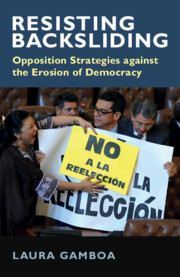
In the past two decades, democratically elected executives across the world have used their popularity to push for legislation that, over time, destroys systems of checks and balances, hinders free and fair elections, and undermines political rights and civil liberties. Using and abusing institutions and institutional reform, some executives have transformed their countries' democracies into competitive authoritarian regimes. Others, however, have failed to erode democracy. What explains these different outcomes? Resisting Backsliding answers this question. With a focus on the cases of Hugo Chávez in Venezuela and Alvaro Uribe in Colombia, the book shows that the strategies and goals of the opposition are key to understanding why some executives successfully erode democracy and others do not. By highlighting the role of the opposition, this book emphasizes the importance of agency for understanding democratic backsliding and shows that even weak oppositions can defeat strong potential autocrats.
As I mentioned at the beginning of this book, the erosion of democracy has become pervasive. Countries in Asia, Eastern Europe, the Middle East, and Africa have seen the rise of executives with hegemonic aspirations. The threat of antisystemic populist outsiders has even spread to developed democracies in Europe and North America. In this chapter, I assess the theory outlined in the book in some of these cases. Doing so allows me to evaluate if, when, and how does the argument of this book work outside Colombia and Venezuela.
In this chapter, I develop a theory that focuses on the opposition’s strategic choices to fight the erosion of democracy. I define democratic erosion as a type of regime transition that happens over time, giving the opposition ample opportunity to respond, even after a leader willing to circumvent democracy has attained power. The strategies the opposition chooses and the goals it uses them for, I argue, are critical to understanding why some executives with hegemonic aspirations successfully erode democracy and others do not.
The erosion of democracy has become globally pervasive. New and old democracies around the world are now led by executives willing to undermine democratic institutions in order to achieve their policy goals. The booming literature on democratic backsliding has, for the most part, focused on the factors that drive these executives with hegemonic aspirations to power (Handlin 2017b; Norris and Inglehart 2019b) or the resources they have available to successfully undermine democratic institutions (Corrales 2018b; Levitsky and Ziblatt 2018b; Ginsburg and Huq 2019b; Weyland and Madrid 2019b). The underlying assumption of these theories is that popular and economically solvent heads of government in institutionally weak countries are almost always going to erode democracy, while their less popular and economically solvent counterparts in institutionally strong countries are almost always going to fail.