To save content items to your account,
please confirm that you agree to abide by our usage policies.
If this is the first time you use this feature, you will be asked to authorise Cambridge Core to connect with your account.
Find out more about saving content to .
To save content items to your Kindle, first ensure no-reply@cambridge.org
is added to your Approved Personal Document E-mail List under your Personal Document Settings
on the Manage Your Content and Devices page of your Amazon account. Then enter the ‘name’ part
of your Kindle email address below.
Find out more about saving to your Kindle.
Note you can select to save to either the @free.kindle.com or @kindle.com variations.
‘@free.kindle.com’ emails are free but can only be saved to your device when it is connected to wi-fi.
‘@kindle.com’ emails can be delivered even when you are not connected to wi-fi, but note that service fees apply.
Movement and the freedom to move are concepts intertwined with the origins and impact of the American Revolution. This chapter views the Revolution and the decades that followed through the lens of those concepts to examine whether that conflict sparked new opportunities for physical movement to, from, and within the newly established United States. To do so it explores the experiences of Loyalists, African Americans, immigrants, citizens, and Native Americans within a thematic framework that identifies the forces and actions altering the dynamics of power, ideology, and policy from the Atlantic seaboard to the trans-Mississippi West from the 1780s to the 1810s. Those diverse experiences demonstrate that the freedom to move was inextricably intertwined with efforts to define the meaning of “we the people” in the new American republic.
Historians have long debated the impact of the American Revolution on the institution of slavery. Did the war create a nation devoted to liberty or one mired in slaveholding? Beginning in the 1780s, Black and white abolitionists won hard-fought battles for gradual emancipation and manumission in some states even as slaveholding expanded across much of the South. At the national level, the choices that federal leaders made to secure a strong union of states gave enslavers unprecedented access to the land and labor that would make the United States a significant slaveholding power. As the United States grasped territory over the next forty years, slavery spread with the nation. These changes were devastating for enslaved people, who lost their families, communities, labor, bodily autonomy, and lives to the world that slavery created. Within just a few decades after the American Revolution, the landscape of slavery was entirely transformed.
Chapter 5 addresses a major demographic puzzle concerning thousands of New York slaves who seem to have gone missing in the transition from slavery to freedom, and the chapter questions how and if slaves were sold South. The keys to solving this puzzle include estimates of common death rates, census undercounting, changing gender ratios in the New York black population, and, most importantly, a proper interpretation of the 1799 emancipation law and its effects on how the children of slaves were counted in the census. Given an extensive analysis of census data, with various demographic techniques for understanding how populations change over time, I conclude that a large number of New York slaves (between 1,000 and 5,000) were sold South, but not likely as many as some previous historians have suggested. A disproportionate number of these sold slaves came from Long Island and Manhattan.
The second chapter delves into slave flight to spaces of informal freedom in the urban South, the most immediate and easily reached destinations for runaways trapped in the second slavery. It considers why enslaved people chose to go to the trouble of fleeing bondage yet remain within the slaveholding states; the networks that helped them do so; the strategies they employed to hide their identities, sustain themselves, and remain at large indefinitely; and the risk they ran of recapture. The actions of these runaways went far beyond mere truancy, as is often suggested in the literature. Many fugitives to urban areas clearly attempted to live their lives there indefinitely. The chapter devotes considerable attention to the importance of family in informing freedom seekers' decisions to remain within the South, even if it meant foregoing more formal freedom in other parts of the continent. It also examines the importance of visibility in runaways' strategies of escape, exploring how they "passed for free" by looking and acting free, procuring false freedom papers and other documentation, and integrating themselves into urban free black communities so as to avoid detection.
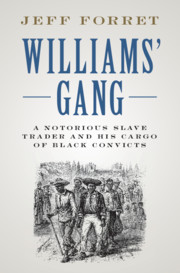
William H. Williams operated a slave pen in Washington, DC, known as the Yellow House, and actively trafficked in enslaved men, women, and children for more than twenty years. His slave trading activities took an extraordinary turn in 1840 when he purchased twenty-seven enslaved convicts from the Virginia State Penitentiary in Richmond with the understanding that he could carry them outside of the United States for sale. When Williams conveyed his captives illegally into New Orleans, allegedly while en route to the foreign country of Texas, he prompted a series of courtroom dramas that would last for almost three decades. Based on court records, newspapers, governors' files, slave manifests, slave narratives, travelers' accounts, and penitentiary data, Williams' Gang examines slave criminality, the coastwise domestic slave trade, and southern jurisprudence as it supplies a compelling portrait of the economy, society, and politics of the Old South.
Already by the 1820s, the national capital of Washington, D.C. had emerged as a significant depot in the increasingly professionalized domestic slave trade. The introduction sketches the history of slave dealing in the capital, William H. Williams’ emergence on to the slave-trading scene there, and the broad contours of how the slave trade functioned, often depositing its victims for sale in New Orleans, Louisiana. It argues that the story of William H. Williams and his one shipment of convict slaves purchased in 1840 provides a snapshot of the antebellum era socially, economically, politically, and legally.
Recommend this
Email your librarian or administrator to recommend adding this to your organisation's collection.