To save content items to your account,
please confirm that you agree to abide by our usage policies.
If this is the first time you use this feature, you will be asked to authorise Cambridge Core to connect with your account.
Find out more about saving content to .
To save content items to your Kindle, first ensure no-reply@cambridge.org
is added to your Approved Personal Document E-mail List under your Personal Document Settings
on the Manage Your Content and Devices page of your Amazon account. Then enter the ‘name’ part
of your Kindle email address below.
Find out more about saving to your Kindle.
Note you can select to save to either the @free.kindle.com or @kindle.com variations.
‘@free.kindle.com’ emails are free but can only be saved to your device when it is connected to wi-fi.
‘@kindle.com’ emails can be delivered even when you are not connected to wi-fi, but note that service fees apply.
This chapter introduces key elements of Robert Brandom’s philosophy. A striking feature of Brandom’s inferentialism is that it offers ‘a unified vision of language and mind’ – a comprehensive alternative to traditional representationalist frameworks. Classical semantic notions such as reference, truth-functions, and propositions are understood in terms of use – that is, through pragmatics. Brandom characterises his position as conceptual pragmatism, which aims to explicate conceptual contents by uncovering what is implicit in our discursive practices.He is a strong inferentialist: inferential articulation alone is sufficient for conceptual content. Yet he also endorses broad inferentialism, which recognizes non-inferential content – such as perceptual judgements – as legitimate within an inferentially articulated framework.The chapter examines several further key components of Brandom’s philosophy: inferential semantics; the distinction between commitments and entitlements; inferential justification; scorekeeping; communication and the challenge of semantic holism; and the role of normative attitudes in grounding normativity.
This chapter analyses the function of pornographic material in Amis’s framing of masculinism in London Fields and Yellow Dog. It emphasises elements of alignment of Amis’s satirical mode with two major late twentieth-century theoretical contributions: feminist legal scholar Catharine MacKinnon’s criticism of heterosexual male-oriented pornography as an instrument of coercion and psychoanalyst Jacques Lacan’s theorisation of ‘imposture’ as a core component of male heterosexual desire as constructed in patriarchy. The chapter further supports my assessment, in prior contributions, that Amis’s discursive techniques denounce heterosexual male-oriented pornographic discourse and practice as insidious ways for masculinist power to thrive under contemporary rule-of-law regimes. It also stresses the continued relevance of Amis’s critical framing of masculinism in a contemporary socio-political environment increasingly dominated by small but powerful extreme right interest groups whose representatives, from ‘manosphere’ social media gurus to heads of state, behave and sound eerily like Amis’s masculinist focalisers.
Building on the findings of Chapter 5 of Persistent Citizens, this chapter shifts focus to the origins of the three "2ei" attitudes (i.e., entitlement, indignation, and self-efficacy). The authors explore various factors that might explain why some individuals feel more entitled, indignant, and efficacious than others. Their analysis finds that domain-specific knowledge – knowledge of social rights – is a particularly strong predictor of these attitudes. The chapter provides evidence that knowledge of social rights is a more significant factor than socioeconomic status, prior experiences with the state, or general civic engagement. Path models show how knowledge of social rights plausibly affects 2ei, driving state-centric persistence.
This chapter presents Persistent Citizens’ central theoretical framework: a psychological explanation for state-centric persistence. The chapter highlights the significant psychological costs associated with engaging the state, including feelings of stigma and shame and the loss of autonomy and control. The authors identify three domain-specific attitudes that they argue can both reduce these costs and otherwise directly increase the likelihood of persistence: entitlement, indignation, and self-efficacy. The book refers to these attitudes collectively as "2ei." The chapter defines each of these attitudes, explaining that entitlement is the belief that one has a right to a benefit; indignation is the emotional response to a violation of that right; and self-efficacy is the belief in one’s ability to successfully interact with the state. The chapter hypothesizes that individuals who possess these attitudes are more likely to engage in state-centric persistence.
Chapter 4 examines local concepts of right(s), dissecting the ways in which brokering and begging were viewed as charitable compensations for the lack of government protection for disabled people, but claimed by the recipients as forms of work. Aspiring to have their activities recognised as rights, they spoke a local language of entitlement that conflated the value of independent work with the ethical and political right to care, asserting obligatory rights or taxes, against the donors’ perception of gifts. The language of ‘rights’ is a space of mutual evaluation, a rich and powerful language for discussing issues of inequality, membership, personhood, welfare, and power in Kinshasa today. It is perhaps most significant as a claim for distribution than as a legal premise of entitlements. Here, the question of a rightful share becomes pertinent, as givers and receivers evoked differing views on the same transaction that expressed contradictory aspirations and values. In the absence of formal institutions to enforce informal disability privileges, people had to recognise the right to be beggars or brokers on an interpersonal level, requiring constant value tests on whether claims to assistance were legitimate. The chapter thus disrupts the classic Maussian focus on giving and production to consider the moral and political controversies associated with asking and distribution.
The Conclusion urges us to consider practices that lead to becoming ‘valuable people’ as something that goes beyond overcoming stigma to changing the evaluations that define what is good. It brings the discussions about values together with a final example of how my interlocutors pursued valued inclusion, by embracing a biomedical model of personhood where people are judged on their minds rather than on their bodies. This draws attention to the wider relevance of questions of entitlement, distribution, and values: wherever my interlocutors went, discussions of values followed.
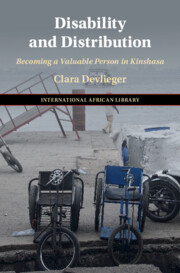
Set in the postcolonial city of Kinshasa (DR Congo), this ethnography explores how people with disabilities navigate debates about the just distribution of resources where there is little state organised welfare, and public perception of disability swings between the 'deserving' and 'undeserving'. Tracing a historic increase of disability due to polio and its long-term effects, this book examines two controversial livelihood activities that serve as informal alternatives to state support: a specialized form of international border brokerage across the Congo River, and a unique practice of bureaucratized begging that imitates state tax collection and humanitarian fundraising. Clara Devlieger examines how such activities shape ways that disabled people conceive the idea of becoming 'valuable people' in local terms: by supporting loved ones, many achieve high esteem against expectations, while adapting exclusionary models of urban personhood to include disability. Devlieger offers a new understanding of the complex dynamic between the imagined role of the state, international discourses of rights, and local experiences of disability.
Willingness to help a needy person may depend on whether the person is perceived as responsible for their predicament. However, information regarding the cause is not always available, and people often ‘look the other way’ when it is. The present research explores whether potential donors choose to obtain information about the cause of the other’s need and, more importantly, how this choice to pursue information is affected by the donors’ feelings of entitlement. Across four studies, we find that decision makers who pursue information about why others are in need are more likely to offer help. Yet we also measure and manipulate the feelings of entitlement and find that those who are high in entitlement are more likely to seek the information regarding the person in need. Their higher tendency to pursue more information makes them more likely to help than they would otherwise.
Chapter 1 addresses the false belief that prejudice and discrimination are individual in nature and not systemic or institutional. Many people believe that racism, sexism, or homophobia comprise an individual’s negative feelings toward marginalized groups – a person has hate in their heart and discriminates against the relevant target. It is certainly the case that people can hate members of certain groups and that hate can manifest in discrimination. However, inequality is also refleted in insitutions. It is systemic and structural. That is, inequality is reflected in laws, policies, and practices, and is baked into insititutions such as health care, the criminal legal system, marriage, education, the military, and so on. Chapter 1 describes the key terms associated with systemic inequality, and describes the process by which systemic inequality is established and maintained. The chapter concludes with strategies to reduce systemic and structural inequality.
The Conclusion describes the stakes of ignoring the impact of bigotry. In particular, the ways in which bigotry impacts the lives of those who benefit from it are a focus.
Chapter 7 examines the belief by some that affirmative action amounts to reverse racism and reverse sexism. The distinction between affirmative action and equal opportunity is described, as is the common belief that affirmative action involves quotas (quotas are illegal). Practices that undermine meritocracy in both college admissions and in employment are explored. These practices include legacy admissions, donors, and, in the context of employment, biases in job selection. Chapter 7 makes the case for the need of affirmative action because subtle forms of bias infiltrate all aspects of employment. The chapter critically examines the argument that diversity benefits organizations. The chapter ends with a discussion of goal-oriented versus process-oriented affirmative action plans, and other strategies to reduce bias in admissions and employment.
I build upon the earlier discussion – in Chapter 3 – of internal forms of social "tiering" and exclusion to further interrogate the politics of belonging in Gulf monarchies, this time through the employment of foreign labor. I disentangle the ways in which foreign labor plays a role in the shaping and consolidation of the national community, and I distinguish among European "expats," non-GCC Arabs, Asian and African laborers. I argue that labor from the three different categories play similar but also distinct roles in the delineation of national community: While they are differentially incorporated in ways that protect the "nation" and appease the citizen-subject, varying degrees of marginality reflect Gulf society’s perceptions or aspirations of the difference between itself and "the other(s)." Additionally, I examine some of the peculiarities of the importation, organization and incorporation of foreign labor, connect them to the normative tradition, and consider how they serve the ruler’s objective to manage and control society.
This chapter considers what arguments can be offered to defend patents (the normative question). It revisits the three types of argument introduced in Chapter 2: the labour, utilitarian and personality arguments.
I read Kripke’s sketches of our ordinary view of meaning in his book Wittgenstein on Rules and Private Language as attempts to highlight the features of meaning that enable us to draw the distinction between what seems right and what is right. I argue that Kripke thinks the best way to clarify these features of meaning is to describe metasemantic conditions that a speaker’s words must satisfy if the speaker is to be warranted in asserting a sentence in which the words occur. Although the view of meaning I attribute to Kripke is initially compelling, I argue that it rests on a subtle yet fundamental misunderstanding of the distinction between what seems right and what is right.
The purpose of this paper is to reject what I call the entitlement model of directed obligation: the view that we can conclude from X is obligated to Y that therefore Y has an entitlement against X. I argue that rejecting the model clears up many otherwise puzzling aspects of ordinary moral interaction. The main goal is not to offer a new theory of obligation and entitlement. It is rather to show that, contrary to what most philosophers have assumed, directed obligation and entitlement are not the same normative concept seen from two different perspectives. They are two very different concepts, and much is gained by keeping them distinct.
This chapter concludes by offering some brief reflections regarding the utility of grievance formation as a theoretical and methodological tool in socio-legal research in order to understand rights developments in context.
This chapter examines the multiple ways in which obtaining food was tied to labor in the ghetto. This includes trading labor for resources to purchase food as well as supplemental food which was provided for certain occupations. It explores different types of work in the ghetto including forced labor, work for the Judenrat, factory work, home-based piece work, as well as employment in the ghetto’s private sector. The chapter looks at ways in which people utilized their social networks to obtain better work as well as how hunger impacted productivity. This chapter also explores the tension between obtaining work that provided enough funds to meet one’s food needs versus positions which protected one against deportation and the strategies employed by individuals and households to meet their needs of adequate food and protection. This chapter also discusses the struggles of the Jewish communal leadership in providing labor to the Germans while feeding working and nonworking ghetto inhabitants. This chapter examines how the Germans took control of food distribution out of the hands of the communal leadership in order to prioritize labor.
A History of World War One Poetry aims to represent the global and multifaceted poetry that emerged from 1914–1918. While poetry did and does not occupy the same place in all national imaginaries, it was a literary genre that flourished during the Great War.The Introduction interrogates not only the term ‘war poetry’ but also the question of ‘who is entitled to write war poetry’.It argues that the poetry that emerged from World War One extended far beyond the British soldier-poet canon, reinforced by influential studies such as Paul Fussell's The Great War and Modern Memory. Rather, as the chapters demonstrate, it was generated and read by men and by women, combatant and non-combatant, and across a continuum in which protest and patriotism, modernity and tradition, propaganda and remembrance, humour and pathos, co-existed, if uneasily.
After half a century since the entrenchment of the notion of right to food (RTF) in international instruments, it remains elusive to millions of South Africans. This development evolves in the backyard of a country with high per capita income, entrenched constitutional provision safeguarding citizens’ RTF, being a net exporter of agricultural produce, and a comprehensive social security structure. Ironically, most of these citizens reside in townships or locations where residents constantly take to the streets in demand for basic social services and yet, have not pressed for the provision of food. Why is this the case, and how can this trend be reversed? In seeking to respond to these discursive questions, the chapters in this book address cardinal legal and politico-economic aspects of the RTF, by assessing the concepts, polices and institutions which have created the stark contrast or paradox between (persuasive) policies and (poor) practice. Assessing the means by which people access food (either through own production or purchase), the chapters adopt an interdisciplinary approach, spanning agriculture, economics, history, land economy, law, political science, nutrition and sociology, to determine the dynamics of the RTF and poor policy interventions.
Connections that help us feel valued and add value impact our health, happiness, love, work, and society. The consequences of mattering or not mattering can be seen everywhere, at every age. The lack of mattering often results in depression, suicide, and even aggression and xenophobia. People who suffer from depression, workers who feel alienated, and citizens whose identity is threatened feel devalued. They feel that their lives, work, and identity do not matter. While some respond to this situation by internalizing feelings of despondence, others overcompensate by nurturing feelings of superiority and joining nationalistic movements headed by authoritarian leaders. Feeling devalued or overvalued, in relationships, at work, and in the world, is one of the most serious threats facing us. They derive from a failure to foster mattering. They results can be disastrous for individuals and society as a whole. When disaffected masses feel that their identity is devalued in society, they respond in one of two ways. They either turn toward nationalism and extremism, as in the case of xenophobic movements, or they protest to defend their rights.