To save content items to your account,
please confirm that you agree to abide by our usage policies.
If this is the first time you use this feature, you will be asked to authorise Cambridge Core to connect with your account.
Find out more about saving content to .
To save content items to your Kindle, first ensure no-reply@cambridge.org
is added to your Approved Personal Document E-mail List under your Personal Document Settings
on the Manage Your Content and Devices page of your Amazon account. Then enter the ‘name’ part
of your Kindle email address below.
Find out more about saving to your Kindle.
Note you can select to save to either the @free.kindle.com or @kindle.com variations.
‘@free.kindle.com’ emails are free but can only be saved to your device when it is connected to wi-fi.
‘@kindle.com’ emails can be delivered even when you are not connected to wi-fi, but note that service fees apply.
This chapter considers Lewis Carroll’s Alice’s Adventures in Wonderland (1865) and William Morris’s New from Nowhere (1890) through the lens of the commons and what counts as “common sense.” Taking its cue from a question Morris poses about art’s role in radical social transformation, the chapter asks if the recent environmental turn in Victorian studies is interested in piecemeal or systemic change. Considering both modes of change, the chapter proposes a “poetry of the commons,” grounded in Carroll’s and Morris’s very different approaches to both the commons and common sense, as an alternative to the market economy and as more accurate approximation of how the commons traditionally worked. Accordingly, Alice and News can be seen as laying the foundations for something like “commons sense” and a practice and poetry of the commons adequate to the demands of the climate crisis.
Chapter 4 provides an environmental interpretation of Kant’s aesthetic and teleological theory as developed in the Critique of the Power of Judgment. To put Kant’s insights in dialogue with new contributions in climate aesthetics, I begin with Kant’s theory of the sublime. I claim that Kant’s account of the dynamical sublime has important moral and political relevance for climate philosophy despite its human-centered focus. Next, I look into Kant’s account of natural beauty, which I suggest justifies duties against environmental degradation. I also touch on Kant’s duties to love nature’s harmony and purposes in light of ecological stewardship. The chapter concludes with a look into Kantian teleology from the Critique of Judgment. I propose that teleological judgment can be used to motivate protection of non-beautiful aspects of ecosystems, especially in light of climate-related biodiversity loss.
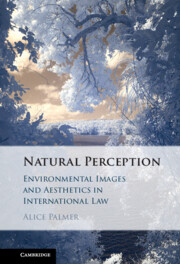
Images of nature abound in the practice of international environmental law but their significance in law is unclear. Drawing on visual jurisprudence, and interpretative methods for visual art, this book analyses photographs for their representations of nature's aesthetic value in treaty processes that concern world heritage, whales and biodiversity. It argues that visual images should be embraced in the prosaic practice of international law, particularly for treaties that demand judgements of nature's aesthetic value. This environmental value is in practice conflated with natural beauty, ethical and cultural values, and displaced by economic and scientific values. Interpretations of visual images can serve instead to critique and conceive sensory, imaginative and emotional appreciations of nature from different cultural perspectives as proposed by philosophers of environmental aesthetics. Addressing questions of value and the visual, this landmark book shows how images can be engaged by nations to better protect the environment under international law.
Recommend this
Email your librarian or administrator to recommend adding this to your organisation's collection.