To save content items to your account,
please confirm that you agree to abide by our usage policies.
If this is the first time you use this feature, you will be asked to authorise Cambridge Core to connect with your account.
Find out more about saving content to .
To save content items to your Kindle, first ensure no-reply@cambridge.org
is added to your Approved Personal Document E-mail List under your Personal Document Settings
on the Manage Your Content and Devices page of your Amazon account. Then enter the ‘name’ part
of your Kindle email address below.
Find out more about saving to your Kindle.
Note you can select to save to either the @free.kindle.com or @kindle.com variations.
‘@free.kindle.com’ emails are free but can only be saved to your device when it is connected to wi-fi.
‘@kindle.com’ emails can be delivered even when you are not connected to wi-fi, but note that service fees apply.
STEM wisdom is the application of wisdom – the deployment of one’s knowledge and abilities for a common good, over the long as well as the short term – to science, technology, engineering, and mathematics. STEM wisdom is a construct that psychologists can actively study and educators can actively develop in their students. Although schools regularly teach the declarative and procedural knowledge of STEM disciplines, they rarely teach for STEM wisdom. Yet the lack of STEM wisdom is wreaking havoc in the world, leading to present and future dangers from global climate change, pollution, weapons of mass destruction, and other problems facing the world. Students and professionals alike need to learn not only STEM knowledge and skills but perhaps more importantly also how to use STEM to make the world a better, not a worse, place. STEM can help save the world, but in the absence of STEM wisdom, STEM also can destroy it.
This chapter discusses how to cultivate wisdom. First, it discusses why people are not wise, mainly, because they are susceptible to foolishness through eight fallacies.
1. The fallacy of unrealistic optimism.
2. The fallacy of egocentrism.
3. The fallacy of false omniscience.
4. The fallacy of false omnipotence.
5. The fallacy of false invulnerability.
6. The sunk-cost fallacy.
7. The fallacy that ignorance is bliss.
8. The fallacy of confirmation (myside) bias.
The chapter then discusses principles of teaching for wisdom.
1. Seek a common good.
2. Balance one’s own with others’ interests and with higher order interests.
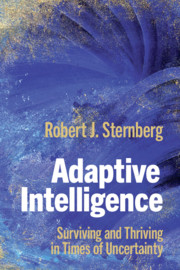
Adaptive Intelligence is a dramatic reappraisal and reframing of the concept of human intelligence. In a sweeping analysis, Robert J. Sternberg argues that we are using a fatally-flawed, outdated conception of intelligence; one which may promote technological advancement, but which has also accelerated climate change, pollution, the use of weaponry, and inequality. Instead of focusing on the narrow academic skills measured by standardized tests, societies should teach and assess adaptive intelligence, defined as the use of collective talent in service of the common good. This book describes why the outdated notion of intelligence persists, what adaptive intelligence is, and how it could lead humankind on a more positive path.
Contemporary politics provides numerous examples in which people fail to use critical thinking skills. There are many obstacles to critical thinking including, overconfidence, obsession with fantasies, and disregard for the truth, among others. To help students develop their critical thinking skills, universities need to be sure that critical thinking is being taught and that it is valued. Instructors need to use real-life examples that are relevant to their students’ lives, and teach students to recognize and overcome the many obstacles to critical thinking. Individuals can improve how they think about political issues by listening to diverse viewpoints, becoming informed about political issues, rewarding politicians who compromise to reach a goal, breaking down echo chambers, and valuing evidence-based thinking.
Recommend this
Email your librarian or administrator to recommend adding this to your organisation's collection.