To save content items to your account,
please confirm that you agree to abide by our usage policies.
If this is the first time you use this feature, you will be asked to authorise Cambridge Core to connect with your account.
Find out more about saving content to .
To save content items to your Kindle, first ensure no-reply@cambridge.org
is added to your Approved Personal Document E-mail List under your Personal Document Settings
on the Manage Your Content and Devices page of your Amazon account. Then enter the ‘name’ part
of your Kindle email address below.
Find out more about saving to your Kindle.
Note you can select to save to either the @free.kindle.com or @kindle.com variations.
‘@free.kindle.com’ emails are free but can only be saved to your device when it is connected to wi-fi.
‘@kindle.com’ emails can be delivered even when you are not connected to wi-fi, but note that service fees apply.
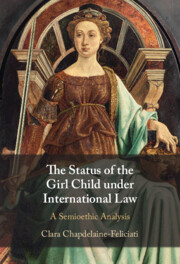
Clara Chapdelaine-Feliciati offers the first comprehensive study of the status of the girl child under international law. This book significantly contributes to bridging two fields usually studied separately: law and semiotics. The author engages in the novel legal semiotics theory to decode the meaning of international treaties (mainly the Convention on the Rights of the Child, Convention on the Elimination of All Forms of Discrimination Against Women, and International Covenants) and assess whether the provisions, as formulated, clearly identify the girl child and take into account the obstacles she faces as a result of sexism, childism, and intersectional discrimination. This is also the first book to apply The Significs Meaning Triad – Sense, Meaning, Significance – in international law, and Semioethics for both a diagnosis and prognosis of problematic signs in view of modifying the wording of relevant treaties.
Few studies from low-income countries have addressed women's fear of childbirth (FOC) although likely to affect women during both pregnancy and childbirth. The aim of this study was to explore FOC in a high maternal mortality setting in the Arab region, Yemen.
Methods.
A multi-stage (stratified–purposive–random) sampling process was used. We interviewed 220 women with childbirth experience in urban/rural Yemen. Answers to the question ‘Were you afraid of giving birth?’ were analyzed using qualitative content analysis.
Results.
Women perceived childbirth as a place of danger. Fear of death and childbirth complications stemming from previous traumatic childbirth and traumatic experience in the community was rampant. Husbands’ and in-laws’ disappointment in a girl infant constituted a strong sociocultural component of FOC. Women's perception of living in tension ‘between worlds’ of tradition and modernity reinforced fear of institutional childbirth. Women without FOC gave reasons of faith, social belonging and trust in either traditional or modern childbirth practice, past positive experience of childbirth and the desire for social status associated with children.
Conclusions.
The numerous maternal and infant deaths have a strong impact on women's FOC. Antenatal care has an important role in reducing fear including that of institutional childbirth and in strengthening a couple in welcoming a female infant. Staff should be sensitized to the fears of both husband and wife and women be allowed support during childbirth. Within the scope of the Millennium Development Goals and strengthening of reproductive mental health programs, FOC urgently needs to be addressed.
Recommend this
Email your librarian or administrator to recommend adding this to your organisation's collection.