To save content items to your account,
please confirm that you agree to abide by our usage policies.
If this is the first time you use this feature, you will be asked to authorise Cambridge Core to connect with your account.
Find out more about saving content to .
To save content items to your Kindle, first ensure no-reply@cambridge.org
is added to your Approved Personal Document E-mail List under your Personal Document Settings
on the Manage Your Content and Devices page of your Amazon account. Then enter the ‘name’ part
of your Kindle email address below.
Find out more about saving to your Kindle.
Note you can select to save to either the @free.kindle.com or @kindle.com variations.
‘@free.kindle.com’ emails are free but can only be saved to your device when it is connected to wi-fi.
‘@kindle.com’ emails can be delivered even when you are not connected to wi-fi, but note that service fees apply.
Chapter 3 investigates the evolution of institutional shareholder activism, focusing on how a diverse range of investors – including pension funds, asset managers, hedge funds, and index funds – have moved from passive holders to more assertive and strategic actors in corporate governance. It traces the theoretical roots of shareholder activism, from the exit-versus-voice framework to the economic constraints and tactical shifts that define modern engagement. Using a typology of firm-, portfolio-, and system-level activism, the chapter explores a broadened strategic repertoire – illustrating a shift from adversarial tactics to more collaborative, coalition-based engagement – and examines how activist goals have expanded from financial returns to encompass ESG and systemic concerns. Drawing on a hand-collected dataset of UK activism campaigns (2010–20), it maps evolving trends in actors, agendas, and tactics, and analyses how ownership concentration and investment horizon influence outcomes. The chapter concludes by situating shareholder activism within policy debates, contrasting ‘engaged’ and ‘transient’ investors, and reframing shareholder voice within a pluralistic model of stewardship.
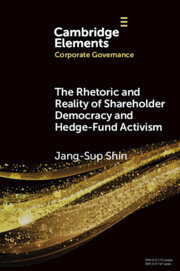
This Element investigates the historical and systemic roots of hedge-fund activism. It argues that the spirit of the New Deal financial regulations was subverted in the 1980s and 1990s in the name of shareholder democracy and opened the door for the rise of hedge-fund activism. It analyzes the effects of regulatory reforms including the introduction of compulsory voting by institutional investors, proxy-voting rule changes that greatly facilitated aggregation of the proxy votes of institutional investors, and rules that allow hedge funds to draw effectively limitless alternative investments from institutional investors. This Element also evaluates the recent empirical research on hedge-fund activism and explains why shareholder activism has gone awry. It argues that the regulatory changes created a large vacuum in the arena of corporate voting that hedge-fund activists can effectively exploit for their own profits. It concludes with policy proposals for rebuilding the proxy-voting and engagement system.
Recommend this
Email your librarian or administrator to recommend adding this to your organisation's collection.