To save content items to your account,
please confirm that you agree to abide by our usage policies.
If this is the first time you use this feature, you will be asked to authorise Cambridge Core to connect with your account.
Find out more about saving content to .
To save content items to your Kindle, first ensure no-reply@cambridge.org
is added to your Approved Personal Document E-mail List under your Personal Document Settings
on the Manage Your Content and Devices page of your Amazon account. Then enter the ‘name’ part
of your Kindle email address below.
Find out more about saving to your Kindle.
Note you can select to save to either the @free.kindle.com or @kindle.com variations.
‘@free.kindle.com’ emails are free but can only be saved to your device when it is connected to wi-fi.
‘@kindle.com’ emails can be delivered even when you are not connected to wi-fi, but note that service fees apply.
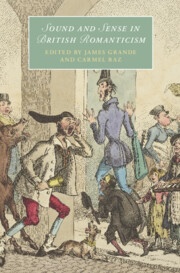
A radical re-imagining of the relationship between sound and sense took place in Britain in the decades around 1800. This new approach reconfigured sound as central to understandings of space and temporality, from the diurnal rhythms of everyday life in the modern city to the 'deep time' of the natural world. At the same time, sound emerged as a frequently disruptive phenomenon, a philosophical and political problem, and a force with the power to overwhelm listeners. This is the first book devoted to the topic and brings together scholars from literary studies, musicology, history and philosophy through the interdisciplinary frameworks of sound studies and the history of the senses. The chapters pursue a wide range of subjects, from 'national airs' to the London stage, and from experiments in sound to new musical and scientific instruments. Collectively, they demonstrate how a focus on sound can enrich our understanding of Romantic-era culture. This title is also available as Open Access on Cambridge Core.
Recommend this
Email your librarian or administrator to recommend adding this to your organisation's collection.