To save content items to your account,
please confirm that you agree to abide by our usage policies.
If this is the first time you use this feature, you will be asked to authorise Cambridge Core to connect with your account.
Find out more about saving content to .
To save content items to your Kindle, first ensure no-reply@cambridge.org
is added to your Approved Personal Document E-mail List under your Personal Document Settings
on the Manage Your Content and Devices page of your Amazon account. Then enter the ‘name’ part
of your Kindle email address below.
Find out more about saving to your Kindle.
Note you can select to save to either the @free.kindle.com or @kindle.com variations.
‘@free.kindle.com’ emails are free but can only be saved to your device when it is connected to wi-fi.
‘@kindle.com’ emails can be delivered even when you are not connected to wi-fi, but note that service fees apply.
Moving away from the grassroots version of events, this chapter explores the official colonial narratives created about the 1935 rebellions and the nature of British imperialism, arguing that the colonial government essentially operated as an extension of the sugar estates. Because of the entrenchment of racial stereotypes, the cross-racial cooperation fundamental to the rebellions seemed implausible to colony officials and was therefore rendered invisible. This chapter demonstrates the racial and ideological anxieties of colonialism itself and the global fractures within the British Empire during this period, where activists made connections between fascism and colonialism.
This article examines the transnational trajectories of two women activists of the International Workingmen’s Association (IWA), Mina Puccinelli (born Wilhelmine Müeller) and Elisabeth Dmitrieff (born Elizaveta Koucheleva), to explore how political mobility shaped women’s participation, organizational practices, and political agency within the internationalist movement. Of German and Russian origin, both moved across national and political spaces within the IWA, the Paris Commune, and wider revolutionary struggles. Dmitrieff became embedded in IWA structures: her involvement in the Russian section and the Geneva women’s section brought experience and contacts leading to official mandates to London and Paris, where she acted in connection with the General Council and helped organize the Union des Femmes during the Commune. Puccinelli moved fluidly between milieus, relying on personal contacts, public interventions, and her reputation as a revolutionary and military figure across Garibaldian, internationalist, republican, and revolutionary networks in Germany, Belgium, Switzerland, France, and Spain. The comparison shows that mobility was both a resource and a constraint: it enabled them to circulate information, contacts, and repertoires across settings, while making their authority dependent on unstable networks and exposing them to scrutiny over credibility, gender, and legitimacy. Situating them within the IWA, a decentralized plurality of sections and correspondence networks, the article presents two modalities of intervention: organizational mediation and personalized mobilization. Drawing on IWA archives, newspapers, police records, and correspondence, it addresses the uneven evidence, particularly for Puccinelli, and highlights the possibilities and limits of women’s engagement and the gendered construction of their authority and memory.
In 1867, Harriet Law (1831–1897) was the first woman to be elected to the General Council of the International Working Men’s Association. Until 1868, she was the General Council’s only woman. Law was already well known in Britain for her outspoken feminism and as a prominent activist within the organized Secularist or Freethought movement. She was also a socialist and supported Karl Marx against some of the more moderate members of the General Council. This article argues that, despite Marx’s impatience with organized Secularism, Harriet Law’s involvement in Freethought is crucial to understanding how she came to be an early feminist voice in the International. Secularism supported women leaders and speakers and fostered an unusually militant and unrespectable form of feminism at a time when the newly organized British women’s movement pursued a much more cautious public image. Law’s feminism combined support for women’s education and professional employment with advocating for the rights of women workers and a strong critique of the Christian institution of marriage. She saw feminism as going hand-in-hand with socialism and was an early campaigner for universal enfranchisement for both women and men. Her socialism was internationalist in its vision, and she also denounced British imperialism and antisemitism.
The post-1919 international order extended to China formal sovereign equality while offering few legal means to exercise it. The Sino-Belgian treaty dispute of 1926–29 reveals this: when China abrogated its 1865 treaty with Belgium and Brussels sued at the Permanent Court of International Justice, the institutions that promised peaceful revision could not deliver it without the consent of the powers whose privileges were at stake. The ‘unequal treaties’, a political category coined only in 1923, named the contradiction the order had built in. Four lawyer-diplomats—Wellington Koo, Wang Chung-hui, C.T. Wang, and Eugene Chen—were each caught between national autonomy and admission among the ‘civilised’ powers. The turn from legal argument to ‘revolutionary diplomacy’ was the structure’s doing, not a failure of nerve. Read beside Turkey, Persia, and the Latin American states, China’s case locates the obstacle: not semi-peripheral weakness as such, but the institutional position from which each engaged an order that subordinated its members through the very terms of their admission.
Seeds of Solidarity is a study of British Guiana amid a wave of Caribbean uprisings that brought modern politics to colonial spaces during the 1930s. It explores the historical power of a movement forged by people at the edges of empire during economic, political, and environmental crises. African- and Indian-Guianese youth, women, and men who worked on sugar plantations led a series of labor uprisings, despite attempts to turn these racialized communities against each other. Rather than erasing identities, their 'overlapping diasporas' signify how solidary can emerge without sameness, and how this process challenged the British Empire and reshaped Caribbean politics. This important work unites Caribbean history, African Diaspora and South Asian Diaspora studies, histories of racial capitalism and labor movements, gender studies, and the politics of colonialism and empire in the post-indenture period. It offers a model of resistance in today's era of deepening racial and economic inequality, fascism, and climate emergency.
The first part of this chapter’s title paraphrases the key sentence from a sermon in which a Presbyterian minister compared southern Protestants to the ancient Hebrews in their Babylonian exile, and in particular to Daniel, who kept his windows – and mind – open towards the Promised Land. Applied to minorities in interwar Ireland, it was both an exhortation and a statement: Irish Protestants and Jews looked beyond Ireland’s shores for their inspiration, like exiles groaning for a promised land. Inherently transnational groups such as Jews and Irish Protestants generated explicitly internationalist politics, accompanied by a rhetoric of social reform at home, often by means of ecumenical endeavour. While both internationalism and social reform were inspired by the then widespread revulsion against the First World War, for most people there was a persistent attachment to the British Empire and a desire to express it without provoking a republican backlash. The chapter’s last part examines minority internationalism as it engaged with the ultimate secular utopia of their day – the Soviet Union – or, rather, the way it was perceived and represented by admirers like Sean O’Casey and Rosamond Jacob.
For poets Ted Joans, Bob Kaufman, and Jayne Cortez, jazz indexes a series of paradoxes and contradictions beyond standard accounts of the music and, in turn, beyond standard accounts of jazz poetry. In Joans’s live collaboration with saxophonist Archie Shepp We Have Come Back, the multiple versions of Kaufman’s ‘War Memoir’, and Cortez’s ‘If the Drum Is a Woman’, jazz reveals contradictions of racial, gendered, and national belonging in the Black Arts Movement era. These poems do not simply imitate jazz rhythms, but conceive jazz as a social form, part of the raced, classed, and sexed negotiations of bohemian community. Jazz becomes a way of thinking about practices of listening, about the way that art and cultural practices encapsulate the values of overlapping communities, and about the way that such practices serve as contested terrain. Drawing both prosodic energy and symbolic strength from jazz, these are also poems about jazz, about the stakes of listening to, consuming, appropriating, and appreciating the music, and about its role in the complex politics of the eras of McCarthyism, decolonisation, and the renewed rise of Black art.
Throughout most of the twentieth century, a writer with the last name “Du Bois” helped articulate the shifting contours and geographies of Pan African and Black anti-imperialist literature. This chapter charts the evolving understanding of Black anti-imperialism within evolving geopolitical conjunctures in W.E.B. Du Bois’s, Dark Princess; Shirley Graham Du Bois’s journal articles, short biographies, and political speeches; and David Graham Du Bois’s novel …And Bid Him Sing. This Du Bois genealogy exemplifies the shifting terrain of Pan-African literature and the politics of Black anti-imperialism in the era of Three Worlds. The chapter tracks the awakening of Black anti-imperialism in the context of global 1930s, the Third World terrain of the 1950s, and the African American Third World left of the 1960s and beyond.
La historia contemporánea de la solidaridad internacionalista está compuesta por miles de trayectorias anónimas que estuvieron inmersas en las grandes trasformaciones globales del pasado siglo. La multiplicidad de sujetos, silencios y barreras socioculturales sostenidas a lo largo del tiempo ha dificultado el acercamiento interdisciplinar desde la historia oral al estudio de una realidad particularmente influyente en territorios como Cuba. El análisis histórico de cuarenta testimonios inéditos relacionados con la proyección externa del proceso revolucionario introduce nociones desconocidas en torno al impacto de un fenómeno que ha marcado a sucesivas generaciones de cubanos desde la década de los sesenta hasta la más inmediata actualidad. Las diversas perspectivas recogidas sobre las raíces, dimensiones y legados de la solidaridad internacionalista revelan un heterogéneo mosaico de experiencias subjetivas que trascienden las narrativas institucionales producidas alrededor de un horizonte todavía presente en los desafíos actuales de la sociedad cubana contemporánea.
Gaining resonance from 1918, pacifism joined socialist internationalism and Communists’ novel militancy. The League of Nations drew much of that sentiment, from refugees and humanitarian relief through public health and the ILO to nutritional science and development economics, claiming economic planning, scientific and technological transfer, and humanitarian cooperation for new networked expertise. Self-consciously “Europeanist” initiatives formed, including fascist ideas of a united European “great space” under Mussolini and Hitler. By 1936–1939, imperialist visions of a New Europe made population politics key to international revisionism, exchanging self-determination and minority protections for greater-national expansion and population removal. Brutally radicalized by the Nazis’ Kristallnacht (November 1938), antisemitism became a violent driver. In 1937–1941, anti-Jewish laws reversed earlier emancipation – from Poland and Romania, through Italy and Hungary, to Czecho-Slovakia, Croatia, and Vichy France. That was the ugly backcloth to Hitler’s drive for war. In September 1939, vitally enabled by Franco-British appeasement and the Nazi–Soviet Pact, Hitler invaded Poland.
What explains how the public views government responses to hostage crises? Existing research has explored how incident-level factors shape public opinion of hostage recovery, but we know less about which Americans support recovery – and why. In this article, we explore how individual-level factors shape public support for bringing captives home. We argue that support for hostage recovery reflects partisan, ideological, and emotional factors. Drawing on two large, national surveys of the American public, we show how Americans’ partisanship, broader foreign policy attitudes, and other personal traits predict willingness to support a range of hostage recovery activities, including negotiations, ransom payment, prisoner exchanges, and military rescue missions. We find that foreign policy internationalists are much more likely to support recovery compared to isolationists, though ‘militant’ and ‘cooperative’ internationalists prefer different recovery options. While broad, bipartisan majorities support recovery efforts, Republicans are significantly less supportive of making concessions to bring captive Americans home – partisan differences that are exacerbated when recovery is proposed by an out-party president. Finally, we show that respondents with children are more supportive of recovery than non-parents, a result we attribute to the emotional pleas made by captives’ parents. This paper explores the domestic politics of international threat, revealing the individual determinants of support for recovery.
This essay gathers the political, literary, and historical significance of India in the poems, memoirs, and articles of Pablo Neruda. It shows that the poet’s career in the subcontinent exceeded and rejected a mystifying Indophilia. Instead, the internationalist framework of Neruda’s two sojourns in India (1927–28 and 1950) corresponds to two major phases of his political thought: decolonization and the anti-imperialist peace movement. Neruda’s refusal of Indophilia brought him closer to Indian writers of English, Bengali, Urdu, Hindi, Malayalam, Tamil, and Kannada and to Indian visual artists. “The Grapes of History” (“Las uvas de la historia”), an image from his long poem on India from 1951, has fructified and fermented in the reflections and translations of Nerudiana among major writers (Ali Sardar Jafri, Shamsher Bahadur Singh, Kunwar Narain, and Arundhati Roy) and artists (Chittaprosad Bhattacharya and Vivan Sundaram) long after the poet’s passing, well into the twenty-first century.
The fin de siècle’s newly emerging scientific discourse of homosexuality was part and parcel of a broader tension between ‘materialists’ and ‘spiritualists.’ Whereas the former believed that human agency was fatally compromised by the determining influence of hardwired compulsions, the latter insisted on the existence of free will and man’s higher calling to resist basic impulses. For this reason, the notion of congenital homosexuality was an unacceptably radical one to the spiritualist faction of liberals and Catholics, which dominated among Belgian intellectuals and policymakers. Like those abroad, Belgian spiritualists associated the notion of inborn homosexuality with socialism in general and with the left-leaning French Third Republic in particular. This chapter zooms in on a series of international conferences to demonstrate how deeply interwoven the issue of homosexuality was with wider ideological tensions. It also shows why in Belgium the issue was sidelined so that its controversial nature would not stand in the way of penal reform.
The chapter develops a genealogy of the notion of moral autopsy that has become the major mode of knowing, judging, and relating to the socialist past in post-Cold War Eastern Europe and beyond, particularly in the context of transitional justice. The chapter traces moral autopsy’s historical and conceptual sources within the post-Cold War context, marked by the proclamations of the “end of history,” celebrations of the rule of law and human rights, conservative historical revisionism and criminalization of communism, the “moral turn,” competitive memory politics based on national victimhood, and neoliberal globalization. Through a detailed analysis of the Polish Institute of National Remembrance and the posthumous media lustration of the Polish journalist Ryszard Kapuscinski, especially the questions of secrecy, truth, and treachery raised about him, the chapter shows how moral autopsy constructs a transhistorical, judicialized, and criminalized account of communism that ultimately impoverishes the understanding of social-historical relations of power, informational practices, ideology, and political subjectivity concerning state socialism and Cold War socialist internationalism.
This chapter examines how Bloomsbury and music intersected at the figure of Edward J. Dent, the Cambridge music scholar. It offers Dent as an embodiment of which Bloomsbury and early twentieth-century musical culture in England and Europe were mutually constitutive, using him as a point for comparison to gauge Bloomsbury’s musical enthusiasm and sensibility. The chapter first surveys existing musical-literary criticism within studies of Virginia Woolf and E. M. Forster. It then explores the overlaps between Dent and Bloomsbury on issues including non-European musical cultures, sexuality, personal relationship, modernist aesthetics, music as a performing art, international politics, education, and state funding. Following a discussion of Dent’s involvement during and after the Second World War in John Maynard Keynes’ work on “national” opera, the chapter ends with Keynes by examining one of his letters to the BBC as an epitome of music’s protean role in Bloomsbury.
Chapter 1 offers a historical introduction as well as an overview of existing research in the field. It argues that by mapping out the trajectories of former volunteer soldiers, it is possible to see the many ways in which the Spanish Civil War and the broader anti-fascist engagement of the inter-war period could constitute a transformative experience and event; an event that expanded volunteers’ political horizons and gradually opened up possibilities for border-crossing political engagement in the post-war era. Thus, it sets the stage for the case studies constituting the main part of the book, showing that the political and military influence of the volunteers in Spain did not necessarily come to an end in 1938/1939 or even in 1945. In a few yet significant cases, it stretched across the globe far into the Cold War period.
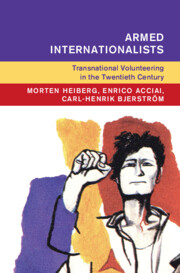
This unique transnational history explores the extraordinary lives of left-wing volunteers who fought in not just one, but multiple conflicts across the globe during the mid-twentieth century. Utilising previously unpublished archival material, Heiberg, Acciai and Bjerström follow these individual soldiers through military conflicts that were, in most cases, geographically centred on individual countries but nonetheless evinced a crucial transnational dimension. From the Spanish Civil war of 1936 to the Nicaraguan Revolution of 1979, the authors marshall these diverse case studies to create a conceptual framework through which to better understand the networks and recruitment patterns of transnational volunteering. They argue that the Spanish Civil War created a model for this transnational left-wing military volunteering and that this experience shaped the global left responses to a range of conflicts throughout the twentieth century.
The global political order that emerged from 1919 inscribed Jews into two distinct legal roles under the League of Nations system: a model national minority in the new nation-states of Eastern Europe, and a virtual national majority in British Mandatory Palestine. Despite extensive scholarship on each of these stories, we know precious little about how they interacted in the interwar Jewish political imagination. In this article I track several key East European Zionist intellectuals through the period between World War I and the aftermath of World War II as they attempted to imagine a new geometry of transnational nationhood via international law. This account of their pursuit of national self-determination beyond sovereignty reveals the promise and limits of interwar Jewish worldmaking and provides an index of the changing meaning of nationhood itself in the interwar period.
This chapter examines the crucial seven-year period between Stimson’s resignation as secretary of state in March 1933 and his return to the War Department in June 1940. Although Stimson did not anticipate he would ever return to Washington to serve in the federal government, some of his most important public service occurred when he was a private citizen in this period. Particularly, this chapter advances two critical arguments. The first is that Stimson had both a much wider definition of national security than most of his contemporaries did and came to those conclusions before nearly any other American leader or opinion maker. The second argument is that attempting to neatly define Stimson’s internationalism is difficult. Stimson borrowed ideas from the legalistic, moralistic, and New Deal-style categories of internationalism and repackaged them into his own fusion that called for US leadership to manage the world.
How can an icon of romantic Ukrainian nationalism be refashioned into a tool for building Soviet internationalism? This article tells the story of the bandura—the musical instrument constructed in the nineteenth century as an icon of romantic Ukrainian nationalism—and its fraught integration into the culture of Young Pioneers in early Soviet Ukraine. Focused on the shift in cultural policy from Leninist korenizastiia to Stalinist socialist realism, this article examines how the emancipatory and universalizing claims of Soviet internationalism became premised on Russified culture that inhibited the possibility of non-Russians’ full assimilation into the project of Soviet revolution. In the hands of Young Pioneers, who were appointed as Soviet “revolutionary agents” and as targets of the state’s pastoral care (“Stalin’s flowers”), the bandura became a particularly vexed symbol, epitomizing the irreconcilable tensions and the apparently inevitable violence inherent to nationalities policies in Soviet Ukraine. Following the intergenerational saga of a family of bandurists, the article shows how the disciplining technologies of Soviet musical-political education yielded often unexpected results.