To save content items to your account,
please confirm that you agree to abide by our usage policies.
If this is the first time you use this feature, you will be asked to authorise Cambridge Core to connect with your account.
Find out more about saving content to .
To save content items to your Kindle, first ensure no-reply@cambridge.org
is added to your Approved Personal Document E-mail List under your Personal Document Settings
on the Manage Your Content and Devices page of your Amazon account. Then enter the ‘name’ part
of your Kindle email address below.
Find out more about saving to your Kindle.
Note you can select to save to either the @free.kindle.com or @kindle.com variations.
‘@free.kindle.com’ emails are free but can only be saved to your device when it is connected to wi-fi.
‘@kindle.com’ emails can be delivered even when you are not connected to wi-fi, but note that service fees apply.
Between the First and Second World Wars, many thousands of working-class and avant-garde theatre-makers created and performed in agitprop – a topical, accessible, and highly physical genre that aims to inform and persuade audiences. Although agitprop has Russian revolutionary origins, it proved so flexible and transmissible that well-known troupes like Moscow’s Blue Blouse and Berlin’s Red Megaphone stimulated waves of performances, adaptations, and original work in other cities and countries, including the UK, US, Japan, and Mexico. Epic theatre, as developed by Erwin Piscator, Bertolt Brecht, and their co-workers during the interwar and early post-war years, shared agitprop’s pedagogical priorities and many of its elements, including loose, episodic structures and anti-mimetic acting styles. This essay follows Piscator and Brecht themselves by emphasising the formal and historical connections between agitprop and epic theatre, refusing to consign the former to the category of juvenilia.
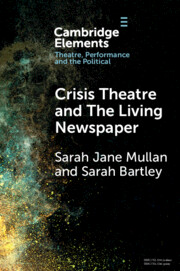
Crisis Theatre and The Living Newspapers traces a history of the living newspaper as a theatre of crisis from Soviet Russia (1910s), through the Federal Theatre Project of the Great Depression in America (1930s), to Augusto Boal's teatro jornal in Brazil (1970s), and its resonance with documentary forms deployed in the final years of apartheid in South Africa (1990s), up until the present day in the UK (2020s). Across this Element, the author is interested in what a transnational and transhistorical examination of the living newspaper through the lens of crisis reveals about the ways in which theatre can intervene in our collective social, economic and political life. By holding these diverse examples together, the author asserts the Living Newspaper as a form of Crisis Theatre.
Recommend this
Email your librarian or administrator to recommend adding this to your organisation's collection.