Refine search
Actions for selected content:
1 results
A refined lower bound theorem for $d$
 -polytopes with at most $2d$
 vertices
- Part of
-
- Journal:
- Canadian Journal of Mathematics , First View
- Published online by Cambridge University Press:
- 01 June 2026, pp. 1-25
-
- Article
-
- You have access
- Open access
- HTML
- Export citation
-
In 1967, Grünbaum conjectured that the function
$$ \begin{align*}\phi_k(d+s,d):=\binom{d+1}{k+1}+\binom{d}{k+1}-\binom{d+1-s}{k+1},\; \text{for } 2\leqslant s\leqslant d \end{align*} $$
provides the minimum number of $k$
 -faces for a $d$
 -dimensional polytope (abbreviated as a $d$
 -polytope) with $d+s$
 vertices. In 2021, Xue proved this conjecture for each $k\in [1, d-2]$
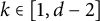 and characterized the unique minimizers, each having $d+2$
 facets. In this article, we refine Xue’s theorem by considering $d$
 -polytopes with $d+s$
 vertices ($2\leqslant s\leqslant d$
 ) and at least $d+3$
 facets. If $s=2$
 , then there is precisely one minimizer for many values of $k$
 . For other values of $s$
 , the number of $k$
 -faces is at least $\phi _k(d+s,d)+\binom {d-1}{k}-\binom {d+1-s}{k}$
 , which is met by precisely two polytopes in many cases, and up to five polytopes for certain values of $s$
 and $k$
 . We also characterize the minimizing polytopes.


