To save content items to your account,
please confirm that you agree to abide by our usage policies.
If this is the first time you use this feature, you will be asked to authorise Cambridge Core to connect with your account.
Find out more about saving content to .
To save content items to your Kindle, first ensure no-reply@cambridge.org
is added to your Approved Personal Document E-mail List under your Personal Document Settings
on the Manage Your Content and Devices page of your Amazon account. Then enter the ‘name’ part
of your Kindle email address below.
Find out more about saving to your Kindle.
Note you can select to save to either the @free.kindle.com or @kindle.com variations.
‘@free.kindle.com’ emails are free but can only be saved to your device when it is connected to wi-fi.
‘@kindle.com’ emails can be delivered even when you are not connected to wi-fi, but note that service fees apply.
Chapter 1 explores modern adaptations of the medieval passion play, analyzing dramas by Sadakichi Hartmann, W. B. Yeats, Djuna Barnes, and Sophie Treadwell that return to narratives of the Christian Passion in order to summon theater’s own artistic resurrections. These profane works were composed in the conceptual penumbra of Friedrich Nietzsche’s iconic The Anti-Christ. Although they seem to announce a radical departure from medieval sources imagined to have a purely devotional function, they actually follow the medieval passion play in sliding between profanation and consecration. Such dramatic experiments pry open the layered temporalities of the passion play as they generate halting improvisations toward a new theatrical future, developing an orientation to the past that is at once resistive and recursive. The figure of Christ’s body in the genre of the passion play thus brings into view modern drama’s rites of renewal, anxiously heralding a new theater waiting to be born.
This Element explores how medieval devotional and disciplinary practices acted as 'immersive technologies' for producing presence and configuring emotions. Through the comparative analysis of Aelred of Rievaulx's De Institutione Inclusarum and the Ordo ad Faciendum Disciplinam of the lay confraternity of Santo Stefano in Assisi, it investigates how the devout subject projected themselves into an imaginal, affective space, where memory, posture, and sensory experience converged to enable a participatory encounter with the divine. Drawing on the concept of the 'avatar' as a psychosomatic projection of the self within visionary and ritual practices, the Element traces how the 'theatre of the mind' redefined the relationship between interior vision, exterior action, and affective identity. By examining the dramaturgies of presence articulated within these memorial plays, this Element sheds light on the role of sensory discipline and emotional posture in shaping embodied devotional experience in the Latin Middle Ages.
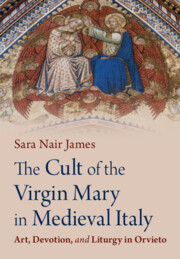
Late medieval Italy witnessed the widespread rise of the cult of the Virgin, as reflected in the profusion of paintings, sculptures, and fresco cycles created in her honor during this period. The cathedral of papal Orvieto especially reflects the strong Marian tradition through its fresco and stained-glass window narrative cycles. In this study, Sara James explores its complex narrative programs. She demonstrates how a papal plan for the cathedral to emulate the basilica of S. Maria Maggiore in Rome, together with Dominican and Franciscan texts, determined the choices and arrangement of scenes. The result is a tour de force of Marian devotion, superior artistry, and compelling story-telling. James also shows how the narratives promoted agendas tied to the city's history and principal religious feasts. Not only are these works more interesting, sophisticated, and theologically rich than previously realized, but, as James argues, each represents the acme in their respective media of their generation in central Italy.
The Ordo virtutum (the Order of the Virtues) is a sung Latin drama that Hildegard of Bingen completed c. 1152 for her newly founded community at Rupertsberg. The drama has invited a multitude of modern responses due to the originality of its language and imagery and the many possible comparisons to her own visionary and theological writing. Yet this work is firmly grounded in the theology and liturgy of the twelfth-century Benedictine convent. This chapter examines how Hildegard draws on the Benedictine rule, the rite of the Consecration of Virgins from twelfth-century Mainz, and the processional and dramatic rituals of the medieval convent to create an embodied drama of the soul’s salvation that is specific to the female monastic experience. Hildegard further emplots the struggle for the soul’s salvation in a narrative which borrows elements from the Descensus Christi ad Infernos, a fourth-century addition to the apocryphal Gospel of Nicodemus and the liturgical commemorations of its central event: Christ’s descent into, or harrowing, of hell. These texts and liturgies provide important context for understanding the dramatic situation and poetic language of the Ordo virtutum.
‘Giving history a voice’ explores the process of designing sound installations for heritage sites. It discusses the role of technology in communicating intangible cultural heritage by focusing on a case study based on research on the acoustics linked to the medieval drama cycle known as the York Mystery Plays.
Recommend this
Email your librarian or administrator to recommend adding this to your organisation's collection.