To save content items to your account,
please confirm that you agree to abide by our usage policies.
If this is the first time you use this feature, you will be asked to authorise Cambridge Core to connect with your account.
Find out more about saving content to .
To save content items to your Kindle, first ensure no-reply@cambridge.org
is added to your Approved Personal Document E-mail List under your Personal Document Settings
on the Manage Your Content and Devices page of your Amazon account. Then enter the ‘name’ part
of your Kindle email address below.
Find out more about saving to your Kindle.
Note you can select to save to either the @free.kindle.com or @kindle.com variations.
‘@free.kindle.com’ emails are free but can only be saved to your device when it is connected to wi-fi.
‘@kindle.com’ emails can be delivered even when you are not connected to wi-fi, but note that service fees apply.
This chapter examines the threefold passionate literary friendship between Anaïs Nin, Henry Miller, and Lawrence Durrell as it forged and evolved via letter-exchanges over the years. It traces the thoughts, desires, and fears that preoccupied the “three musketeers,” providing a glimpse into the intellectual and emotional interconnections that grew between these three twentieth-century pioneering authors. To do so, this chapter focuses on the intrinsically dialogical, relational, and collaborative nature of epistolarity, suggesting it permeates their compositional practice of fashioning themselves through writing. This reading of the edited collections The Durrell–Miller Letters, 1935–1980 (1988), A Literate Passion: Letters of Anaïs Nin & Henry Miller 1932–1953 (1989), and Letters to Lawrence Durrell 1937–1977 (2020) suggests that the three friends navigated through love, creativity, intellectual growth, and personal freedom in a co-constructed three-way epistolary conversation in which letters to, from, and about had an impact on each other’s lives and work.
This chapter considers the role of periodicals, little magazines and literary clubs in fostering communities of Australian poets in the late nineteenth and early twentieth centuries. It discusses the importance of such communities in encouraging debate, circulating new poetries and encouraging generative connections between poets. The chapter discusses periodicals such as The Bulletin as a hub for what came to be known as the Bush School of poetry, and Vision that became an instrument for the poetics of the Lindsay circle. Yet it also discusses other little magazines such as The Heart of the Rose, The Triad and Stream. It considers the proliferation of literary clubs, which began as bastions of male homosociality but also began to include women writers or were for women only. It also discusses how periodicals and little magazines drew attention to and encouraged experimentation with new forms and concepts such as Symbolism and Vitalism. The chapter also includes the significance of literary magazines, some of which were supported by or emerged out of universities.
This chapter considers the increased opportunities for women writers to travel and relocate in the early to mid twentieth century. It analyses the possible impact that living in Australia could have on their writing but also how increased mobility generated a sense of independence that led to an experimentation with form. It would also embolden some to protest against social injustice, as well as enable more unconventional life paths. The chapter also considers how these writers navigated a sense of displacement and liminality in their writing. Lastly, it demonstrates how national categories were delimiting for these writers’ careers and had a negative effect on the later reception of their work.
This chapter discusses literary representations of the ‘peripheral’ city, highlighting depictions of the urban landscape as dreamlike and anachronistic in modernist and proto-modernist texts. From Dostoevsky to Machado, Kafka to Joyce, the clash between imperial and Westernising discourses, on the one hand, and the perceived incompleteness of urban modernity at the periphery of Western Europe, on the other, played a key role in the critical and experimental urban aesthetics that emerged from the late nineteenth century. Chronicling literary responses to the complex modernity on display at the margins of European culture, the chapter builds towards a theory of modernism at the urban semi-periphery – or metrocolonial modernism.
During the late colonial period, as successive waves of decolonisation swept regions from Ireland in the 1910s to the Pacific islands in the 1970s, a number of writers took inspiration from the cultures of colonial port cities, where they reflected critically on the ideals inscribed into their architectural landscapes. This introductory chapter outlines the historical connections between colonial urbanism and modernist fiction, introducing key theoretical ideas and outlining the comparative method.
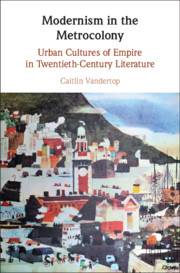
While literary modernism is often associated with Euro-American metropolises such as London, Paris or New York, this book considers the place of the colonial city in modernist fiction. From the streets of Dublin to the shop-houses of Singapore, and from the botanical gardens of Bombay to the suburbs of Suva, the monumental landscapes of British colonial cities aimed to reinforce empire's universalising claims, yet these spaces also contradicted and resisted the impositions of an idealised English culture. Inspired by the uneven landscapes of the urban British empire, a group of twentieth-century writers transformed the visual incongruities and anachronisms on display in the city streets into sources of critique and formal innovation. Showing how these writers responded to empire's metrocolonial complexities and built legacies, Modernism in the Metrocolony traces an alternative, peripheral history of the modernist city.
Recommend this
Email your librarian or administrator to recommend adding this to your organisation's collection.