To save content items to your account,
please confirm that you agree to abide by our usage policies.
If this is the first time you use this feature, you will be asked to authorise Cambridge Core to connect with your account.
Find out more about saving content to .
To save content items to your Kindle, first ensure no-reply@cambridge.org
is added to your Approved Personal Document E-mail List under your Personal Document Settings
on the Manage Your Content and Devices page of your Amazon account. Then enter the ‘name’ part
of your Kindle email address below.
Find out more about saving to your Kindle.
Note you can select to save to either the @free.kindle.com or @kindle.com variations.
‘@free.kindle.com’ emails are free but can only be saved to your device when it is connected to wi-fi.
‘@kindle.com’ emails can be delivered even when you are not connected to wi-fi, but note that service fees apply.
This chapter examines how musical practices illuminate the development and interaction of three major right wing movements in Austria between 1900 and 1938: Austrian National Socialism, the Heimwehr, and the Austrofascist Vaterländische Front. Although differing in ideology and organisation, all three used music to articulate identity, mobilise supporters and assert cultural authority. Austrian National Socialism relied on patriotic songs, rallies and the Kampfbund für deutsche Kultur to spread völkisch ideas and court the middle classes, even during periods of prohibition. The Heimwehr, a loose federation of provincial militias, deployed marches, field masses and veterans’ laments to express provincial patriotism, Catholic tradition and anti-socialist sentiment. The Vaterländische Front attempted to synthesise these elements into a state-directed cultural programme through mass ceremonies, new patriotic repertoire and cultural agencies. While ultimately fragile, these musical strategies reveal how competing authoritarian movements contested the meaning of “Austrian” and “German” identity in a turbulent interwar landscape.
This chapter examines how music functioned as propaganda in fascist Italy and Nazi Germany and follows Jacques Ellul in locating propaganda’s power less in overt political messaging than in an ability to integrate and mobilize populations within a developing mass culture. Under Italian fascism, musical attempts to channel collective emotion incorporated all genres, from patriotic marches like E.A. Mario’s Noi tireremo diritto to works of modernist high culture, such as Luigi Dallapiccola’s Musica per tre pianoforti. Yet the cultural sphere of Italian fascism was neither fully controlled nor stylistically uniform. Elite composers such as Dallapiccola maintained aesthetic distance from the regime’s anthems, reflecting ongoing class divides beneath fascism’s rhetoric of unity. Mass culture—radio, cinema and light music—operated semi-independently from the regime, drawing heavily on American idioms. Fascist Italy’s most effective agitational propaganda arose from popular songs like Faccetta nera, whose eroticized colonial fantasy captivated the public more successfully than officially commissioned music. Nazi Germany similarly relied on technologically mediated musical consumption, emphasising integration over explicit mobilization. While Nazi youth sang aggressively ideological songs, high art music rarely embodied explicit National Socialist themes. The chapter concludes, by way of contrast, with the identification of a specifically fascist musical form in Italian works, whose grand, slow codas—notably that of Bàrbara Giuranna’s X. Legio—modelled the regime’s philosophy of collective, self grounding historical power.
Following its formation in 1935, the Nazi German think-tank, the Ahnenerbe, launched numerous archaeological investigations, including two expeditions to create detailed casts of Swedish rock art. Previous scholarship has emphasised the pseudoscientific claims made by Ahnenerbe scholars and the racist motivations behind the fieldwork, yet the casts and other documentation from these early expeditions have not been analysed in detail. This article delves into the archives, examining how the casts were produced and interpreted and tackling the question of why it was necessary to make exact copies of rock-art images when the past was already being falsified for political means.
This Element explores the transnational dynamics of Italian fascism and its reception in the Nordic countries from the foundation of Mussolini's Fasci di Combattimento (Combat Fasces) in 1919 to the onset of the Second World War. Although Italian fascism found fertile ground among far right movements and organisations in the Nordics, reactions varied significantly across Denmark, Norway, Sweden, and Finland. The Element emphasises the ideological influence of the March on Rome and highlights how the Nordic far right drew inspiration from Mussolini's regime while also adapting to local contexts. By examining the intricate connections between Nordic and Italian fascisms, this Element aims to provide a nuanced understanding of the complexities of fascism's international appeal, illustrating how local political situations shaped the diverse expressions of fascism in the region and the interplay between fascist ideologies and anti-Bolshevism.
This article examines the negotiation of ethnopolitical categories in wartime Nazi Germany by analyzing Gestapo investigations into accusations of “friendliness to Poland” against German citizens of Polish descent in the industrial Ruhr conurbation. By relying heavily on denunciations and informing, the Gestapo incentivized ordinary Germans in the Ruhr to identify perceived “dangerous outsiders” to the Volksgemeinschaft. Some therefore relied on longstanding anti-Polish tropes to frame accusations in the racial categories of the Nazi state. But while many such accusations alerted the Gestapo’s attention, they frequently masked a pursuit of personal issues and presented officers with significant investigatory difficulties. Unlike the generally brutal treatment of ethnolinguistic minorities in Nazi Germany, Gestapo officers often did not simply employ blanket repression in these cases. They frequently considered accused individuals’ socioeconomic productivity and “commitment” to Germany, characteristics that defendants stressed, thus highlighting the often contingent, unstable process of ethnic boundary formation in Nazi Germany.
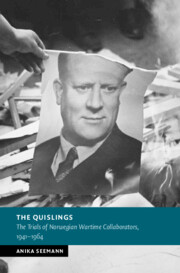
The Norwegian 'treason trials' were the most extensive post–Second World War 'reckoning' with wartime collaboration in all of Europe. Following the war, tens of thousands of Norwegians were sentenced for their wartime actions, including the notorious leader of Norway's collaborationist party Nasjonal Samling, Vidkun Quisling. And yet many wartime actions also went unpunished, including, in the vast majority of cases, violence perpetrated against Norway's Jewish minority. The Quislings examines how the Norwegian authorities planned, implemented and interpreted this reckoning between 1941 and 1964. In doing so, it looks at the broader political purposes the treason trials served, how these changed over time and the mechanisms that brought these changes about. This wide-ranging study argues that the trials were not driven by the agenda of any one institution or group. Instead, their final shape was the result of a complex process of weighing up demands for legal form and consistency against a fast-changing political and social environment.
This chapter addresses the nexus between racism and return migration in the early 1980s, which marked the peak of anti-Turkish racism. As the call “Turks out!” (Türken raus!) grew louder, policymakers debated passing a law that would, in critics’ view, “kick out” the Turks and violate their human rights. During this “racial reckoning,” West Germans, Turkish migrants, and observers in Turkey grappled with the nature of racism itself. Although West Germans silenced the language of “race” (Rasse) and “racism” (Rassismus) after Hitler, there was an explosion of public discourse about those terms. Ordinary Germans, moreover, wrote to their president expressing their concerns about migration, revealing both biological and cultural racism. The simultaneous rise in Holocaust memory culture (Erinnerungskultur) is crucial for understanding this racial reckoning. While many Germans warned against the mistreatment of Turks as an unseemly continuity to Nazism, the emphasis on the singularity of the Holocaust offered Germans a way to dismiss anti-Turkish sentiment. Turkish migrants fought against this structural and everyday racism with various methods of activism. Turks at home, including the government and media following the 1980 military coup, viewed these debates with self-interest, lambasting German racism in the context of the 1983 remigration law.
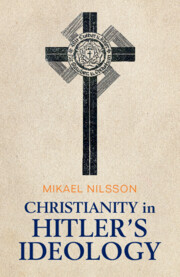
How did Hitler's personal religious beliefs help to shape the development of National Socialism? Through close analysis of primary sources, Mikael Nilsson argues that Hitler's admiration of Jesus was central in both his public and private life, playing a key role throughout his entire political career. Christianity in Hitler's Ideology reexamines the roots of National Socialism, exploring how antisemitic forms of Christian nationalism de-Judaized Jesus and rendered him as an Aryan. In turn, the study analyses how Hitler's religious and ideological teachers such as Völkisch-Christian writers Houston Stewart Chamberlain and Dietrich Eckart weaponised these ideas. Nilsson challenges the established understanding that Hitler only used religion as a tool of propaganda. Instead, it is argued that religious faith and deeply held convictions were at the core of National Socialism, its racism, the Second World War, and the Holocaust.
Here, I deal with the issue of Hitler’s belief in Jesus’ divinity and show that, in contrast to what modern scholarship has thus far claimed about this question, Hitler did indeed refer to Jesus as divine on many occasions throughout his life. He even spoke of Jesus as the Son of God. I argue that Hitler’s views cannot be explained away by claiming that his words were simply clever propaganda intended to draw Christians into the NSDAP. The particularities of Hitler’s religious views and his interpretation of Jesus were simply too odd for them to act effectively as a propaganda tool designed to gain the sympathies of mainstream Christians. This chapter builds on an article that was published in the Journal of Religious History in June 2021.
The conclusion that Hitler was genuinely inspired by Jesus in his antisemitic struggle against the Jews thus cannot be avoided. Hitler viewed Jesus as the original Aryan warrior who had begun an apocalyptic battle against the Jews, but who had been killed before he had had a chance to finish the job. Historians must start taking Hitler’s (and the other leading Nazis’) religious beliefs seriously if we wish to fully understand how Hitler and his followers could be so morally convinced that what they were doing was the right thing – indeed, the “good” thing – to do. It adds significantly to our understanding not only of how Hitler could sway so many Germans to do what he wanted, but also of how the Nazis’ ultimate crime – the Holocaust – was possible to undertake in one of Europe’s most “civilized” and culturally and economically developed nations. Hitler thought he was following in the footsteps of Jesus – an alleged Aryan warrior who had dedicated his life to fighting the Jews – and that the National Socialists had a duty to finish what he was convinced Jesus had started: the eradication of theof the Jewish people from the face of the earth.
In this chapter, I cover the religious and ideological background development of how the character of Jesus came to be remade a Jew into an Aryan. I show the complicity of many leading Christian theologians in this development through their willingness to adapt to racist ideas and to integrate these into the Christian faith, thereby laying the foundation for what became National Socialist Christianity, most clearly embodied in the form of the splinter group in the German Protestant church known as German Christians (Deutsche Christen). This chapter is crucial in order for the reader to be able to understand how Hitler’s interpretation of Jesus could ever have come about and been accepted. It was not Hitler who created the idea of Jesus as an Aryan warrior attacking the Jews; Hitler only integrated an already existing and established idea into his own worldview.
In the last empirical chapter, I show the many ways in which Hitler’s belief in Jesus as an Aryan warrior turned Jesus into a moral/ethical, religious, and ideological role model for the Nazis. Hitler’s selective interpretation of Jesus’ life and mission meant that the latter was seen as an Aryan hero and combatant against the Jews. The story of how Jesus had cleared the Temple grounds of moneylenders was one of Hitler’s favorite images and one that he constantly brought up as an example for every Nazi to follow. The National Socialists were considered to be the true heirs and followers of Christ; but while the Jews had prevented Jesus from fulfilling his divine mission by killing him, the Nazis would indeed succeed in destroying the Jews and thus completing Jesus’ divine mission on earth. The chapter stresses the important point that Hitler believed his genocidal war on the Jewish people to be a mission sanctioned and proscribed by God.
Why is yet another book about Hitler necessary? Has not Hitler, the Third Reich, and National Socialism already been sufficiently mapped and described so that another book about these historical phenomena cannot but be superfluous? Judging by the constant stream of new books on the topic every year, the obvious answer is “no.” There does not seem to be a limit for the number of books that can be produced and consumed. The market appears to be insatiable. Granted, not every book written has been either necessary, or helpful when it comes to increasing our understanding of this part of our common history. Nonetheless, there may be a more interesting question to be answered here, namely: Are there aspects of this topic that have not yet been given quite the attention in the literature that they deserve? The answer to this question is an equally obvious “yes.” There are many issues and aspects of National Socialism that are in need of further research. Among them is the topic of this book: Hitler’s and National Socialism’s relationship to the central figure of Christianity – Jesus Christ.
In Mein Kampf, Hitler presented his Damascus Road experience, and in doing so he put himself on a par with the real founder of Christianity, Paul of Tarsus. Both narratives include a period of temporary blindness, a highly symbolic theme in the Christian tradition. Both stories contain a conversation with some divine entity. In Paul’s case, God speaks to him from the outside in the form of a vision. In Hitler’s case, God, in the form of Hitler’s own conscience, thunders his commands from the inside. In Mein Kampf, it is not explicitly said that this was a vision per se, but newspaper reports from 1923 stated exactly that. It is very likely that these reports were based on interviews with Hitler himself or someone close to him and therefore represented the view that Hitler wished to give of himself. This obviously served as a propaganda tool as well. Both in the case of Paul and in the case of Hitler, these voices are said to have urged them to let go of the past and present, and instead focus their energy on the future.
This chapter deals with the two main sources of inspiration for Hitler’s religiosity, namely Houston Stewart Chamberlain and Dietrich Eckart. The latter was the man who acted as his ideological and religious teacher and father figure during the early 1920s, the self-proclaimed Catholic Dietrich Eckart. I argue that it was Eckart who was largely responsible for having introduced Hitler to the religious views that he came to have and express for the rest of his life. I focus on the fictive dialogue between Hitler and Eckart as laid out in Eckart’s book Der Bolschewismus von Moses bis Lenin (Bolshevism from Moses to Lenin) from 1923, which presents the National Socialist idea of Jesus in great detail. I argue that the reason why Eckart knew Hitler’s religious beliefs, including his views of Jesus, so well was that he in fact was the source of these beliefs. Furthermore, Houston Stewart Chamberlain’s ideas about the Aryan Jesus gave Hitler the foundation for his belief in Jesus as a viscious antisemite who became the role model for himself personally and for the National Socialist movement as a whole.
This article details the influence of Russian psychologist Sergei Chakhotin on the propaganda of the Iron Front, an antifascist organization that resisted the rise of the Nazis in the dying days of the Weimar Republic. Notably the creator of the Three Arrows symbol, Chakhotin espoused theories and methods that used Ivan Pavlov's notion of the conditioned reflex and Fredrick Taylor's theory of scientific management to transform socialist propaganda to better combat the rise of fascism. By scrutinizing Social Democratic Party of Germany (SPD) periodicals and Iron Front propaganda, I argue that Chakhotin's ideas played a crucial role in catalyzing changes in the form and content of street campaigning throughout 1932. Chakhotin provided a scientific lens through which his allies in the SPD could view and understand the mass appeal of the Nazis, as well as the necessary changes in party tactics that were required in the age of mass media, popular spectacle, and emotional struggle.
This chapter seeks to illustrate from the bottom up the role that social justice played in establishing and maintaining authoritarian rule in Czechoslovakia under National Socialism and state socialism. The author investigates how notions of social justice were included in the social practice of both regimes and how the working population responded to these policies. By analysing legal disputes, this chapter explores the critical space between rulers and ruled to assess when and how notions of social justice were articulated in Czechoslovakia. In their opposition to the ‘injustices’ of past governments, such as those wrought by social inequality and economic suffering, both National Socialists and Communists drew on a language of social justice to articulate their own visions of a new order. However, their respective notions of social justice differed radically: from social justice defined in racial terms, typical for New Order movements, to social justice delimited by social class and attained for all members of the ‘socialist working society’. The main difference that emerged from the transition from the Nazi to the post-war Communist regime was a shift from the language of individual rights to a language related to the collective, to society, and to the state.
The history of political economy is tormented by beasts. The most famous is the Leviathan, the giant serpentine monster that figures in Hobbes’s masterpiece of modern political theory. Robert Fredona and Sophus Reinert spotlight another sea monster, the Kraken, that giant octopus or squid with a particular morphology (i.e., its tentacles) that so fittingly describes the grip of multinational corporations, stateless financial capital, social media, and tech giants today. But there are still other monsters in the bestiary of political economy. In this essay, I highlight the Behemoth, a land monster that captures another critical dimension of political economy: the willful and intentional deployment of chaos and disorder as a way of governing. Franz Neumann, political and legal theorist and lawyer, Columbia University professor, and member of the Frankfurt School in exile, placed the Behemoth at the heart—and in the title—of his analysis of Germany’s political economy under the Nazi regime. Alongside the Leviathan surveillance state and the many tentacular grips of multinational, social media, and tech Krakens, the Behemoth remains a key model to better understand current forms of capitalism.
The Wehrmacht's stunning victories in the first three years of the Second World War produced a euphoric response among Nazi leaders. Suddenly, the East became a vast expanse of nearly limitless possibilities, and creating a new racial order topped the list. Although most historians have focused on the Volksdeutsche, the regime also planned to settle veterans after the war's conclusion to serve as model Germans, farmers, and a “living wall” to defend the East. As the war dragged on into 1942 and these men continued to fight, the regime turned to disabled veterans to garrison the East. The SS designed a racial selection process that proved too restrictive to generate enough applicants and, during 1943 and 1944, settlement officials revised standards. In the process, contingency, constrained practices, and contested ideology all cast the boundaries of race, gender, sexuality, able-bodiedness, and disability as much more malleable than Nazi propaganda projected.
The difference between the representation of German femininity in the 1920s and the 1930s is striking: while glamorous flappers with bob haircuts ruled the beginning of the interwar period, its end is characterized by serious and earnest—and often longhaired—young women. Rather than taking the obvious route of relating this change to the political changes in Germany, most importantly the rise of the Nazis, this article argues that the changing representation of interwar femininity in Germany was always embedded in a transnational, transatlantic process. The transformation of flappers into humble girls started well before the Nazis came to power and was fueled by a wide variety of voices, from communist to bourgeois actors.