To save content items to your account,
please confirm that you agree to abide by our usage policies.
If this is the first time you use this feature, you will be asked to authorise Cambridge Core to connect with your account.
Find out more about saving content to .
To save content items to your Kindle, first ensure no-reply@cambridge.org
is added to your Approved Personal Document E-mail List under your Personal Document Settings
on the Manage Your Content and Devices page of your Amazon account. Then enter the ‘name’ part
of your Kindle email address below.
Find out more about saving to your Kindle.
Note you can select to save to either the @free.kindle.com or @kindle.com variations.
‘@free.kindle.com’ emails are free but can only be saved to your device when it is connected to wi-fi.
‘@kindle.com’ emails can be delivered even when you are not connected to wi-fi, but note that service fees apply.
Theories of metaphor must account not only for embodied universals but also for systematic sociocultural variation. Although recent scholarship has highlighted the role of context in metaphor production, the extent to which intersecting macro-social variables shape metaphorical source-domain choice remains underexplored. This study therefore tests the hypothesis that metaphorical source-domain selection is systematically associated with group-level social identity by examining how NATIONHOOD is conceptualised in Nigerian presidential discourse and whether these choices correlate with ethnicity, region, and religion. Using CORNIPS, a 65-year diachronic corpus of Nigerian presidential speeches, and hierarchical log-linear analysis, the study finds that ethnicity emerges as the primary predictor of metaphorical choice. Specifically, leaders from the historically dominant Hausa-Fulani group show a marked preference for metaphors of personification and conflict (NATION AS PERSON, NATION AS WAR), while a minority-group leader favours metaphors of inclusion (NATION AS FAMILY). This suggests that these speakers draw on distinct cognitive models, notably NATION-AS-PERSON/ORGANISM-UNDER-THREAT and NATION-AS-KINSHIP to conceptually structure the nation. Although the findings are situated within specific historical and individual contexts, the study nevertheless shows that metaphorical cognition is meaningfully shaped not only by embodied experience but also by social identity, political history and cultural context.
The Introduction begins with a short paragraph of conventional views about the Declaration, drawn from legal and historical writings, and argues that everything in this paragraph is wrong. It argues that when we get the Declaration wrong, we get America wrong, and we need to get America right. It then provides an overview of the major themes of the book.
This groundbreaking volume shatters many longstanding myths about the Declaration of Independence. Although states-rights advocates have long claimed that the Declaration created thirteen independent nations, Carlton F. W. Larson shows that the Declaration announced the birth of a new nation: the United States of America, a nation governed by an unwritten constitution in which the states were confederated and subject to national authority from the very beginning. Larson counters libertarian claims that the Declaration views government as a necessary evil, demonstrating instead how it embraces constitutionalism, active government, and the rule of law as positive goods. Along the way, Larson debunks other myths, such as the notion that the Declaration is the parchment text enshrined in the National Archives and that it was authored by Thomas Jefferson. By exploring the true meaning of the Declaration of Independence, One Nation Under Law helps us better understand America itself.
This Introduction reviews the structuring significance of the Europe-wide constitution-making upheaval of the 1860s, whose consequences shaped Europe’s histories during the later nineteenth century. Unfolding beneath the impact of combined and uneven development, a new metropolitan modernity defined the possibilities for social, cultural, and political change across a series of major arenas: state-making and nationhood; capitalist industrialization and class formation; liberalism and the rise of socialism; societal change and conditions for democracy; empire, colonies, and global rivalries. Developments between the 1880s and 1914, in particular the gendered and racialized languages of people, personhood, and the mass, set the stage for the violent conflicts of the first half of the twentieth century.
I argue that Winthrop Pickard Bell’s 1915 prediction that Canada would develop into a nation was accurate by examining two Canadian public figures. First, I examine Bell’s analysis that a nation has its own culture. Second, I analyze Roméo Dallaire’s explanation that his actions in Rwanda were guided by his Canadian background. Third, I turn to Harold R. Johnson who argues that culture is story: we choose which stories to tell about ourselves. I conclude that there is a thread that runs through Bell, Dallaire, and Johnson, a cultural thread about nation, culture, and story.
The paper investigates processes and consequences of ‘philanthropic kinning’, that is the use of kinship and family idioms in constructing and maintaining personal relations between donors and recipients in philanthropy. Usual studies collapse the occurrence of kinship metaphors in philanthropy either as evidence of ‘prosociality’ (e.g. trust, care or love) or more frequently as evidence of ‘paternalism’ (power and domination of donors over recipients, and their objectification). This paper claims that introducing kinship and parenting studies into researching philanthropy would greatly refine our understanding of donor–recipient relations. In the framework of a qualitative case study of a philanthropic ‘godparenthood’ programme organised in Hungary supporting ethnic Hungarian communities in Romania, this paper looks at the roles, responsibilities and obligations various forms of philanthropic kinship offer for the participants; and relations of power unfolding in helping interactions. With such concerns, this paper complements earlier research on hybridisation of philanthropy, through its sectoral entanglements with kinship and family. Also, it contributes to research on inequalities in philanthropy, by showing how philanthropic kinning may recreate, modify or reshape donor–recipient power relations in diverse ways.
Using the library of eighteenth-century attorney and legal historian Frances Hargrave as a starting point, this chapter considers the place of law, property, and state formation in the causes and results of the American Revolution. Focusing on three related themes to the place of laws in independence – the influence and break from English legal culture, the pluralism of legal practice within North America, and the place of legal institutions in either maintaining or changing the status quo – this chapter considers how both different forms of property and the different individuals and communities involved with it played a central role in the creation of an independent United States. The governments that emerged from the Revolution each relied heavily on these varied legal threads.
Environmental problems have become increasingly evident in post-revolutionary Iran. As a result, the field of environment has come to be a focus of research studies and technical management in the country. The recent proliferation of scientific analyses of the so-called environment indicates that the schemes of modern science are developing to combat the problems therein. Research findings also suggest, however, that environmental discourses and practices are not entirely reducible only to the terms of the natural sciences; distinctively, differing ideas of “nature” are drawn on to conceptualize differing schemes of environmental activities. This article explores how the materiality of national symbols brings to light particular social histories that reflect on and unfold through environmental discourses and practices encountered in Tehran.
This article assesses the inner workings of Cuban diaspora statecraft behind the ‘La Nación y la Emigración’ Conference, post-Soviet era Cuba's first major outreach to the Cuban community abroad. In contrast to works observing how changing emigration demographics might have transformed Cuba, this study argues that the Cuban state purposefully tried to reshape the homeland–diaspora relationship through the design of its emigration strategies. Because the Cuban geopolitics of mobility had profound security, economic and ideological implications, the leadership discussed not just how to neutralise the counterrevolution abroad but how to address both the diaspora's needs and popular sentiment at home.
Post-cessation nationhood in South Sudan presented a paradoxical situation: a country united during struggle is fragmented after independence. Among the triggers for this scenario was the death of Dr John Garang de Mabior—the country’s founding father. This article is a multidisciplinary semiotic critique of Akuol de Mabior’s film, No Simple Way Home (2023), against the history of South Sudanese nationhood. Without claiming a political scientific analysis, the author proposes that South Sudan’s crisis of nationhood is symptomatic of a quest for a unifying icon. He theorizes the protagonist’s quintessence of motherhood as a semiotic gesture of her de jure iconicity of unified nationhood.
During Iran's 2022–2023 countrywide uprising, the intensity of popular protests in Kurdistan and Baluchistan drew attention to the question of national oppression. Some scholars then revisited a debate, originally articulated in Marxist circles, on whether Iran's culturally and politically oppressed communities, like Azeris, Kurds, Baluchis or Arabs, are ethnic or national minorities. This article approaches the debate within the frame of national oppression as a historical construction. It argues that in Iran, as in almost all modern nation-states, nationhood was established through the forcible creation of minoritized communities whose potential claims to nationhood, or an equal place in a politically democratic and culturally pluralist nation, have been denied.
This chapter considers how English dictionaries made sense of sexuality beyond modern English society. It begins with the early modern assumption that a nation’s character was commensurate with its language, and that the moderate nature of England’s language and culture entailed that any ‘excess’ found in either must be the result of foreign influence. The chapter examines how sodomy and buggery, along with the semantic field of pederasty, were positioned by etymological, general, and hard-word dictionaries as ethically and ethnically remote, vices practised in the Mediterranean by ancient heathens or modern heretics. These xenophobic associations remained in dictionaries into the nineteenth century. Conversely, lexicographers’ retellings of classical myths of same-sex love—male and female—reveal sites of tension between the moderns’ veneration of Greek and Roman literature and their rejection of its pagan sensuality. The life of Sappho in particular provoked sharp disagreements over what her moral character had been, and what could or should be said about it, in a range of dictionary genres: hard-word, general, classical, and biographical.
Gupta’s conviction indicates that Indian nationhood had earlier beginnings than has generally been supposed. The “Mutiny-Rebellion” of 1857, long regarded as a key transformative event, being hailed as the “first war of Indian independence” having “national” elements, was situated within a longer genealogy. This underscored the evolutionary process through which Indian nationhood developed. It also highlighted the multivalence of the revolt. It at once symbolized “power,” Indian agency, and collective identity: cutting across caste, class, and communal divisions. By connecting the revolt with the imperial glory of Mughal Delhi, Gupta mediated the many meanings of 1857, and linked it with a long patriotic past that evoked the idea of India despite endless fragmentation. His remarks hold the key to understanding how the many stories of Indian nationhood converged at complex levels.
Did the ancients have the concept of nationhood? To raise that question is to enter a minefield. The issue of what counts as a nation has generated a flood of articles and monographs, mostly by anthropologists and sociologists, with a smattering by historians.
The very idea of a nation or nationhood has been preeminently associated with modern history. Its relevance for antiquity is not obvious and has prompted much debate. Those who see it as an exclusively modern phenomenon tend to associate it with the creation of new polities in the late eighteenth and nineteenth century as nation-states. Others, however, and they have been growing in number, argue that the existence of a unifying consciousness of affinity, kinship, and shared history goes back to antiquity and amounts to nationhood or whatever one wishes to call it.
from
Part III
-
Intersections: National(ist) Synergies and Tensions with Other Social, Economic, Political, and Cultural Categories, Identities, and Practices
Ever since the era of Romanticism, it has been a commonplace to link language and literature to ideas of nationhood. The ideal “nation” is understood to be one that unites all people speaking the same language within a common territory, effectively constituting a nation-state. This principle undergirds most nineteenth- and twentieth-century processes of nation formation in Europe. In some cases, this has led to the breakup of larger territorial units organized along earlier and different principles into smaller units. In other cases, it has led to the unification of territories previously divided. Notwithstanding the principle cited, many of the countries thus constituted have within their borders linguistic minorities. Some European countries have no language of their own, using one or more languages that are claimed, and usually also perceived, as the “national” language of other, bigger countries. In all instances, literature, as the most visible and enduring embodiment of a people’s language, serves as a binding element.
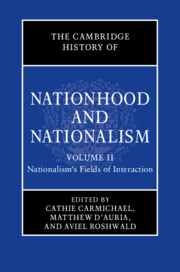
This major new reference work with contributions from an international team of scholars provides a comprehensive account of ideas and practices of nationhood and nationalism from antiquity to the present. It considers both continuities and discontinuities, engaging critically and analytically with the scholarly literature in the field. In volume II, leading scholars in their fields explore the dynamics of nationhood and nationalism's interactions with a wide variety of cultural practices and social institutions – in addition to the phenomenon's crucial political dimensions. The relationships between imperialism and nationhood/nationalism and between major world religions and ethno-national identities are among the key themes explained and explored. The wide range of case studies from around the world brings a truly global, comparative perspective to a field whose study was long constrained by Eurocentric assumptions.
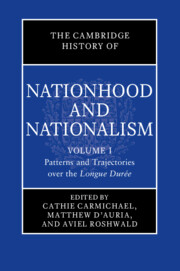
This major new reference work with contributions from an international team of scholars provides a comprehensive account of ideas and practices of nationhood and nationalism from antiquity to the present. It considers both continuities and discontinuities, engaging critically and analytically with the scholarly literature in the field. Volume I starts with a series of case studies of classical civilizations. It then explores a wide range of pivotal moments and turning points in the history of identity politics during the age of globalization, from 1500 through to the twentieth century. This overview is truly global, covering countries in East and South Asia as well as Europe and the Americas.
Since independence, the “Anglophone” and “Francophone” identities (both legacies of British and French colonialism, respectively) have remained the dominant national identity of Cameroonians. This linguistic national identity was formalized by the adoption of bilingualism at the dawn of independence and the enactment of English and French as the two official languages of the country. Nationalism and national integration in the Cameroonian context therefore revolve around the cohabitation of the aforementioned distinct linguistic and cultural identities, which harbors significant incompatibilities. This article probes into the effectiveness of the cohabitation model of nation-building in Cameroon and attempts a new alternative. A survey was conducted to sample the opinion of Cameroonians on national identity and nationalism in Cameroon. The results indicate there are enormous challenges with the implementation of the cohabitation model, which an overwhelming majority of respondent believe has a negative impact on national integration. A new approach dubbed “Civic-multicultural model” is proposed. This model is based on the “Kamerun Idea,” which is a glaring reminder that before being “anglicized” by the British on the one side of the Mungo river, and “gallicized” by the French on the other side, the inhabitants offshore the “Rios dos Cameroes” were first “kamerunized” by the Germans.
This article focuses on production cycles of traditional embroidery making (yaka) in Turkmenistan. In Turkmenistan, yaka is a key element in the national dress for women's everyday wear and since the process of the embroidery making is often handmade, the distribution of yaka and the networks of producing and dealing this essential apparel offer a rich ethnographic context. The article focuses on the study of resellers and dealers who control the market flow and the precarious labor of those women who produce this highly valued handmade product in villages and households and then resell them at the major bazaar hubs in the central cities. At each stage, there is a quality, price and “tradition” control—whether the product adheres to the constructed but widely shared idea of the “national dress.” These relations are also imbued with logics of the gendered economy of respect for work and mutual help given the precarious circumstances of each individual yaka-maker. Yaka-making is seen by many women as a way out of financial crises, but it becomes a cycle of precarity based on the trends, demands, and forms of the formal dress requirement in the state institutions to which female clients have to adhere to when choosing the product. What influences the market flows in trends, supply, and everyday profit? How do women regulate the market from within despite the growing precarity? Studying these internal power relations will help us reveal how cultural and social control stems from the precisely political and male domination and how the rules of the game in that field are guided by completely different gendered and labor principles on the ground.
The intersection of nationalism and inequality is undoubtedly gaining interest in current debates in nationalism studies. The effects of economic inequalities on nationalist politics are the most researched area; however, there are other ways to explore the relationship between nationalism and inequality. Focusing on economic and political aspects of inequality this state-of-the-field article offers an overview of existing research on the relationship between inequality and nationalism in various areas of nationalism studies, ranging from nationalist politics to exploring the symbolic construction of nationhood. Following the inequality scholars, we highlight the growing importance of capital accumulation and emphasize the spatial aspect of it. We argue that while being largely overlooked, the role of territory—and territorial politics more broadly—becomes crucial for the understanding of the intersection of nationalism and inequality today. Overall, we show that it is necessary for nationalism studies scholars to engage in contemporary literature on inequality and acknowledge the wider implications of growing inequality to various manifestations of nationalism.