To save content items to your account,
please confirm that you agree to abide by our usage policies.
If this is the first time you use this feature, you will be asked to authorise Cambridge Core to connect with your account.
Find out more about saving content to .
To save content items to your Kindle, first ensure no-reply@cambridge.org
is added to your Approved Personal Document E-mail List under your Personal Document Settings
on the Manage Your Content and Devices page of your Amazon account. Then enter the ‘name’ part
of your Kindle email address below.
Find out more about saving to your Kindle.
Note you can select to save to either the @free.kindle.com or @kindle.com variations.
‘@free.kindle.com’ emails are free but can only be saved to your device when it is connected to wi-fi.
‘@kindle.com’ emails can be delivered even when you are not connected to wi-fi, but note that service fees apply.
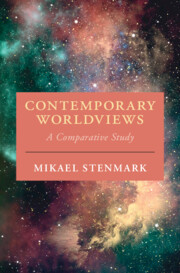
In this book, Mikael Stenmark identifies and explores several prominent religious and secular worldviews that people in contemporary society hold. Three nonreligious worldviews are highlighted: scientism, secular humanism, and transhumanism. These are contrasted with four religious worldviews: Abrahamic theism, Buddhism, the new spirituality (the so-called 'spiritual but not religious' individuals, SBNR), and religious naturalism. Some challenges facing each of these worldviews are discussed toward the end of each chapter. The book offers a unique study of several key secular outlooks on life that go far beyond previous studies of atheism, nonreligion, and religious 'nones.' It also provides a rare insight into the beliefs, values, and attitudes that secular and religious thinkers consider essential to our identity and place in the world, as well as what we should deeply care about in life.
Neoclassical theists reject the traditional divine attributes of impassibility and immutability, holding that God can be affected by the things he has created and is thus changeable. Some claim, for example, that God undergoes changes in emotional state, has desires that can be either satisfied or frustrated, grows in knowledge, and can suffer. I argue that this position rests on a simplistic distortion of perfect being theology grounded in highly contestable intuitions and conceptually sloppy usage of key terms (such as “emotion” and “knowledge”). By contrast, the first-cause theology of Thomism is grounded in a rigorously worked-out metaphysics that neoclassical writers typically engage with only superficially if at all. Nor is “neoclassical” theism really new, but in fact marks a regression to a crudely anthropomorphic conception of God that Western thought moved beyond at the time of Xenophanes.
Recommend this
Email your librarian or administrator to recommend adding this to your organisation's collection.