To save content items to your account,
please confirm that you agree to abide by our usage policies.
If this is the first time you use this feature, you will be asked to authorise Cambridge Core to connect with your account.
Find out more about saving content to .
To save content items to your Kindle, first ensure no-reply@cambridge.org
is added to your Approved Personal Document E-mail List under your Personal Document Settings
on the Manage Your Content and Devices page of your Amazon account. Then enter the ‘name’ part
of your Kindle email address below.
Find out more about saving to your Kindle.
Note you can select to save to either the @free.kindle.com or @kindle.com variations.
‘@free.kindle.com’ emails are free but can only be saved to your device when it is connected to wi-fi.
‘@kindle.com’ emails can be delivered even when you are not connected to wi-fi, but note that service fees apply.
Aḥmad Fāris al-Shidyāq’s magnum opus Leg over Leg (al-Sāq ʿalā al-sāq, 1855) is perhaps the most important work of Arabic literature from the nineteenth century. It laid the foundation for modernist Arabic prose at once rooted in Arabic literature's classical forms, language, and genres and pushed them to innovative and modern critical ends. Despite al-Shidyāq’s unprecedented redirection of the forms of classical Arabic literature to modern critical ends, Leg over Leg and the roots of Arabic literary modernity and modernist prose it sprouted were systematically marginalized to the point that by the mid twentieth century they had become largely irrelevant and forgotten. This chapter outlines how twentieth-century literary critics covered up Leg over Leg’s pioneering modernist roots, elaborates the nature of al-Shidyāq’s modernism, and argues that it is still rich with potential.
The Iranian author Ṣādiq Hidāyat (usually anglicized as Sadegh Hedayat; 1903–1951) penned the best-known example of modernist Persian prose, a short novel called Būf-i kūr (The Blind Owl) while living in Bombay in 1936. Critics writing in several languages have spilt barrels of ink attempting to make sense of the story, which presents readers with a narrative in two parts, told from the perspective of an opium-addicted pen-case painter living in squalor outside an unnamed city that may or may not be the ancient settlement of Ray, near modern Tehran, at an indeterminate time in history. This chapter briefly situates Hidāyat’s life and work within this historical moment before highlighting two relatively unexplored modernist facets of The Blind Owl: first, the elision of a key term, barzakh, from the earliest published manuscript when it was reprinted and, second, how both Hidāyat and his novel’s narrator situate themselves not between Iran and Europe but rather between Iran and India, thus redirecting our search for modernist beginnings in Persian literature.
World War I, the Turkish War of Independence, and the subsequent change of the empire into a republic, along with “revolutions in everyday life,” meant that from management and the legal system to clothing and the position of women, daily life had been massively transformed. Halide Edib Adıvar (1884–1964) and Ahmet Hamdi Tanpınar (1901–1962) are two authors whose works responded to such drastic change. Arslan and İmşir argue in this chapter through Halide Edib’s Maskeler ve Ruhlar/Masks or Souls? and Ahmet Hamdi Tanpınar’s The Time Regulation Institute, that these authors understood and showed that this change was beyond national borders and, with what the two world wars showed, it was all-encompassing. In other words, Edib and Tanpınar should not be read solely in order to understand the political transformations of early Republican Turkey. Their works also testify to a global transformation that they present as threatening all individuals – including the writers themselves – with the possibility of becoming machines.
This chapter takes up Jabrā Ibrāhīm Jabrā’s first published novel, Ṣurākh fī layl ṭawīl (Cry in a Long Night, 1955), arguing that it integrates modernist elements and themes into Arabic prose. Jabrā’s prose experiments derived from a literary-intellectual posture that he fully articulated in his 1958 essay al-Ḥurriyyah wa-l-ṭūfān (Freedom and the Flood). This posture, which Jabrā framed through the term al-qalaq (anxiety), was the basis of his adamant rejection of iltizām (political/social commitment) in literature. Jabrā’s experiences as a student in the UK and Harvard, his embrace of literary formalism modeled after New Criticism, and his investment in the project of cultural renewal (tajdīd) in Arabic art and literature, guided his approach to translating modernist form into Arabic. The chapter argues that Jabrā’s adaptation of the late modernist discourse of aesthetic autonomy into Arabic, which he articulated through the language of individual freedom, was positioned against discourses of commitment in an Arab intellectual tradition that viewed the relationship of aesthetics to politics as irrevocably tied to the questions of class and colonialism.
Martin Amis’s prose style has been profoundly influential, and so has the consistency with which he foregrounded questions of style in his fiction and non-fiction. This chapter discusses what Amis meant when he spoke about style. It also discusses what it might be possible to say about style as such and argues that we can only really argue about a given style. It goes on to anatomise Martin Amis’s prose style using the tools of close reading, quoting from his novels Money and Time’s Arrow as well as his memoir Experience and his short story ‘The Coincidence of the Arts’. It discusses Amis’s style as a hybrid of postmodern and liberal-humanist insights into the nature of the world; as essentially urban; as positing style as a dandified response to British post-imperial decline; and, finally, as intrinsically comic.
The emergence of vernacular French prose at the dawn of the thirteenth century gave rise to a new form of Arthurian romance. Prose allowed the development of lengthy cycles of interconnected romances that functioned autonomously while also forming an overarching story. The most popular of these cycles, the Vulgate or Lancelot-Grail Cycle, became the canonical version of the Arthurian narrative for the rest of the medieval period, influencing subsequent texts in the French-speaking world (Guiron le Courtois, the Prose Tristan, etc.) and beyond (the Middle Dutch Lancelot Compilation, Thomas Malory’s Morte Darthur, etc.). This chapter details the circumstances that made the Vulgate Cycle possible, its inner workings and dynamics, popularity, audience and legacy. It ends with a survey of the Post-Vulgate texts that were composed shortly after the initial cycle and examines the hypothesis of a ‘Post-Vulgate Cycle’ that may have connected them.
This chapter addresses the diverse modes in which poetry is found in and around Bloomsbury by focusing on three different aspects. First, it charts the presence of poetry and poets across different Hogarth Press series (the Hogarth Essays, the Hogarth Lectures on Literature, and Hogarth Living Poets). Second, it considers poetry both as a genre and as a critical issue in the debate on form in art, for example in Woolf’s numerous essays on prose and on the novel, in which her discourse on the subject is inextricably linked to her reflections on poetry, or in the work of Roger Fry, Charles Mauron, and Julian Bell on Mallarmé. Third, it focuses on Julian Bell’s practice of and critical discourse on poetry as they develop in crucial moments for the Bloomsbury group more at large. By addressing these points, the chapter outlines a network of people across generations whose discourse on, or writing of, poetry intersected in one way or another with the cultural and aesthetic practices of the group, thus illuminating some of the fertile tensions and contradictions within it.
Michael Field are remembered for their poetic works, but they also wrote short prose. Focusing on their collection of prose sketches or ‘croquis’ entitled For That Moment Only, this chapter sets their prose writings in the wider context of the fin-de-siècle trends towards the short story and aesthetic essay. Through analysis of stories like ‘A Maenad’, the chapter outlines Michael Field’s affinities with New Woman prose writers like George Egerton, as well as their affinities with decadent aesthetes like Oscar Wilde. Ultimately, this chapter shows that attending to Michael Field’s prose works as well as their poetry provides a more accurate picture of their distinct contribution to turn-of-the-century literary culture.
This paper examines the criticism of Munīr Lāhorī (1610–44) regarding the early modern literary style of tāza-gū'ī (speaking anew) through his unedited commentaries on the qasidas of ʿUrfī Shīrāzī (1556–90). Munīr is critical of the Iranian poet's overly complex style, ungrounded in the literary tradition as he perceived it, and of developments in Mughal courts that began to favor Iranian literati over their Indian counterparts. His philological criticism of ʿUrfī's qasidas and the promulgation of tāza-gū'ī elucidates the methodologies of Safavid-Mughal literary criticism and illustrates how the prominence of Iranian figures in South Asian courts influenced the discourse on early modern Persian literary developments.
O’Casey had originally thought about writing a book about his life experiences as early as August 1926. In 1938 he completed the first volume, but the project continued to balloon, such that O’Casey eventually composed his autobiographies over the course of two decades, publishing six volumes between 1939 and 1954. This chapter puts the autobiographies in the perspective of working-class self-representation in Ireland during the twentieth century, interrogates the sense of self that can be found in the books, examines the response to the autobiographies in Ireland and beyond, and assesses the worth of O’Casey’s autobiographical writings.
Hopkins’s journals are usually read as source-books for his poems. Their fragmentariness smacks of the archive, seeming to position this material as purely of scholarly interest. These odds and ends are meant, it would seem, to be searched for aperçus, inscapes, what Whitman would call ‘go-befores and embryons’, later immortalized in verse. But it’s also possible to read the journals as literature in their own right: as a great poet’s utmost experiment with the possibilities of prose. Hopkins’s nature descriptions experiment relentlessly with the poetics of prose his letters assert piecemeal. He inherited an aesthetic of notation that, arising from the diaries of Romantic poets like Samuel Taylor Coleridge, was made irreversibly self-conscious within the published prose of his Victorian precursor, John Ruskin. Revealing an apparently spontaneous, self-shaping spirit alive in plants, stones, clouds, and water, Hopkins’s self-conscious sentences illuminate – as well as transcend – Victorian habits of intellectual enquiry.
This chapter explores how early prose writers made use of intertextuality, from the emergence of prose until the classical age. First, it considers the earliest writers, especially early Greek mythographers and philosophers, who faced the challenge of dealing with the authoritative world of epic poetry. To inherit this credibility, they could either acknowledge its importance or reject it. In many cases, they tried to improve upon the poets or kept their narratives up to a certain point before swinging in another direction. Second, the chapter studies the developments in the classical age and focuses especially on Herodotus, who cites poets, but never prose writers, favourably. Harsh attacks are reserved for those predecessors whose work was recognised as significant and thus as a direct competitor.
Was the stylistic exuberance and formal ambition of twelfth-century classicizing prose linked to the unprecedented study of ancient poetry during this period? Why would aspiring prose writers have been nurtured largely in verse? Long accustomed to regard Byzantine interest in ancient poetry as culturally antiquarian in nature, we have been less alert to the formal lessons available to aspiring Byzantine authors, most of whom would go on to compose in prose instead of verse. By tracing the long history of poetry as the school of prose, this chapter draws examples from Eustathios’ Parekbolai or ‘commentaries’ on Homeric epic in a bid to illustrate attempts to render Byzantine prose more ‘poetic’. The author thus hopes to underline the reciprocal and often seamless relation between prose and verse in the twelfth century and what this may teach us about both during what is widely regarded as the most innovative period in Byzantine literature.
This chapter surveys the contingencies and forces of influence between the two prose genres ofearly modern sermons and essays. With reference to the sermons of Lancelot Andrewes and John Donne, it argues that essayists who turned to printed sermons for inspiration found in them unique modes of rhetorical self-fashioning. Sermons bring to the fore questions of style that reveal how learned preachers attempted to construct a sacred authorial persona, whose aim was not just to convey the force of an idea, but frequently to evoke its experiential consequences in the pursuit of a religious life. It also considers how the Montaignian essay form offered itself as a model for preachers seeking to perfect, or essay, their voice in preparation for their religious vocation as divine mediators.
Chapter 10 examines Goethe’s development as a writer of prose across the spectrum of forms, beginning with his radicalisation of the epistolary novel through his Werther. It highlights significant influences – from Giovanni Boccaccio to Sophie von La Roche – and, at the same time, emphasises the singularity of his writing. It also reflects on Goethe’s use of deliberate aestheticisation as a means of contending with the instability of human life. The chapter shows that Goethe’s prose writing is both thoroughly embedded in and transcends the many contexts from which it emerged.
Edited by
Alejandra Laera, University of Buenos Aires,Mónica Szurmuk, Universidad Nacional de San Martín /National Scientific and Technical Research Council, Argentina
The Argentine crisis of 2001 saw economic collapse, social unrest, and police repression. But if it caused a political and economic fracture with apocalyptic overtones, in literature – and in prose fiction, specifically – it did not mean a complete break with the past nor an eruption of the new, but instead the return or reformulation of the old. Despite everything, the 2000s was a period of productivity and global acclaim for Argentina’s writers. Certain activist uses of literature and its insertion in other areas of social praxis coexisted with a search for a personal voice, namely autofictions, writings of the self, and stories of everyday life. This chapter structures a reading of the literature of the 2000s around three key topics that emerge from this conjuncture: an aesthetic of recycling; an aesthetic of haunting; and the presence of a reinvigorated feminist gaze. After a period of scepticism about the role of literature in social change, these trends sparked a renewal of interest in the activist uses of fiction. At the same time, other writers made abject characters the protagonists of their stories and agitated for a literature that strives to be both autonomous and political at the same time.
Since the eighteenth century, Swift’s prose has been admired for its simplicity and clarity. This chapter pays attention to how the ‘purity’ of Swift’s prose style interconnects with the coarseness and grotesquery of his writing. Swift, this chapter argues, was part of a reaction that emerged in the late seventeenth century against the Elizabethan writers and their ornate metaphysical style. The level of details that he imported into his prose fictions opened up new visual possibilities, both for narrative and for disgust. His microscopic eye collides with his scatological vision.
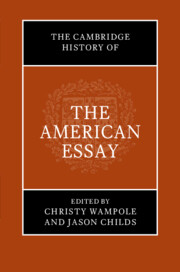
From the country's beginning, essayists in the United States have used their prose to articulate the many ways their individuality has been shaped by the politics, social life, and culture of this place. The Cambridge History of the American Essay offers the fullest account to date of this diverse and complex history. From Puritan writings to essays by Indigenous authors, from Transcendentalist and Pragmatist texts to Harlem Renaissance essays, from New Criticism to New Journalism: The story of the American essay is told here, beginning in the early eighteenth century and ending with the vibrant, heterogeneous scene of contemporary essayistic writing. The essay in the US has taken many forms: nature writing, travel writing, the genteel tradition, literary criticism, hybrid genres such as the essay film and the photo essay. Across genres and identities, this volume offers a stirring account of American essayism into the twenty-first century.
Accounts of the battles of Bannockburn,by the anonymous writer of the Chronicle of Lanercost, of Henry V’s battles at Harfleur and Agincourt, by Thomas Elmham or Ps.-Elmham and by Titus Livius, and of Richard III’s death at the battle of Bosworth Field by Polydore Vergil are given here as examples of military historiography of the fourteenth and fifteenth centuries.A section of a metric poem on Henry V, in elegiac couplets, is also included. The reader must decide as to whether the writers on Henry V and Richard III can be regarded as writing ‘humanist’ Latin.
Birinus, who was to become bishop of Dorchester and a missionary in southern England, came from Rome in the seventh century. An anonymous writer of the late eleventh-century wrote a distinctive Latin biography of Birinus, with a highly rhetorical style. Here the account of Birinus’ crossing of the English Channel, involving a miracle, is included, both in the Anonymous version and in a verse version of the thirteenth century by the prolific Latin poet Henry of Avranches.