To save content items to your account,
please confirm that you agree to abide by our usage policies.
If this is the first time you use this feature, you will be asked to authorise Cambridge Core to connect with your account.
Find out more about saving content to .
To save content items to your Kindle, first ensure no-reply@cambridge.org
is added to your Approved Personal Document E-mail List under your Personal Document Settings
on the Manage Your Content and Devices page of your Amazon account. Then enter the ‘name’ part
of your Kindle email address below.
Find out more about saving to your Kindle.
Note you can select to save to either the @free.kindle.com or @kindle.com variations.
‘@free.kindle.com’ emails are free but can only be saved to your device when it is connected to wi-fi.
‘@kindle.com’ emails can be delivered even when you are not connected to wi-fi, but note that service fees apply.
This chapter sets out the book’s central claim, namely that deafness offers a new perspective on early modern England. It does this by revealing both the diversity of deaf experiences and the cultural weight attached to speech and hearing. Drawing on extensive archival research, it recovers the lives of deaf and deafened people across the social spectrum, showing how prelingually deaf individuals using sign language to work, marry and participate in religious life. Their stories challenge long-standing assumptions that a primarily oral society excluded them. Instead, deaf people were more integrated than printed sources or legal guides suggest, even as prejudice about speech and rationality persisted. The chapter also introduces the methodological challenges of writing deaf history, foregrounding the rarity of first-person accounts and the importance of interpreters, family networks and teachers. By combining insights from medical, theological, legal and cultural models of disability, the chapter reframes deafness as a historically situated experience that illuminates broader questions of knowledge, communication and what it meant to be human in early modern England.
This revised and updated edition of the definitive history of the French Wars of Religion explains why they were fought and how peace was finally restored after two generations of fighting. Since the publication of the second edition in 2005, recent scholarship has challenged traditional ideas of how the wars started and has included new research on peace-making, memory studies, and the international dimensions of the conflict. Mack P. Holt offers a fresh narrative which incorporates these ideas, while continuing to make this complicated series of civil wars understandable and accessible to readers. Holt explores why France become divided by a civil war fought between both professional armies and civilians, why French elites believed that a simple policy of repression could succeed against the growth of Protestantism, and how peaceful coexistence between the two confessions was eventually established after nearly four decades of war. As a result, this study remains an essential introduction for both students and general readers.
This chapter examines the lexicons of texts in Early Modern English from the 1520s through the 1560s: the turbulent decades spanning the English Reformation. On the one hand are works that look to the world of Catholic Christendom, such as books by the politician, philosopher, propagandist, and martyr Sir Thomas More and – later in the century – the polemical texts written by Jesuit exiles. On the other are outputs by reformers such as William Tyndale – also a martyr – and of later Protestant controversialists. Among the latter group is a royal figure whose writings have in recent years attracted increasing attention: Henry VIII’s last queen, Katherine Parr. The chapter begins with an examination of versions of a key work of the English Reformation: the Book of Common Prayer. Protestant and Catholic lexicons are identified, and shown to align with distinct confessional/theological orientations.
The Sandtoft settlement in Hatfield Level is the best-documented of several refugee communities established on improved wetlands. Described via the resonant language of ‘plantation’, the settlement connects agricultural improvement in England to imperial expansion in the British Atlantic, acting in the service of empire and state while forging transnational Protestant networks. As improvers, the Sandtoft settlers were fastened to the crown’s agenda to produce profit, subdue commoners, and integrate marginal localities into the nation. As Calvinists and cultivators, however, they met with hostility in England: at odds with Archbishop Laud’s repressive efforts to demarcate a distinctively English Protestantism, while facing a violent campaign of expulsion by fen commoners opposing improvement. Interpreting these experiences through the transnational lens of Protestant adversity, the settler community entangled their quest for religious freedoms with their remit as fen improvers. Moving beyond dichotomous arguments about xenophobia in early modern England, this chapter traces how engineered environmental change forged lines of solidarity and separation.
The years between about 1780 and 1850 can be understood as a meaningful period in the making of a romantic Ireland. Nestled within the cradle of that century, though, lie folds and divisions that lend a distinctive texture to the underlying political formations described. The introduction traces some of these textures while setting out the main phases and patterns through which Irish romantic culture can be analysed and understood.
The jamʿiyyāt (learned societies) are hallmarks of the Arab Nahḍa (“Renaissance”) in Beirut. This article focuses on the agency of Syrian members and studies the earliest three institutions in the context of social dynamics, economic linkages, political aspirations, and religious contestations. Centred around Syrians and Protestant missionaries, the Syrian Society of Arts and Sciences (1847) functioned as a site of growing American religious and cultural soft power. At the Oriental Society (1849), Syrian Catholic notables from the recently collapsed political regime assembled, alongside French Jesuit missionaries, to maintain their erstwhile power and prestige. Lastly, at the Orthodox Syrian Society (c. 1850), the traditional Orthodox elite attempted to preserve their flock and prove sociopolitical relevance in the face of Protestant and Catholic encroachments. Through the religious and political struggles that played out at the three jamʿiyyāt, this article demonstrates the politicization of confessional identities at the hands of Syrians and foreigners alike.
For the last fifty years, scholars have accepted that the political philosophies associated with the Enlightenment and British country ideology played a central role in provoking the American Revolution. This chapter moves away from this approach to consider the broad spectrum of political thought in colonial America in the decades immediately before independence. The bulk of this thought was neither as secularized, nor as hostile to imperial authority, nor as egalitarian, nor as American as scholars have assumed. This broader perspective makes it evident that the Revolutionary breach did not grow in any meaningful way from the Enlightenment or British country thought. I argue instead that it was political thought normalized within the empire – indeed central to imperial authority’s proper functioning – and familiar to British Americans that served as the primary intellectual basis for resistance to the London authorities as the imperial crisis intensified. Colonists used Protestant political idioms that warned of the continuing dangers of popery and tyranny to indict the imperial ministry’s actions, formed arguments about the nature of the British constitution drawn from mainstream imperial political theory to undermine the London government’s authority, and invoked episodes from Britain’s tortured seventeenth-century history to legitimate their acts of resistance. This appropriation ultimately destroyed the logic of empire in British America. argue in stead that it was the colonists’ understanding of the British constitution, their use of mainstream imperial Protestant political idioms that denounced popery and Catholicism to indict the imperial
The Eternal Wanderer: Christian Negotiations in the Gothic Mode provides new ways of reading the Gothicisation of the Wandering Jew. It argues that early Gothic writing conjured iterations of this figure that reimagine and revise him, adding Gothic layers to a popular Christian myth that refuses to die. Drawing on the work of Carol Margaret Davison, Lisa Lampert-Weissig and Galit Hasan-Roken and Alan Dundes, whose studies trace the myth's development across history, folklore and literature, this Element studies the figure as an antisemitic, palimpsestic Derridean spectre and establishes early Gothic writing as a significant development in his continued spectral existence. By reading the production of the Wandering Jew in conversation with his historical and theological contexts, and employing theoretical traditions of spectralisation according to Jacques Derrida and Steven F. Kruger, this Element provides a dedicated account of Gothic iterations of this figure and examines its alchemical, Faustian and theological figurations.
In 1928-29, politicians of the Irish Free State debated the Censorship of Publications Bill, which included a clause banning print media on contraception. They contended that ignorance of birth control would increase reproductive rates and prevent Irish “race suicide.” W. B. Yeats contested the Bill in the press, in part due to apprehension about Catholic population growth and dwindling Protestant numbers. This chapter positions the Free State’s “race suicide” debates into the context of their eugenic origins, and it argues that Yeats’s reaction to the Bill set the stage for his eugenic plan in On the Boiler, one that responded to what he believed was an Anglo-Irish “race suicide.” Through coded references to Irish class divisions, Yeats proposes restraints on Catholic reproductive rights, strategies of selective breeding among an Irish elite, and population control achieved through violence. His ideas about race and reproduction offer a study of scientific racism that reflects fringe and mainstream rhetoric that endures today in the form of “replacement theory.” An investigation of Yeats contributes to the ongoing, multidisciplinary effort to pinpoint the origins, development, and effects of theories that bring together questions of science, race, reproduction, and rights.
This chapter shows how the material and ritual legacies of apostolic Rome provoked debate among Protestant travellers and called attention to the intertwined legacies of early Christianity and imperial Rome. We demonstrate how one site (St Peter’s Basilica) became a battleground for sectarian readings of the apostolic past. Previous scholarship has demonstrated how anglophone travellers constructed their modernity in opposition to an imagined archaic Italian Other. Yet critics have paid insufficient attention to how religious difference and sectarian identity shaped such attitudes. Catholics had a special commitment to validating the early history of the Roman Church, but Protestants also had an active interest in apostolic legacies. By demonstrating that the earliest Christians practised a simple and earnest form of worship – anathema to the splendour of medieval Catholicism – Protestant commentators vindicated their faith as a return to apostolic authenticity. Yet if British and American travellers wanted to put Catholicism in its place, some Catholics sought to win over Protestant sceptics by appealing to a shared antiquarian epistemology, combining the aesthetic appeal of Catholic ritual with an historicizing emphasis on the material legacies of apostolic antiquity.
It is a commonplace in discussions of Anne Lister to identify her as a self-proclaimed Tory, and eventually a Tory landowner. But the Lister of the diaries also fancied herself a Rousseauvian individualist and something of a Byronic hero, a champion of Romantic individualism that sits somewhat oddly with her sense of social entitlement. I have argued elsewhere that Lister’s conservatism may have been compensatory, a form of normalisation and possibly of protection. In this chapter I complicate those arguments by looking more closely and more broadly at Lister’s politics - and politics with both a capital and a small ’p’. Lister lived during an age of revolution and reaction, of Napoleonic wars, of abolitionist agitation, of the first major Reform Act, of colonial expansion, of early industrialisation and rail travel. What were her attitudes to these major phenomena that do not necessarily line up neatly with a single party? What issues did she care about, and what did being a (non-voting, because female) Tory mean to her? Were there chinks in her conservative political philosophy? Did her views change over time? And is it possible that Lister’s conservatism was not compensatory at all, but rather part and parcel of her self-fashioning as a lesbian?
Cambridge was at the very heart of national events and the great political and religious changes of the Tudor period. By Queen Elizabeth I’s reign, the University was closer to royal power than it had ever been. The author explains how and why the Tudor monarchs became so involved in Cambridge and examines the crisis of Henry VIII’s Break from Rome, the Dissolution of the Monasteries and Protestant Reformation. The author includes key figures in Cambridge such as Lady Margaret Beaufort, John Fisher, Erasmus and Thomas Cranmer. She also looks at the early Cambridge Protestant reformers such as Latimer, Ridley and Matthew Parker, who secretly discussed Luther’s ideas at the White Horse Tavern near King’s Parade.
This chapter delves into early modern theories about a key scriptural story, that of Noah’s flood, and the theological implications of explaining the flood in a largely naturalistic manner through appeal to laws of nature. Seventeenth-century French philosopher René Descartes used laws of nature as the basis for a naturalistic account of the creation of the world, and others followed suit. This chapter analyses two accounts of the world’s creation and subsequent dissolution in the flood written in England in the closing decades of the seventeenth century that drew on laws of nature: Thomas Burnet’s Sacred Theory of the Earth, and William Whiston’s New Theory of the Earth. Burnet and Whiston each explore how those early events in the earth’s history might be accounted for through natural processes, making their treatises among the earliest explicit attempts in England to explain key scriptural events chiefly in terms of natural causality.
This chapter looks at prodigies, unusual or unexpected phenomena thought to be personally or communally meaningful. Prodigies were widely thought to be an integral feature of a providentially governed world, and many different occurrences were taken to be communicative signs of God’s disposition toward, or impending judgement of, humanity. Some saw these strange occurrences as miracles and hence instances of divine action, but others dismissed such views as superstitious and misinformed, and conceived of ways to correct them. Following the lead of Francis Bacon, John Spencer was convinced that the explanation of these unusual occurrences should be reformed, and made the case for placing them under the purview of natural philosophy and explaining them naturalistically. This chapter looks at the occurrences that Spencer labelled as prodigies, his strategies for understanding them, the consequences of providing naturalistic explanations of prodigies for the perceived communicative capacities of nature, and the afterlife of Spencer’s analysis among members of the Royal Society
This chapter looks at Epicurean atomism as it was articulated by the physician and natural philosopher Walter Charleton. Charleton was among the first in England to advocate for a Christianised version of Epicureanism, a philosophy long considered suspicious because of its purportedly atheistic implications. Charleton countered these concerns by situating Epicurean atomism within a providential picture of the world. This chapter examines the main elements of Charleton’s worldview, the influence of atomism on his providential naturalism, and his understanding of the affective consequences of invoking natural causality in a providentially governed world.
The doctrine of providence traditionally has shaped how Christians view nature. In early modern English Protestant thought the doctrine enveloped natural causality and deployed it in a variety of ways, with God’s government of the created order often believed to occur through the operation of natural causes. To grasp how natural causality was perceived at the time we must therefore appreciate the broader providential context within which naturally caused phenomena were located. This chapter looks at how English Protestants understood some of the main categories used to expound providence, including creation, conservation, concurrence, government,and ordinary and special providence. These categories appear in one form or another in the texts discussed in later chapters.
This chapter looks at chance-based gambling activities like dice and lots. Early modern Protestants thought gambling through such instruments was a widespread societal problem. This chapter analyses competing accounts of how these activities should be understood. It focuses on Thomas Gataker’s deployment of a more naturalistic alternative to the supernaturalistic approaches that some of his fellow Protestants, such as James Balmford, were using to fight back against the problem. Gambling activities may not seem like the other kinds of phenomena in nature studied elsewhere in the book, but to early modern thinkers they involved very similar causal mechanisms to many other kinds of occurrences in nature. They therefore shed considerable light on how Christians at the time thought about and explained many kinds of phenomena in nature.
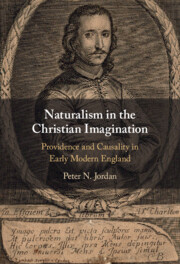
Science today is often seen as providing the definitive frame of reference for understanding what goes on in nature. Furthermore, the history of science has frequently been portrayed as the story of steady progress in overturning religious explanation in favour of scientific truth. This narrative has been challenged by those who – like the author of this book – recognise that a naturalistic way of looking at the world, which lies at the heart of modern science, has a far richer relationship to religion than many have allowed. Peter Jordan now takes this recognition in fresh and exciting directions. Focusing on key thinkers in early modern England, who located causality within a divine and providential view of the cosmos, he shows how they were able to integrate ideas which today might be dichotomised as 'scientific' and 'religious'. His book makes a compelling contribution to current science and religion debates and their history.
argues that Aemilia Lanyer’s Salve Deus Rex Judæorum (1611) participates in an oppositional brand of religious politics associated with the poem’s female dedicatees. Building on the system of correspondences in which wife was to husband as subject was to ruler, Lanyer issues a call for “libertie” not as protofeminist appeal but as defense of the rights of the Church and the nation at a time when both were threatened by James’s growing use of his royal prerogative. Reviving the woman-centered discourse of the Protestant Reformation, Lanyer champions an ultra-Protestant corrective to masculine tyranny, the true Church of the persecuted elect represented by the oppressed collective of women. In “Cooke-ham,” Lanyer pays tribute to her primary patron and zealous Puritan Margaret Clifford by representing her as a virtuous monarch whose intimate relation to Christ in her rural retreat recalls the Song of Songs and offers pointed anticourt critique.