To save content items to your account,
please confirm that you agree to abide by our usage policies.
If this is the first time you use this feature, you will be asked to authorise Cambridge Core to connect with your account.
Find out more about saving content to .
To save content items to your Kindle, first ensure no-reply@cambridge.org
is added to your Approved Personal Document E-mail List under your Personal Document Settings
on the Manage Your Content and Devices page of your Amazon account. Then enter the ‘name’ part
of your Kindle email address below.
Find out more about saving to your Kindle.
Note you can select to save to either the @free.kindle.com or @kindle.com variations.
‘@free.kindle.com’ emails are free but can only be saved to your device when it is connected to wi-fi.
‘@kindle.com’ emails can be delivered even when you are not connected to wi-fi, but note that service fees apply.
The conclusions discuss the significance of the WCC’s evolving agenda, emphasizing above all the distinctly Christian meaning the ecumenical movement sought to imbue human rights with. Against accounts that exaggerate the scope of the WCC’s commitment to human rights in the 1940s, the book shows the organization’s focus on religious freedom. Contrary to narratives that cast the WCC’s articulation of religious freedom as essentially universalizing and cosmopolitan, the book emphasizes how its advocacy was part of wider ideological contests against specific adversaries. The conclusions discuss the ramifications for our understanding of religious freedom today. With regard to the 1970s, the book demonstrates the significance of Protestantism to progressive Christianity and liberation theology. It also illuminates the difficulties liberation theology faced, and has continued to face. Scholars today debate the utility of human rights in the face of material inequality, exacerbated by neoliberalism. The WCC’s attempt to “radicalize” human rights shows the promise as well as the perils inherent in expanding our current understandings of human rights beyond liberal premises.
During the mid-century wave of decolonization, the ecumenical movement sought to dissociate Christianity from its role – real and perceived – as a handmaiden of empire. At the same time, the WCC and IMC sought to anchor Christianity in the constitutions of postcolonial states, in order to secure the religious freedom of missionaries and Christian minorities, especially in majority-Muslim countries. Ecumenical advocacy thus sought to enshrine the international norm they had shaped in the Universal Declaration’s Article 18 in domestic law. After discussing the wider trajectory of the ecumenical movement in relation to empire, this chapter turns to two important cases: Indonesia and (Northern) Nigeria. In each case, the ecumenical movement successfully influenced the drafting of postcolonial constitutions, using the language of human rights to claim impartiality while enhancing Christianity’s position vis-à-vis Islam. In doing so, ecumenists drew on their ties to departing colonial powers, the influence of those missionaries and Christian minorities that remained, and postcolonial leaders’ desire to establish essentially secular states.
With regard to communism, the WCC placed its faith in dialogue. Despite the onset of the Cold War, the WCC’s first General Secretary, Visser ’t Hooft, concertedly pursued ecumenical fellowship across the Iron Curtain. While this effort came to fruition with the 1961 integration of the Russian Orthodox Church and several other Eastern bloc churches, it locked in a pattern whereby – given that it was ultimately a body composed of member churches, not individual believers – the WCC collaborated with Russian Orthodox delegates who were under pressure or control by Soviet authorities. This strategy’s inherent tensions were exacerbated by the 1970s rise of the Soviet dissident movement, which included Christian dissidents, and the simultaneous leftward shift of the WCC, which came to view Western campaigning for religious freedom in the Eastern bloc as self-righteous and counterproductive. The downfall of communism around 1989 would allow religious freedom to become more universal than it had ever been, but despite having been the leading voice for the principle’s articulation in the 1940s, the ecumenical movement could claim little credit.
This introduction to Part I explains how the World Council of Churches (WCC) arrived at its 1948 embrace of human rights, based on its interwar “antisecularism,” the appeal of “personalism,” and the need to resist “totalitarian” state power. Protestant activism on behalf of missionaries and churches predated the turn to human rights, and as did ecumenists’ emphasis on the need to enable Christianity to “leaven” society and international affairs. The emergence of human rights as an foundational principle of the postwar order invited a reframing of these concerns in terms of human rights, even if concern for the corporate rights of churches remained part of the WCC’s approach to religious freedom. Representatives of the ecumenical movement, especially O. Frederick Nolde and Charles Malik, helped to enshrine the ecumenical conception of human rights in Article 18 of the Universal Declaration of Human Rights. The WCC, the International Missionary Council (IMC), and the Commission of the Churches on International Affairs (CCIA) advocated for this conception against what they identified as their three main opponents: Islam, “political” Roman-Catholicism, and Communism.
Against “political” Roman Catholicism, the WCC’s legal lobbying ultimately proved less important than ecumenical dialogue with the Roman Catholic Church. Though the ecumenical network shared legal tactics with representatives of the small Protestant Churches in Spain, in the face of Franco’s “National-Catholicism,” legal activism was at best an uphill battle, subject to the vagaries of Franco’s desire for international respectability and the Western bloc’s willingness to criticize a staunch anti-communist ally. Discrimination against Protestants in Spain ultimately rested on the Catholic hierarchy’s rejection of religious liberty in predominantly Catholic states – a position sanctioned by the Vatican under Pope Pius XII. It was, consequently, the ecumenical movement’s contribution to the Catholic Church’s embrace of religious freedom and ecumenism, via the Second Vatican Council (1962–1965), that made possible religious (and political) liberalization in Spain. Working through personal contacts with Catholic leaders, especially Bishop Johan Willebrands and Cardinal Augustin Bea, the WCC contributed to the extension of religious freedom to Spain and across the Catholic world.
This introduction opens with the World Council’s foundation in 1948 in Amsterdam, where the organization embraced human rights as a pillar of the postwar international order. Its focus, however, was on safeguarding religious freedom, especially that of coreligionists and missionaries. Going beyond ecumenical lobbying at the United Nations as well as a traditional focus on communist countries, the book’s Part I focuses on the global advocacy of the ecumenical movement. Part II traces how, in the 1970s, the WCC self-consciously rejected liberalism, reoriented itself toward the Third World, and articulated a “liberationist” approach to human rights. Rooted in liberation theology and drawing first and foremost on the experience of Latin American Christians, this approach called attention to the political-economic “root causes” of human rights violations, called for the recognition of collective rights claims, and emphasized the agency of the “poor” and the “oppressed.” It also generated blinders with regard to postcolonial and socialist repression, however, which undermined the WCC’s legitimacy as a global voice for human rights.
Religious freedom is protected in both international human rights law (IHRL) and international humanitarian law (IHL), yet the interference with that freedom caused by the mishandling, concealment and improper disposal of human remains in armed conflict has remained largely under-examined in the jurisprudence of the Inter-American Court of Human Rights (IACtHR). This article addresses that gap. It reconstructs the normative framework governing religious freedom in relation to the treatment of the dead under IHL and IHRL, analyzes emblematic IACtHR cases involving human remains in armed conflict settings and proposes a doctrinal path for strengthening protection in this field. The article does not contend that the IACtHR may autonomously apply IHL or declare State responsibility for violations of IHL as such; rather, it argues that, in cases arising from armed conflict, the Court may, and should, interpret American Convention on Human Rights (ACHR)-based obligations in light of IHL in order to specify duties concerning the search, recovery, identification, respectful handling, return and burial of the dead. It further argues that Article 12 of the ACHR can capture the distinct religious and spiritual dimension of the harm when funeral rites are obstructed, denied or rendered impossible.
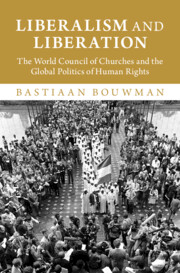
Founded in 1948, the World Council of Churches (WCC) was an important voice for human rights during the establishment of the postwar liberal international order. Bastiaan Bouwman demonstrates how its Christian human rights advocacy underwent a dramatic change over the following decades, from its initial focus on religious freedom to its later emphasis on social justice. By the 1970s, the WCC had moved to the left, focusing on causes such as the struggle against white minority rule in Southern Africa, right-wing repression in Latin America and Asia, and domestic and international inequalities. Drawing on extensive archival research, Bouwman sheds much needed light on a half century of contest over the concept of human rights. He challenges the notion that the rise of human rights was either a strictly secular or liberal phenomenon and shows how the WCC's advocacy interacted with major political developments such as decolonization and the Cold War.
In Australia, divisive debate on the matter of religious freedom has come to the fore following the introduction of marriage equality in 2017 and increasing protections against trans and gender diverse intolerance. This chapter analyses this concern with religious freedom through a social imaginaries framework. Social imaginaries are what facilitate our sense of ‘the world’; here, I illustrate how social context and embodied identity factor into affective and cognitive dissonance between one’s world of experience and their image of ‘the world’. I argue that the rise of religious freedom discourse indicates the emergence of such dissonance among conservative Christians in Australia and that this discourse is a response to the condition of ‘meaning vertigo’. Herein, I elucidate the role of op-eds from Australia’s only national daily broadsheet, The Australian, in constructing a possible path of exit from ‘meaning vertigo’: promulgating the affectively seductive image of Christians as ‘the persecuted faithful’.
In Employment Division v. Smith (1990), the U.S. Supreme Court held that neutral and generally applicable laws would no longer receive strict scrutiny review. Many feared that Smith had severely truncated the protection of the First Amendment Free Exercise Clause. Three years later, however, in a controversial Santerian slaughtering case, Douglas Laycock persuaded a unanimous Supreme Court in Church of Lukumi Babalu Aye, Inc. v. City of Hialeah to highlight an important limitation on the Smith neutrality standard. Both “masked as well as overt” government hostility, targeting, or discrimination against religion are constitutionally “suspect,” Lukumi made clear. Recent Supreme Court free exercise cases have emphasized this limitation. Over the past decade, the European Court of Human Rights and the Court of Justice of the European Union are replaying the same story that played out in the U.S. Supreme Court in the 1980s and 1990s and have gradually weakened their religious freedom provisions into a guarantee of government neutrality alone. In their most recent cases, these pan-European high courts have upheld blatantly discriminatory regulations of Muslim and Jewish ritual slaughtering, favoring animal welfare over religious freedom. These courts need to take a lesson from Laycock’s argument in Lukumi that neutrality requires states not to take sides for or against religion and not to uphold laws that have the mere pretense of neutrality while targeting the core practices of religious minorities.
This chapter is about the concept of religion in International Relations (IR) scholarship, the pitfalls of multiculturalist approaches, and the potential of alternative approaches centring genealogical care. It illustrates this through close conceptual readings of central figures such as Daniel Philpott, Jürgen Habermas, William Connolly, and Iza Hussin. It argues that such conceptual analysis is necessary in order to understand the endemic ideological and cognitive bias built into the dominant multiculturalist framework on religion in IR, as well as the importance for alternatives to it. This is significant because these biases continue to structure both scholarship and political practice of religious freedom, the regulation and governance of religious minorities, the identification and evaluation of ‘religious’ conflict and conflict parties, as well as the initiatives for reworking the relationship between religion and politics within international practices and theory.
When it comes to making political decisions about religion, decision-makers often rely on the testimonies of two kinds of religious experts: religious leaders and academic experts of religion. While such religious experts have epistemic authority for questions of religious identification and religious orthodoxy, their expertise is the wrong kind in a religiously neutral state. Questions of religious identification unfairly treat religion as being uniquely special and questions of religious orthodoxy give priority to religious traditions over individuals. Instead, only the subjective importance of commitments matters for cases of religious freedom, and only the objective interpretation of religious establishment matters in cases of religious establishment. Religious experts having no epistemic advantage here, they should not be playing any special role in making decisions about religion.
Our thesis is that the degree of permissible interaction between government and religion and its policy implications is most strikingly documented in the educational arena. To support our claim, we make three arguments: (1) by the early 1970s, New York, Pennsylvania, Rhode Island, and other states were experimenting with accommodationist policies in education that neither increased religious divisiveness nor denied religious freedom. These policy experiments contributed to the Supreme Court’s new understanding of religious accommodation under the First Amendment; (2) beginning in the late 1970s, a scholarly reappraisal of the establishment clause—based on a close reading of the debates over the First Amendment in Congress and the states—was demonstrating that reasonable governmental accommodations, particularly in education, would not violate the establishment clause; and (3) that periodizing the establishment clause’s history, by focusing on state-level innovations and scholarly reinterpretations, enhances the understanding of the policy developments of the First Amendment, particularly in the educational field.
It is a powerful question, that of the English writer Mary Astell in 1700: ‘If all Men are born free’, she asks, ‘how is it that all Women are born slaves’? What seems at first glance to be a striking statement of women's rights, however, Astell's words turn out to be a full-on attack on the liberal political theory of the rights-theorist, John Locke. Her presumption is that no person is ‘born free’; indeed, all are born under a condition of subjection to God. As Astell knew full well, in England, marriage stripped a woman of rights, those to property and those to her own person, to her sexuality and to control over her labor. Since this chapter is interested in the history of women's rights, it is best to consider what sorts of rights might be considered. Political rights, after all, are only one kind of right. And the category of women also presents challenges: a woman's marital position determined her rights.
Justin Reynolds narrates how Christians argued for religious freedom in rights terms at a moment of transatlantic hegemony in the 1940s, divorcing protection for religious practice from that for religious belief. That required abandonment of older models of Christian politics, but the results have been fateful for the regulation since of non-Christians around the world.
The extent to which religious motivations helped inspire the American Revolution has generated debate among historians. Some perceive the Revolution to be the convergence of the English radical traditions of religious dissent and political protest. In this view, a strong millennialist, anti-Catholic strain in Protestant evangelicalism saw the war of independence as an apocalyptic confrontation with the Antichrist. Other historians regard religion as a secondary factor in the independence movement. Yet consideration of connections between religion and Revolution cannot be limited to spiritual influences on the independence movement. Many enslaved African Americans embraced Protestant Christianity to criticize slavery and claim a right to freedom. Native American revival movements from the Great Lakes to the Deep South fueled resistance to colonial and Revolutionary land grabs. Loyalists asserted the same right to individual conscience as the Revolutionaries. Accordingly, the narrative of religion must include the sacred motives of many more participants, including those opposed to the struggle for independence.
The book concludes with recommendations for the future of religion in America, suggesting that a commitment to pluralism and inclusive civil religion is necessary to maintain one, indivisible nation. The authors make a case for allowing for public and private expressions of religion, promoting respectful religious pluralism, carefully balancing religious mission and activism, and broadening American civil religion beyond Judeo-Christianity to foster a vibrant American religious landscape.
The chapter demonstrates how religious freedom and robust pluralism can be catalysts for social healing – benefiting individuals and communities, building social capital, and encouraging solidarity. The chapter concludes with four case studies of bridging religious divides to achieve positive change, address injustice, reach compromise, and overcome adversity.
This chapter explains the reasons for the popularity of the anti-Iranian movie Not Without My Daughter in 1990s Türkiye despite the country’s own harrowing experience with Hollywood’s Midnight Express (1977). In conjunction, I analyze a moment of failed outreach from Iranian woman reformists to a devout, US-educated Turkish woman politician called Merve Kavakçı, who was denied her seat in parliament because of her headscarf in 1999. The chapter demonstrates how US discourses and Iran–Türkiye comparisons influenced the work of Turkish and Iranian women’s activists who sought to expand Muslim women’s political participation and reform repressive clothing codes in the 1980s and 1990s.
Hobbes argues that in a “condition of meer nature,” lacking a common power, reason requires that we appoint one, lest our lives be “solitary, poore, nasty, brutish, and short.” No covenant of peace can be effective without a Sovereign arbiter to enforce it. Therefore, reason requires each of us to surrender the natural right to judge for ourselves, and to appoint a Sovereign. An effective Sovereign must have authority to determine religious practice and to raise an army – precisely the powers the “Roundhead” rebels had denied Charles I.