To save content items to your account,
please confirm that you agree to abide by our usage policies.
If this is the first time you use this feature, you will be asked to authorise Cambridge Core to connect with your account.
Find out more about saving content to .
To save content items to your Kindle, first ensure no-reply@cambridge.org
is added to your Approved Personal Document E-mail List under your Personal Document Settings
on the Manage Your Content and Devices page of your Amazon account. Then enter the ‘name’ part
of your Kindle email address below.
Find out more about saving to your Kindle.
Note you can select to save to either the @free.kindle.com or @kindle.com variations.
‘@free.kindle.com’ emails are free but can only be saved to your device when it is connected to wi-fi.
‘@kindle.com’ emails can be delivered even when you are not connected to wi-fi, but note that service fees apply.
Costumed dress became powerful imperial propaganda, with masquerade balls taking a British form. Their numbers rose sharply from the 1760s, as imperial power soared, a popularity seemingly unbounded. Racial hierarchies were played and displayed, with costumed figures claiming authenticity, echoing territorial claims. This chapter puts the history of cultural cross-dressing into the context of empire and its aims. Britain’s White pedigree was staged in classical and medieval garb, while blackface, brownface and antisemitic tropes were performed. Heroes of empire strutted. Specific costumes paralleled landgrabs and racial ranking. “Masquerade Intelligence” became a staple of periodicals empire-wide, recounting guests’ bejewelled attire from across the social order: royalty through nobility, officers, imperial administrators, industrialists, merchants and families. Apparent frivolity held serious intent, performed in countless private and public affairs throughout Britain, Ireland, India and beyond. Resistance arose among those facing the perils of colonization, differently costumed. Defiance and mimicry were their counterthrusts, pivotal factors in the politics of masquerades.
Abstract: This chapter explores how enslaved Americans challenged and resisted bondage during the long eighteenth century. Using specialized skills, cross-cultural knowledge, and personal networks that stretched beyond colonial borders, some chose to self-emancipate, fleeing their enslavers and seeking refuge in neighboring colonies or among Indigenous peoples, while others carved out lives marked by the daily struggles of enslavement. The years leading up to the American Revolution saw European colonists engage more broadly with notions of slavery and liberty, and enslaved people took the opportunity to argue for rights more forcefully, to escape, or to actively fight back against their enslavers, whether through open rebellion or by joining the British or American forces.
Karen Cook Bell interrogates how Black women in Louisiana and Georgia used Freedmen’s Bureau courts and their knowledge of the landscape to make their own freedom. In both regions, low wages and legal battles placed formerly enslaved women at a disadvantage; however, their labor aided their families and communities. Through the “contract labor system” in Louisiana and access to abandoned lands in Georgia, these women were able to improve their conditions in the short term. While some freedpeople derived marginal economic benefits from wage labor in the immediate aftermath of the war, in Louisiana these newly emancipated women were persistent in their demands for full and fair compensation from the Bureau of Free Labor, which adjudicated a significant number of cases in their favor.
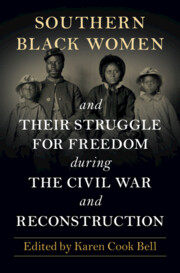
This rich and innovative collection explores the ways in which Black women, from diverse regions of the American South, employed various forms of resistance and survival strategies to navigate one of the most tumultuous periods in American history – the Civil War and Reconstruction era. The essays included shed new light on individual narratives and case studies of women in war and freedom, revealing that Black women recognized they had to make their own freedom, and illustrating how that influenced their postwar political, social and economic lives. Black women and children are examined as self-liberators, as contributors to the family economy during the war, and as widows who relied on kinship and community solidarity. Expanding and deepening our understanding of the various ways Black women seized wartime opportunities and made powerful claims on citizenship, this volume highlights the complexity of their wartime and post-war experiences, and provides important insight into the contested spaces they occupied.
This study chronicles the self-emancipatory journey of two Black female scholars from small, predominantly White liberal institutions in the American Midwest, through narrative inquiry, and by employing an Africana womanist lens. The authors use narrative vignettes to illustrate representative incidents that punctuated and pervaded their trajectories as pre-tenured faculty at their respective higher education institutions. In this reflective analysis, although the authors acknowledge their valuable contributions to the institutions, students of color, and other underrepresented student populations, they make the difficult decision to prioritize their mental, emotional, and intellectual well-being. Grounding their emancipatory process in the Africana womanist tenets of being self-namers and self-definers, the authors connoted a keen awareness of their spirituality, mothering, and wholeness. The authors underscored their imperative to self-liberate while also providing practical strategies to higher education institutions interested in supporting and retaining Black faculty.
Recommend this
Email your librarian or administrator to recommend adding this to your organisation's collection.