To save content items to your account,
please confirm that you agree to abide by our usage policies.
If this is the first time you use this feature, you will be asked to authorise Cambridge Core to connect with your account.
Find out more about saving content to .
To save content items to your Kindle, first ensure no-reply@cambridge.org
is added to your Approved Personal Document E-mail List under your Personal Document Settings
on the Manage Your Content and Devices page of your Amazon account. Then enter the ‘name’ part
of your Kindle email address below.
Find out more about saving to your Kindle.
Note you can select to save to either the @free.kindle.com or @kindle.com variations.
‘@free.kindle.com’ emails are free but can only be saved to your device when it is connected to wi-fi.
‘@kindle.com’ emails can be delivered even when you are not connected to wi-fi, but note that service fees apply.
Although MacDonald is chiefly known as a literary figure, he saw himself first and foremost as a preacher, preaching thousands of sermons across his career and publishing five volumes explicitly on spirituality. This chapter explores these sermons, both spoken and unspoken, seeing them as metaphysical landscapes providing a space and a medium for theological reflection and spiritual formation. MacDonald’s theological aesthetic is to be found not only in the synthetic biblical hermeneutic he employed but also in the sense of the transcendent which pervades his sermons; his modus operandi in the sermons is the divine sonship, with an emphasis on ‘our real life with Christ concealed’, a distinctive feature of Scottish spirituality. MacDonald was a spiritual explorer, always in search of the inexhaustible ‘treasures of darkness’.
This chapter focuses on the final two local protective mechanisms, in this case those that primarily operate through interaction with the local public, in church services and beyond: raising moral salience and building solidarity. Raising moral salience encompasses activities that attempt to convince the local public that Drug War violence is an urgent moral issue rather than business-as-usual policing, through religious observances such as the Mass, community processions, and even art installations. Efforts at building solidarity involve strengthening the cohesion of local communities, via local dispute resolution, social connection, and mutual aid. Resolving even petty disputes among neighbors makes it less likely that such tensions could feed into Drug War violence by involving local police. After using the parish-based survey to get an overall sense of the distribution of these activities, the authors empirically substantiate their operation through qualitative and quantitative evidence, including parish interviews, experimental evidence from a sample of plausible Philippine police personnel, and survey evidence of ordinary Filipinos.
In Burundi, weekly services are the primary point of contact between churches and their followers, with most of the population attending. These gatherings provide churches with a strategic platform to attract and retain members. Over six months, we collected data from five churches in the rural town of Muramvya—Catholic, Anglican, Pentecostal, FECABU (Evangelical), and Adventist—analyzing 125 transcripts for structure, themes, scope, tone, and key words. We find that emerging denominations—Pentecostal, FECABU, and Adventist—pursue different strategies than traditional ones. Pentecostal and FECABU churches place greater emphasis on rituals than on scripture readings, adopt a more positive tone, and focus on the immediate concerns of their congregants rather than abstract topics. The Adventist Church, while also emphasizing rituals and using a positive tone, distinguishes itself with a stronger commitment to scripture. The Pentecostal church uniquely combines a focus on morality with references to supernatural punishment. We argue that this blend of approaches among emerging denominations strengthens group cohesion and enriches individual faith experiences, helping them attract followers. Our findings shed light on the growth of these denominations in Burundi and may help explain broader religious trends across Sub-Saharan Africa.
Chapter 4 surveys the ways in which imperial officials were represented in various forms of late ancient Christian literature. In so doing, it acts as an introduction to Part II, which explores how contemporaries conceived of distinctly Christian forms of political service in this period. There is not a straightforward ‘archive’ of sources for this problem. Texts on government by current or former administrators do not tend to discuss the implications of their religious identities. As a result, it is rare that we can reconstruct an officeholder’s own perspective. At the same time—and in sharp contrast to other Christian authority figures (emperors, bishops, ascetics)—there is no single genre of Christian literature which focuses consistently on the careers of imperial or royal officials. This chapter thus considers how the purposes, audiences and generic expectations of letters, sermons, church histories, and saints’ lives shaped (and sometimes demanded) positive portrayals of officials, their religious identities, and their interactions with Christian communities and authority figures.
Chapter 1 examines faith in Lancelot Andrewes’s preaching. It shows that his discussions of religious belief frequently draw on the methods used in early modern England of evaluating forensic testimony. After a survey of Andrewes’s interest in religious belief and witness evidence, it turns its attention to discussions of faith and epistemology in his lectures from the 1580s. The chapter then shows how Andrewes’s interest in religious belief is reframed in explicitly legal terms in his seventeenth-century Easter sermons at court. Andrewes valued legal evidence for its ability to establish the Resurrection as an attested matter of fact. Yet these sermons also trace the limitations of legal methods of proof. For Andrewes, a true faith in the Resurrection involves a more diverse set of epistemic resources – bodily participation in the Eucharist, for instance. These mysterious aspects of faith are nevertheless articulated through the framework of legal proof and evidence.
Chapter 2 focuses on discussions of faith in John Donne’s religious prose. Donne often addresses such questions by turning to legal discourses. Processes of evaluating forensic testimony provide useful structures for measuring probability or certainty in evidence and the assent that it generates. This is exemplified in Donne’s Pseudo-Martyr, which relies on widely recognised rules about forensic testimony to discuss pressing questions regarding belief and its legitimacy in post-Reformation England. The chapter then shows how Donne adapts this legal handling of belief to address questions about salvation and certainty for a variety of audiences. To lawyers at Lincoln’s Inn, Donne uses the technicalities of civilian law to support and critique post-Reformation understandings of soteriology. To a broader congregation at St Paul’s, he deploys common law evidentiary procedures to show that, to a limited but helpful extent, the evidence of salvation can be apprehended through legal methods.
State-registered religion is puzzling because it can be portrayed as both an opponent and a partner of the state. While registered religions need to be receptive to the rules of the government, they also need to satisfy the needs of their congregants. In light of the Communist Party’s increasing repression, I investigate how this complex positioning between the government and the congregation has influenced the content of sermons in state-approved Protestant churches. Using computational text analysis on sermons from a state-approved Protestant church in China between 2009 and 2021, I analyze the pastors’ degree and composition of self-censorship in their receptiveness to changes over time, as well as to politically and religiously sensitive dates. By focusing on sermons shared in state-approved churches, I shed light on the complex positions in which these Party-registered pastors maneuver. This research also contributes to the broader discussion of civil rights and state-society relations in the context of a strong authoritarian state.
This chapter examines how the theological ideas discussed in Chapter 5 were successfully disseminated throughout English society. To do this it examines the religious split between the established Church of England and non-conformity. The development of the theology self-love, happiness, and interest is examined in the writings of the enormously influential philosopher and theologian Richard Cumberland. It then discusses how this evolved into Latitudinarianism, and examines printed sermons as they commented on these ethical concepts, as well as on consumption and worldly goods. The writings of the Anglican ministers Joseph Butler and Josiah Tucker are examined to show how these ideas became directly linked to economic thought. The concurrent development of non-conformist theology relating to the same concepts is traced through the writings of John Locke on the mind, and the dairy of the student lawyer Dudley Ryder. The Third Earl of Shaftesbury and his theory of polite sociability is also investigated to show how it provided a less austere means to disseminate Locke’s psychology of the mind. Central to this investigation will be the process by which individual selves were able to become comfortable with trusting new institutions by using the concept of interest as a form of commitment.
Nazi Germany’s policies profoundly altered both private and public lives of religious Jews in Germany and then across Europe. Despite targeting Jews as a “race,” anti-Jewish measures forced the Jewish religious leadership to seek new ways to assist their communities. Maintaining Jewish religious practices during the Holocaust became increasingly challenging and eventually impossible for most Jews.
The medieval transmission of Augustine’s preaching, in particular that of the Sermones ad populum, has had a significant impact on which parts of his vast homiletic corpus have survived and what state the texts find themselves in after a millennium of being copied by medieval scribes. This chapter will sketch a broad overview of the way Augustine’s sermons were transmitted, focusing in particular on their dynamic organization in sermon collections throughout the Middle Ages. It will discuss the implications of the modes of transmission and the medieval afterlife of Augustine’s preaching for the usability of these sermons as primary sources.
Over the course of a tumultuous ecclesiastical career, John Chrysostom (ca. 349–407) put on many hats. He was a brilliant student of rhetoric and literature under the tutelage of Libanius of Antioch; he joined Diodore of Tarsus’ ascetic circle, which counted as a member Theodore of Mopsuestia, among others; he was appointed lector in 371 and then presbyter in 381 by Meletius of Antioch; and finally he was consecrated as bishop of Constantinople after the death of Nectarius (a target of Gregory of Nazianzus’ ire in Poem 2.1.12, “On Himself and Concerning the Bishops”). It was during his time as a presbyter in Antioch that he earned his gilded reputation for preaching, which Christians in the fifth century would encapsulate with the moniker “Chrysostom,” or Golden-Mouth. His sermons were known for their power and eloquence, but also for their confrontational tenor and furious hostility toward opponents (in this case, Jews and “Judaizing” Christians). John hoped that every member of his congregation would demonstrate the same zeal that he strived to embody every day.
We know precious few facts about the life of Maximus of Turin. He was not a native of Turin, as Maximus himself implies in Sermon 33, and his clerical status upon arrival in the town is unclear. Gennadius of Marseilles’s On Illustrious Men (late fifth century) notes that Maximus was a bishop of Turin and that he died during the period when the reigns of the western emperor Honorius and the eastern emperor Theodosius II overlapped – that is, sometime between 408 and 423. Gennadius also describes Maximus as a competent preacher able to fit his discourse to any occasion or any biblical text. Neither a terribly significant figure from late antiquity nor the most gifted orator of his era, Maximus left behind a collection of more than a hundred sermons that, collectively, offer a glimpse into a rural Christian community in northern Italy during the late fourth and early fifth centuries. Here Maximus testifies to the region’s theological diversity; both heretics generally and “Arian heretics” specifically lurk around his community, as do pagans and lukewarm Christians. Indeed, he frequently complains directly to his congregation that they should attend his sermons with greater frequency.
This introduction extols reasons to study Augustine’s sermons for the academy and Church today. It introduces the sixteen chapters written by an international team of experts. It then lays the foundation of humility for the rest of the volume by considering this theme in the volume’s three parts: Augustine’s pastoral task of preaching sermons; sermons on the Scriptures and liturgical feasts; and preaching themes.
This chapter examines Augustine’s sermons given on the feasts of the Ascension and Pentecost. The homilies given on the Ascension highlight Augustine’s Christology, particularly the Ascension as disclosing Christ’s presence and the totus Christus. Augustine’s sermons on Pentecost and its vigil emphasize the unity of the church, imaged in the speaking of tongues in Acts 2, through the giving of the Holy Spirit. The sermons on Pentecost also unpack, through the image of the new wine and drunkenness in Acts 2, the newness and continuity of Pentecost as the fulfillment of the law in the Spirit’s gift of charity.
Augustine’s preaching touches numerous aspects of his theology which are predominantly present in his most important treatises. The sacraments of the Church are treated in his controversies with heretics but they are also very much present in his sermons, where he teaches the sound doctrine of the Church and performs the Christian rites for the edification of the faithful. This chapter examines Augustine’s teaching on baptism and the Eucharist in his preaching. Having considered his definition of the sacraments in general in his preached works, it presents his teaching on the sacraments in his catechesis to the baptism candidates and to the newly baptised Christians of his congregation. The study further takes into consideration what Augustine says on baptism and the Eucharist in his sermons while addressing the problems of the Donatists and Pelagians. Augustine makes difficult theological concepts understandable to his flock by adapting his language to them.
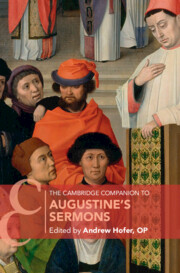
Augustine of Hippo is known for some of the greatest theological masterpieces in Christian history, notably, his Confessions, The Trinity, and The City of God. Over 900 of his sermons, a treasure trove of his insights into God, Scripture, and humanity, have also survived. Given the wide dissemination of many of these texts over the past 1600 years, Augustine is arguably the most influential preacher since the time of the apostles. In recent decades, scholars have paid more attention to his sermons, including those newly discovered, with the result that Augustine's preaching has become increasingly accessible to a broad audience. The Cambridge Companion to Augustine's Sermons furthers this work by offering essays from an international team of experts. It provides a reliable guide for scholars and students of early Christian biblical exegesis, liturgy, doctrine, social practices, and homiletics, as well as for those dedicated to the retrieval of early preaching for the Church today.
Hopkins centred his life on the Gospel and the Incarnation from the time of his conversion to Catholicism in 1866 onwards, and the exposition of the faith in the Mass became his life’s central activity when he joined the Jesuits in 1868. His sermons deserve to be read as ardent yet stylish examples of the genre as well as for their relevance to Hopkins as poet and to Hopkins as original thinker. This chapter examines the liturgical context of the sermons and ways in which they relate to the context of Victorian preaching and Jesuit homiletics. Hopkins’s sometimes baroque preaching style was not always orthodox, running counter to the simple language advised by Jesuit preaching manuals. In the texts of his sermons, it is nevertheless possible to find moving autobiographical testimony to Hopkins’s psycho-spiritual struggles, as well as his desire to empathize with his congregants’ lives and work.
This chapter provides a survey of ecclesiastical and monastic organisations and how lay people engaged with them. There was no singular ‘Frankish Church’. There was considerable variation in what people wanted, how the liturgy was arranged, access to church councils and books, and how communities connected to Roman, English, Irish, Spanish, or Byzantine religious worlds. Communities were united by relatively compact beliefs, not least the need for imminent moral reform and penance ahead of an inevitable appearance at Judgement Day – whether it was at hand or far in the future.
This chapter surveys the contingencies and forces of influence between the two prose genres ofearly modern sermons and essays. With reference to the sermons of Lancelot Andrewes and John Donne, it argues that essayists who turned to printed sermons for inspiration found in them unique modes of rhetorical self-fashioning. Sermons bring to the fore questions of style that reveal how learned preachers attempted to construct a sacred authorial persona, whose aim was not just to convey the force of an idea, but frequently to evoke its experiential consequences in the pursuit of a religious life. It also considers how the Montaignian essay form offered itself as a model for preachers seeking to perfect, or essay, their voice in preparation for their religious vocation as divine mediators.
During his long professional career as a clergyman in the Church of Ireland, Swift was obliged to preach sermons. This chapter analyses the dozen sermons attributed to him that have been preserved. Sermon culture in Swift’s lifetime was strongly politicised and Swift, like other preachers, took sides. He was a partisan polemical divine. His extant sermons inveigh against Protestant dissenters, rebellion, faction, regicide, fanaticism, and disobedience. While doctrinally orthodox and written in the plain style of contemporary Anglican homiletics, this chapter argues that Swift’s sermons are nevertheless idiosyncratic, occasionally strange and sometimes even amusing performances.