To save content items to your account,
please confirm that you agree to abide by our usage policies.
If this is the first time you use this feature, you will be asked to authorise Cambridge Core to connect with your account.
Find out more about saving content to .
To save content items to your Kindle, first ensure no-reply@cambridge.org
is added to your Approved Personal Document E-mail List under your Personal Document Settings
on the Manage Your Content and Devices page of your Amazon account. Then enter the ‘name’ part
of your Kindle email address below.
Find out more about saving to your Kindle.
Note you can select to save to either the @free.kindle.com or @kindle.com variations.
‘@free.kindle.com’ emails are free but can only be saved to your device when it is connected to wi-fi.
‘@kindle.com’ emails can be delivered even when you are not connected to wi-fi, but note that service fees apply.
The Australian Army’s commitment to the war in South Vietnam unfolded gradually over several years. It commenced with the deployment of the Australian Army Training Team Vietnam (AATTV) in 1962, followed by the arrival of a small Australian force headquarters in Saigon and the 1 RAR battle group in 1965, and completed with the establishment of the 1st Australian Task Force (1ATF) in 1966. The task force initially consisted of two infantry battalions with supporting arms and services, deployed to Nui Dat in Phuoc Tuy province under the operational control of the US II Field Force Vietnam (IIFFV), and a logistic element at the nearby port of Vung Tau. As 1ATF operated separately from the established Australian Army divisional structure, it received additional intelligence resources that would not usually form part of a task force, including a detachment of the Divisional Intelligence Unit and a small signals intelligence capability. In addition, the headquarters of 1ATF had assigned a senior intelligence officer of major rank, a captain intelligence officer, and a small battle intelligence, or order of battle staff.
At the end of January 1968, the VC and North Vietnamese Army (NVA) launched their Tet Offensive, a series of coordinated attacks on more than one hundred towns and outposts in South Vietnam. These attacks aimed to foment rebellion among the South Vietnamese population so that they would revolt against the corrupt South Vietnamese regime and break the United States’ resolve before peace talks. In response to this offensive, the US and South Vietnamese forces commenced a massive operation, Toan Thang (Complete Victory), which aimed to destroy the remaining enemy involved in the Tet Offensive and prevent fresh enemy forces from moving towards the capital, Saigon. In these objectives neither side obtained complete success. In April 1ATF became part of this operation with its infantry battalions conducting ‘reconnaissance-in-force’ operations to block enemy infiltration routes. In May, the task force changed its concept of operations by deploying several units outside Phuoc Tuy province into Area of Operations (AO) Surfers, which had been sub-divided into battalion areas of operation Manly, Newport and Bondi. Artillery located at Fire Support Bases Coral and Balmoral would support these tactical areas.
There were two fundamental problems that the commander of 1ATF, Brigadier Oliver Jackson, had to deal with when the task force was established at Nui Dat. The first was the presence of main force enemy in Phuoc Tuy province. The second was the VCI: ‘the extortionists, the terrorists, the standover men, [and] the tax men’. This infrastructure provided a shadow government and support network for the North Vietnamese military and VC local forces in the south. Most villages and towns had representatives of this network – men, women, and children – who provided a recruitment base for the VC, an intelligence network, a supply service and various other forms of support. The VCI enabled the enemy to conduct operations in the south. While it was the National Police, ARVN and associated paramilitary forces that were responsible for its destruction, this proved to be beyond the capability of the Saigon government.
From 1945 to 1975, the Australian Army always served overseas as a junior partner in a coalition, usually as part of a British Commonwealth force. This was the case during the occupation of Japan and the Korean War and under British command in Malaya and Borneo. However, the Vietnam War highlighted several problems for the junior partner in an American-dominated alliance. Relations remained cordial throughout the war in South Vietnam, especially at the individual level. However, stress points soon emerged that had the potential to damage the relationship and adversely affect intelligence collection, analysis and sharing.
Republican candidate Richard M. Nixon’s promise during the 1968 presidential election campaign to extricate the United States from the Vietnam War, combined with the loss of American domestic political support resulting from the January 1968 Tet Offensive, saw a fundamental change to how the war was conducted. The United States began a process of withdrawing their own combat forces and placing the burden for future combat operations on ARVN formations. While the Australian Government was aware of this change in policy, it was not actively included in American political deliberations and hence was unable to take an active position in the face of Vietnamisation. Left with no detailed guidance on the intended timelines for American withdrawal, the Australian Government could provide no direction to Army on the level of future commitment to the war, other than to reinforce the existing rhetoric that participation in the conflict remained vital for Australian national interests. In this policy vacuum, Army leadership concentrated on the military aspects of the war, with the CGS Exercises of both 1967 and 1968 exploring the implications of increasing the size of the force deployed to South Vietnam.
On 29 April 1965 the Australian Government announced the commitment of an Australian battalion to South Vietnam. Prior to the public announcement, discussions had taken place in Hawaii as to the nature of any future commitment in Vietnam. The staff talks, held early May to late April, were between the American Commander-in-Chief Pacific Command, Admiral U.S.G. Sharp Jr, an Australian delegation led by Air Chief Marshal Sir Frederick Scherger, and a New Zealand delegation headed by the Chief of the New Zealand Defence Staff, Admiral Sir Peter Phipps. The participants discussed broad American strategy and possible options as to where any future Australian and New Zealand forces could be deployed within the overall American design. Sharp strongly supported the concept of American forces being deployed in enclaves. He believed that the mere existence of American forces within these enclaves would deprive the North Vietnamese Government of an opportunity for victory and thus encourage them to begin negotiations. If the Australians and New Zealanders did deploy in an enclave, the Americans would provide all combat support capabilities (armour, artillery and air support) as well as the necessary logistic support.
At the Australia, New Zealand and the United States (ANZUS) security treaty council meeting in May 1962, the US Secretary of State asked the Australian Minister for External Affairs for a contribution of instructors to help the US training mission in South Vietnam. This approach was hardly a surprise to the Australian Government, as the US State Department had made similar approaches for military support to the Australian Embassy in Washington, DC in November and December of 1961. After some negotiation on the nature and conditions of the Australian commitment, on 24 May 1962 the Minister for Defence, A.G. Townley, announced that Australia was to deploy up to 30 military instructors to Vietnam.
In 1968 the dual operational requirements to conduct counterinsurgency and main force operations simultaneously also challenged the way 1ALSG provided logistic support to 1ATF. In 1966, HQ AFV and 1ALSG had constructed a logistic system to provide support to 1ATF centred on a static base at Nui Dat, with 1ATF conducting operations within Phuoc Tuy province. However, the events of the impending VC Tet Offensive in January to February 1968 would bring a radical change in how 1ATF operated, requiring 1ALSG to provide support not only to Nui Dat but also to a series of air-mobile operations and associated fire support bases (FSBs) established outside the province.
The announcement by Prime Minster Holt on 8 March 1966 to send a task force to South Vietnam represented an expansion of the policy associated with the initial deployment of the battalion group. While 1RAR was making an Australian contribution to the conflict, the small size of the force meant it had operational and political limitations. A battalion was too small to conduct operations independently from an American parent unit, reducing its operational flexibility and the political effect of the Australian involvement. Increasing the size of the Australian commitment to a task force would enable Australian forces to exercise their own operational doctrine. It would also placate some criticism that under American leadership 1RAR was suffering a disproportionate number of casualties compared to the American battalions – even if such criticism was unwarranted. Politically, a task force would mark a substantial Australian contribution to the war and thus further reinforce the Australian commitment to ANZUS.
The geography of South Vietnam posed particular challenges for the conduct of any military campaign. Dominated by a mountain chain that runs from the China–Vietnam border to just north of Saigon, the landscape comprises dense jungle in the highland areas flanked by a coastal strip on the South China Sea. South of Saigon, the Mekong Delta combines with the Mekong River to form a vast alluvial plain. The climate is either hot and wet or hot and dry, these conditions respectively producing excessive mud or debilitating dust. The climate also created tropical diseases in endemic and epidemic proportions, adversely affecting the health and efficiency of troops in the field and making medical treatment challenging since it was difficult to ‘preserve and maintain medical supplies and sophisticated medical equipment’.
In early 1967 the new commander of 1ATF, Brigadier Stuart C. Graham (succeeding Brigadier Jackson), planned and conducted a ‘classical’ counterinsurgency campaign. His focus on intensive patrolling, intelligence gathering, enemy logistics, political infrastructure, and the need to separate the civilian population from the influence of the VC were all elements germane to the British Army’s campaign during the Malayan Emergency. Graham emphasised the political and psychological nature of counterinsurgency warfare as opposed to the American approach of kill ratios and body counts, which he considered to be misguided. By the end of Graham’s tenure in October 1967, he believed that VC forces had either been forced out of Phuoc Tuy province or confined to their sanctuaries at the margins of the province.
The Australian Government’s involvement in South Vietnam was undertaken as a war of choice, driven by the desire to maintain the ANZUS alliance and keep America engaged in the defence of South-East Asia. While Menzies justified the Australian deployment in South Vietnam as responding to a direct threat to Australia from China, there was no Australian military assessment to support such an assertion. Since Australian national sovereignty was not at risk, the conflict did not require the significant economic and manpower commitments typically associated with the Second World War. Indeed, keeping the Australian commitment to the Vietnam War limited was the primary and recurrent aim of government policy. For defence planners and politicians alike, there was little other guidance, as the conflict suffered from a clear lack of aims in both Washington, DC and Canberra.
In 1962 the Australian Government deployed Australian military forces in support of the Republic of Vietnam. Before the cessation of combat operations and complete withdrawal in 1972, this commitment would escalate from an initial advisory team, to a battalion group, to a three-battalion task force with supporting armour, cavalry, aviation, artillery and associated logistics elements.After the war in Afghanistan, this would be the Australian Army’s second-longest conflict, lasting almost 11 years and surpassing the previous longest Australian commitment which was to the Malayan Emergency (1955 to 1963).
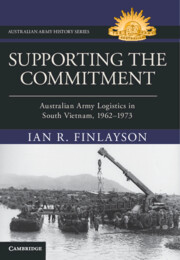
In 1962, the Australian Government deployed Australian military forces in support of the Republic of Vietnam. Supporting the Commitment: Australian Army Logistics in South Vietnam, 1962–1973 investigates how the Australian Army structured its logistics to support its operations in Vietnam. This book examines how the Australian Army interacted with the US Army's logistic framework to secure its own logistic support for the training team, the battalion group and then the task force. Particular attention is given to the logistic units which supported these deployments, including the raising, siting and operations of the 1st Australian Logistic Support Company (1ALSC) and the 1st Australian Logistic Support Group (1ALSG). Acknowledging that the Australian Army's involvement in South Vietnam was a war of choice, the book explores how Army's institutional attitudes towards logistics influenced the nature of support provided.
After President Lydon Johnson announces a massive increase in US troop levels in South Vietnam, American Catholics become more deeply engaged in debating the war, particularly in terms of morality. The radical Baltimore protest attracts attention to the Catholic antiwar movement.
Counterinsurgency tactics for winning hearts and minds are key weapons in state efforts to suppress rebellion and the possibility of rebellion. Always predicated on the threat of state violence, hearts and minds counterinsurgency is usually thought to originate in British or French strategies for managing insurgency in their colonies in Asia, especially in suppression of the 1948-1960 communist insurgency in Malaya. However, work with archival data, a genealogical approach to clear, hold and protect population management, which is a key principle of hearts and minds strategy, and careful review of scholarship on Japan's colonial military and governance (especially but not only in Japanese language) indicates that hearts and minds/hold and protect counterinsurgency principles have origins in imperial management of insurgency in Japan's colonies. It is also possible that elements of imperial Japanese “soft” counterinsurgency strategy undergird American and British hearts and minds counterinsurgency strategies in Malaya and South Vietnam in the 1950s and 1960s.
Politics in South Vietnam (aka the Republic of Vietnam) have long been overlooked in most English-language accounts of the Vietnam War, especially during the final years of the conflict. But the breakdown of the Saigon government’s legitimacy in the eyes of its own anti-Communist constituents during this period was decisive in determining the outcome of the war. This chapter explores the wave of anti-Communist solidarity that swept through South Vietnam’s cities and provincial towns following the 1968 Communist Tet Offensive. It analyzes the South Vietnamese state’s ambitious efforts to implement economic, agricultural, and political reforms. And it demonstrates that President Nguyễn Văn Thiệu’s bid to monopolize political power, following clashes with South Vietnam’s civilian parties and institutions, dealt a fatal blow to the establishment of legitimate anti-Communist government in the South. Thiệu’s autocratic turn betrayed the constitutional order on which the state’s authority was based, deflating post-Tet enthusiasm, accelerating American funding cuts, and precipitating South Vietnam’s collapse from within during the final Communist offensive in 1975. Drawing on newly available Vietnamese-language sources, the chapter examines the underappreciated impact of a diverse range of Vietnamese protagonists, who shaped the decisive political breakdown that brought the Vietnam War to its conclusion.
In response to the radicalization of the late 1960s, many governments turned to repression. With so many of their comrades behind bars, radicals in the North Atlantic decided to pay closer attention to prisoners, promote civil rights, build alliances with progressives, rebrand themselves as defenders of liberty. At the same time that activists were reconsidering their revolutionary priorities, the United States reoriented its war in Vietnam by using the issue of the POWs to reframe American intervention as a fight for humanitarian principles. Antiwar radicals in the United States and France responded by focusing on political dissidents in South Vietnam. Drawing on their experiences with prison organizing, they connected their newfound concern with civil liberties to antiwar activism, calling for the liberation of political prisoners in South Vietnam. Despite their new focus on rights, anti-imperialist radicals still thought in Leninist terms, framing their internationalism around the problematic of the right of nations to self-determination. Yet in arguing that South Vietnam violated civil rights, anti-imperialist solidarity increasingly took the form of criticizing the internal affairs of a sovereign state, which brought radicals close to competing visions of internationalism like human rights. While most radicals never agreed on a single radical rights discourse, and did not convert to human rights in the early 1970s, their new collective attention to rights, along with alliances with groups such as Amnesty International, shifted the political terrain in a way allowed a rival approach to global change to attract new audiences. In so doing, anti-imperialists lent legitimacy to a competing form of internationalism that shared the progressive aspirations of anti-imperialism but rejected nationalism in favor of human rights.
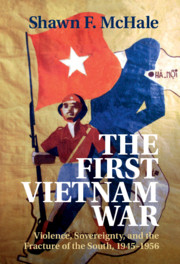
Shawn McHale explores why the communist-led resistance in Vietnam won the anticolonial war against France (1945–54), except in the south. He shows how broad swaths of Vietnamese people were uneasily united in 1945 under the Viet Minh Resistance banner, all opposing the French attempt to reclaim control of the country. By 1947, resistance unity had shattered and Khmer-Vietnamese ethnic violence had divided the Mekong delta. From this point on, the war in the south turned into an overt civil war wrapped up in a war against France. Based on extensive archival research in four countries and in three languages, this is the first substantive English-language book focused on southern Vietnam's transition from colonialism to independence.
After more than four decades since its reunification since 1975, Vietnam has achieved remarkable results in social and economic development. With the rapid speed of recent modernization, society has loosened numerous old values related to the family and promoted individual freedoms. Marriage and family affairs, including divorce, have modernized with liberal characteristics. The paper examines the trends of divorce and reasons for divorce using statistical data from the Vietnam People's Supreme Court and from the government's annual population statistics. The analysis compiled and analysed a database of every divorce case at six urban and rural districts in Can Tho province. The analysis highlights changes in the reasons for divorce in the South in comparison with previous divorce studies in the North of Vietnam, discussed in relation to modernization, individualism and gender equality. The analysis is supported by interview data with thirty male and female divorcees.