To save content items to your account,
please confirm that you agree to abide by our usage policies.
If this is the first time you use this feature, you will be asked to authorise Cambridge Core to connect with your account.
Find out more about saving content to .
To save content items to your Kindle, first ensure no-reply@cambridge.org
is added to your Approved Personal Document E-mail List under your Personal Document Settings
on the Manage Your Content and Devices page of your Amazon account. Then enter the ‘name’ part
of your Kindle email address below.
Find out more about saving to your Kindle.
Note you can select to save to either the @free.kindle.com or @kindle.com variations.
‘@free.kindle.com’ emails are free but can only be saved to your device when it is connected to wi-fi.
‘@kindle.com’ emails can be delivered even when you are not connected to wi-fi, but note that service fees apply.
This chapter introduces Decentralized Finance (DeFi), a rapidly growing area that enables financial transactions such as lending, borrowing, and trading to occur without traditional intermediaries. You will learn the foundational components of DeFi by exploring token standards, such as ERC20 and ERC721, stablecoins and their mechanisms for maintaining price stability, and wrapped tokens that facilitate cross-chain interoperability. The chapter explains how DeFi protocols are structured and how they function, focusing on core areas including decentralized exchanges, lending protocols, derivative markets, and yield farming. You will gain an understanding of key financial concepts adapted to blockchain systems, such as leverage, hedging, and impermanent loss. Particular attention is given to algorithmic innovations like automated market makers, flash loans, and synthetic asset creation. You will also study how oracles feed real-world data into smart contracts and how decentralized governance structures such as DAOs shape protocol evolution. Throughout the chapter, we emphasize the risks, incentives, and architectural trade-offs involved in designing and interacting with DeFi systems.
We can define a Central Bank Digital Currency (CBDC) as a digital currency issued by a central bank to retail customers.
The main argument in this book is a simple one: that CBDCs offer no benefits to the public that cannot be better achieved using existing tools; at the same time, CBDCs entail substantial disadvantages and risks. These include the risks that CBDCs pose to the stability of the banking system, their inefficiency compared to private alternatives and especially the risks to civil liberties that come from giving the central bank an immensely powerful instrument of surveillance and control. In short, retail CBDCs would provide no tangible benefits and entail serious problems that could be avoided by not introducing a CBDC in the first place. The case for CBDCs should therefore be dismissed.
By contrast, privately issued digital currencies such as stablecoins should be encouraged as they offer potentially enormous benefits to the public.
Central Bank Digital Currencies (CBDCs) arose as a reaction by central banks to the threats posed to their currencies by cryptocurrencies. The process began with the development of digital currency, which required the prior development of strong cryptography. These developments led to the creation of Bitcoin in 2009, and its success then prompted the development of other so-called cryptocurrencies especially stablecoins. These in turn led to the idea of CBDCs, which were first proposed in 2013. The threat posed by Facebook’s proposed Libra cryptocurrency in 2019 then galvanised a subsequent ‘CBDC mania’ among central banks that is still going strong. However, this mania was misconceived and will prove to be embarrassing to its proponents when its underlying folly becomes obvious for all to see. It turns out that CBDCs have no distinctive useful functions and come with serious drawbacks as well.
The result is that there is no rational use for CBDCs, which should therefore be dismissed.
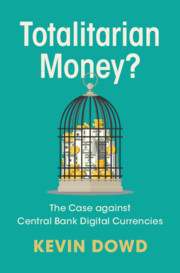
Kevin Dowd's Totalitarian Money? provides a comprehensive critique of proposals to establish CBDCs (central bank digital currencies) around the world. He argues that they are economically inefficient, as they provide no benefits that cannot be obtained by other means. He explains why CBDCs are dangerous to financial stability and personal freedom as they enable digital currency to be weaponised against people to comply with the political or social agendas of those in control. Dowd reveals that, despite being promoted by central banks as the next 'big thing', public demand for CBDCs is negligible and they have been rejected by the public wherever they have been introduced. Evaluating the track record of countries that have introduced CBDCs, Dowd explores the drawbacks of CBDCs and explains why the private sector is better equipped to provide a retail digital currency to the general public.
The discourse and trials revolving around Central Bank Digital Currencies (CBDCs) stem from substantial shifts and advancements within the financial landscape of the past decade. Emerging within the broader sphere of Fintech, these technological strides, often linked to disruptive innovations, have been championed by entrepreneurs aiming to drive essential progress towards universal financial inclusion. Notably, initiatives like Libra Coin, once spearheaded by the now-defunct Libra Consortium, were specifically geared towards fostering financial inclusion globally, especially within economies grappling with inefficient payment infrastructures. Amid the surge of CBDC projects in response to private global stablecoins, a critical query arises: do they genuinely enhance financial inclusion compared to traditional fiat currencies reliant on established public-private payment frameworks? This chapter navigates this dilemma by scrutinizing pivotal attributes of CBDCs and the spectrum of design choices accessible to central bankers and governments. It addresses key challenges confronting CBDCs in advancing financial inclusion, analyzes potential alternatives to CBDCs — specifically, instant payment systems — and contextualizes CBDCs within the broader challenge of preserving the centrality of central banks and fostering financial inclusion. This assessment also considers the issues associated with upholding democratic values.
This chapter explores the world of stablecoins, crypto assets pegged to a benchmark. The explosive growth of stablecoins in recent years is explained by the fact that they try to remedy a major drawback of cryptocurrencies, the instability of their price. The standard adopted for the peg is usually the US dollar: One stablecoin should always be equal to one dollar. Most stablecoins are “collateralized” by a portfolio of assets supposed to match the total value of the stablecoins issued against them. Others are “algorithmic”; the peg is obtained through a trading rule governed by an algorithm. One risk of collateralized stablecoins is that the collateral sits in an inherent uncomfortable trade-off: To yield attractive returns, the collateral pool has to sacrifice part of its liquidity, but this puts the stability of the stablecoin’s balance sheet at risk. The same conundrum characterizes another important asset class, money market funds. For the reason just explained, money market funds experienced severe liquidity problems during the financial crisis. On the other side, algorithmic stablecoins, having no collateral, have no intrinsic value, which explains why they were subject to spectacular failures. The chapter concludes with some indications on the regulation of stablecoins and on the possible use of them in facilitating the flow of workers’ remittances.
This chapter looks at how new forms of digital money – in particular stablecoins, digital banknotes (retail central bank digital currencies or CBDC), and crypto currencies (Bitcoin) – impact the ability of the central bank to effectively implement monetary policy. This chapter first illustrates how central banks typically steer market interest rates to the desired level. It then shows how these new forms of money change the balance sheets of the central bank, commercial banks, and households and firms. We find that impact of stablecoins, retail CBDC, and cryptocurrencies on the effectiveness of monetary policy appears to be modest. Since retail CBDC will reduce the deposits at commercial banks, the central bank may have to increase its lending to them to keep the credit provision to the economy at the previous level.
The initial title of this chapter was “Will the U.S. Security Law Lead Cryptoassets Regulation?”, because I was quite confident it would do. Then, the exploration of this topic in different jurisdictions questioned my belief. The US was not properly leading the regulatory intervention and neither Europe nor UK, which are the jurisdictions part of my analysis. The key element that was missing in all the three regulatory frameworks was a global vision. Crypto-assets run on the Internet, which has no geographic boundaries. As a consequence, a crypto-asset regulation cannot be developed in isolation. However, there are important lessons that can be drawn from the experience of each jurisdiction singularly taken.
Chapter 6 discusses MiCA’s bespoke product regulation for so-called stablecoins under the labels of ARTs and EMTs. Section 6.2 lays out the scope of Titles III and IV MiCA, after which Section 6.3 discusses the licensing requirements forming the basis for the token issuer’s European Passport. Section 6.4 then covers the rules on redemption rights and reserve management, while Section 6.5 addresses disclosure requirements. Section 6.6 lays out the EBA’s supervision of significant ARTs and EMTs, and Section 6.7 concludes.
Cryptocurrencies are reshaping money and payment systems in unprecedented ways. Catalysts include the launch of Bitcoin in 2009, the evolution of decentralised and centralised technologies, the announcement of Libra in 2019, the ongoing live trials of China’s Digital Yuan, and the COVID-19 pandemic and the related move to presenceless payments.This chapter considers the policy issues and choices associated with cryptocurrencies, stablecoins, and central bank digital currencies (‘CBDCs’) and emphasises that there is no single model for CBDC design. The catalysts reshaping monetary and payment systems challenge regulators. While Bitcoin and its thousands of progenies could be ignored safely by regulators, Facebook’s proposal for Libra, a global stablecoin (‘GSC’), brought an immediate and potent response from regulators globally. This proposal by the private sector to move into the traditional preserve of sovereigns– the creation of currency– was always likely both to trigger such a regulatory response and the development of CBDCs by central banks. China has moved first with its e-CNY– an initiative that may, in time, provoke a chain of CBDC issuance around the globe.
This contribution discusses some critical aspects of the upcoming Markets in Crypto-assets (MiCA) Regulation. There is already extensive and comprehensive literature on the MiCA proposal, and the scope of these brief notes is to consider some – necessarily not all – of the issues that MiCA (as it stands in the original proposal) raises, and that might be considered in the next steps of the legislative process. In particular, we discuss the relationship between MiCA and MiFID-Prospectus rules, the issues raised by DeFI, tokenisation of assets, and some general commercial and civil law aspects.
Recommend this
Email your librarian or administrator to recommend adding this to your organisation's collection.