To save content items to your account,
please confirm that you agree to abide by our usage policies.
If this is the first time you use this feature, you will be asked to authorise Cambridge Core to connect with your account.
Find out more about saving content to .
To save content items to your Kindle, first ensure no-reply@cambridge.org
is added to your Approved Personal Document E-mail List under your Personal Document Settings
on the Manage Your Content and Devices page of your Amazon account. Then enter the ‘name’ part
of your Kindle email address below.
Find out more about saving to your Kindle.
Note you can select to save to either the @free.kindle.com or @kindle.com variations.
‘@free.kindle.com’ emails are free but can only be saved to your device when it is connected to wi-fi.
‘@kindle.com’ emails can be delivered even when you are not connected to wi-fi, but note that service fees apply.
While every law student must study torts, not every torts student has the same experience. More than 30 universities in Australia offer this subject, in courses of different lengths, focusing on different torts delivered by different methods, and assessed in different ways. The most common assessment is the open-book exam, which requires students to answer hypothetical problem-solving questions and discuss essay-type questions. No matter how these courses are designed and delivered, every student’s journey has common aspects, and this chapter aims to help you to navigate through your course by focusing on the issues that concern all students. This book is written primarily for students who may not yet have developed the full range of study techniques that lead to success in their legal studies. Torts is a fascinating subject of study but, because it is frequently taught in the first year of law, students sometimes struggle – not because they cannot understand the law or because they are not interested in the law, but because they do not know how to study the law effectively. This chapter explains how to organise your study so that you can achieve the results that you deserve.
The book has combined a focus on both cognitive coping strategies and socio-emotional techniques for overcoming negative emotion. As such, the book has built on work completed for Dyslexia in Higher Education: Anxiety and Coping, but rather than aiming to raise awareness of the prevalence of anxiety and negative emotion, the book instead has focused on expanding the research undertaken on effective cognitive and emotional techniques used by dyslexic learners. This has enabled provision of a pragmatic, study skills development book for the purpose of supporting students with dyslexia to deal more effectively with their study tasks and learning experiences whilst at university. Consequently, the book’s main themes have focused on the presentation of strategies for overcoming barriers prevalent for the dyslexic learner both cognitively and emotionally. These have included ways in which technology can be utilised, making learning multisensory, applying practicality to study tasks and exemplifying the dyslexic learners featured in the book favourite ways of studying to make learning enjoyable. These have been presented with the aim of improving metacognition and metacognitive awareness, helping to reduce scotopic sensitivity, and ultimately have been intended to help the reader to cope with academic life cognitively and emotionally.
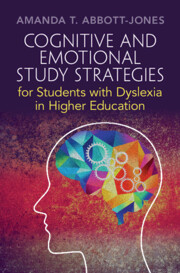
Amanda T. Abbott-Jones provides practical and motivational guidance for dyslexic learners in higher education. It presents effective strategies appropriate for dealing with an array of study tasks including note taking, essay writing, reading, exams etc., while also delivering targeted emotional support. Pragmatic methods are delivered from the voices of students with dyslexia who have first-hand experience of fine-tuning study techniques, making learning suitable for how the dyslexic brain processes and memorises information to become successful in the academic world. As such, this book does not simply present strategies from an educational perspective, but instead draws on the wealth of empirical knowledge from the source of dyslexia – the dyslexic people themselves. This gives readers a collective shared identity, which has been previously lacking, teamed with valuable advice on ways to overcome cognitive and emotional difficulties by using appropriate strategies to enable people with dyslexia to flourish in the university environment.
Recommend this
Email your librarian or administrator to recommend adding this to your organisation's collection.