To save content items to your account,
please confirm that you agree to abide by our usage policies.
If this is the first time you use this feature, you will be asked to authorise Cambridge Core to connect with your account.
Find out more about saving content to .
To save content items to your Kindle, first ensure no-reply@cambridge.org
is added to your Approved Personal Document E-mail List under your Personal Document Settings
on the Manage Your Content and Devices page of your Amazon account. Then enter the ‘name’ part
of your Kindle email address below.
Find out more about saving to your Kindle.
Note you can select to save to either the @free.kindle.com or @kindle.com variations.
‘@free.kindle.com’ emails are free but can only be saved to your device when it is connected to wi-fi.
‘@kindle.com’ emails can be delivered even when you are not connected to wi-fi, but note that service fees apply.
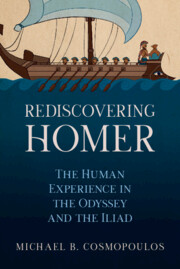
The prologue frames the Iliad and the Odyssey as poems that speak to the aftermath of violence. Rather than treating war as an episode that ends when fighting stops, it introduces the book’s central claim: Homeric epic preserves the textures of lived experience, including silence, grief, and the long work of rebuilding. It also explains the book’s approach, combining archaeology and close reading for general readers and students.
A timeless tale of a heroic character's journey through life, Homer's Odyssey has captured the imagination of readers from antiquity to the present day. Michael Cosmopoulos approaches this epic, together with the Iliad, not as remote works of literature, but as a living record of human experience shaped by war, loss, memory, and survival. He offers a poignant exploration of the aspects and consequences of war as captured in the Odyssey, including trauma, leadership and politics, human relations, religion and fate, and the struggle to return home and rebuild after upheaval. Cosmopoulos also situates both the Iliad and the Odyssey within the social conditions and the material realities of Greek society during the Aegean Bronze Age. Based on decades of archaeological field work and study of classical antiquity, and written in an accessible style, his book powerfully demonstrates how the poetry of ancient Greece preserves collective memory across the generations – and why these poems still speak to modern readers.
This chapter examines how the records of the poor law, including petitions to magistrates, reveal everyday attitudes towards deafness in early modern England. These records show that deafness was rarely treated as a disabling condition in itself; deaf men and women were generally expected to work, contribute to their households, and support themselves. When deaf people did seek relief, their petitions almost always combined deafness with another factor – old age or illness for example – indicating that deafness alone was not considered sufficient grounds for charitable support. Yet the material also shows how deafness increased vulnerability to life cycle poverty, heightening the risks of unemployment. The language of care, seen in these petitions and in private family trusts for deaf relatives, was sometimes protective but could also function as a mechanism of control, framing deaf petitioners as dependent or incapable. The chapter argues that tensions between expectation of independence and protective oversight shaped the lived experience of many deaf people within early modern systems of welfare or justice
Union veterans faced significant challenges returning to civilian life. The war had removed them from civil society, collected them into vast armies where new social norms prevailed, subjected them to hardship, introduced them to different geographies and climates, and often exposed them to combat trauma. Readjusting to civilian norms was difficult in a society that expected them to quietly resume their prewar lives. As a result, many veterans left their antebellum communities and moved west. Those who reinvented themselves on the frontier differed from the overall Union veteran population. They were more mobile both before and after the war, served longer enlistments, were more likely to have been wounded or have encountered wartime trauma, and often either consciously or unconsciously compensated for their exposure to trauma when choosing where to settle and with whom to interact. The frontier provided the mechanism they needed to reclaim their lives. The nuances of veteran migration to the frontier cannot be fully understood without accounting for both the war and its aftermath, blurring the line between “military history” and “war and society” as paradigms of analysis.
Since the 19th century, the U.S. military has grown increasingly adept at saving the lives of troops injured in combat. Yet rising survivability rates, coupled with social attitudes linking disability to diminished manhood and economic dependency, contributed to a perceived national crisis about what came to be known as the “problem of the disabled veteran” (PDV). What is U.S. federal policy toward disabled veterans? What is its aim—to keep veterans alive or to help them reintegrate into postwar society? And how might the U.S. military curb disability in future conflicts? Drawing upon works in disability studies, military history, and war and society studies, this chapter surveys the evolution of U.S. efforts to solve the PDV, from the colonial era to the present. In World War I, when the term originated, anxieties about war disability prompted the federal government to embrace the policy of veterans’ rehabilitation. In later years, the military would explore other ways to limit U.S. wartime casualties, disabled or otherwise. Ultimately, this chapter argues that the PDV stems from the United States’ failure to come to terms with the violence and trauma of military conflict.
This article reflects on the state of war and society scholarship in the context of current global conflicts. It argues for bridging the gap between traditional military history and the war and society school to gain a deeper understanding of war's complexities. It uses examples from contemporary conflicts and historical analyses to explore themes such as comradeship, gender, memory, and culture, demonstrating their relevance in interpreting modern warfare. In emphasizing the importance of interdisciplinary approaches in examining war's multifaceted impact on societies and individuals, it calls for war and society scholars to engage more directly with contemporary issues, applying their insights to foster a more nuanced comprehension of the roots and implications of war.
Among military veterans, loneliness is common and associated with poorer mental and physical health and functioning. Epidemiological studies have revealed bidirectional, longitudinal associations between loneliness and posttraumatic stress disorder (PTSD). Little is known about loneliness among treatment-seeking veterans, how loneliness impacts PTSD symptom change during treatment, and whether loneliness has differential associations with specific PTSD symptom clusters.
Method
Data were derived from the Veterans Outcome Assessment, an annual, repeated-measures (baseline and 3-month follow-up) telephone survey of patients beginning new episodes of mental health care in the Department of Veterans Affairs. Participants were 1,155 veterans (23% women) entering PTSD specialty care. We tested whether baseline loneliness predicted change in total PTSD symptom severity and according to the five-factor Dysphoric Arousal model of PTSD using hierarchical regressions in which we statistically adjusted for demographics and mental health encounters.
Results
Loneliness decreased between baseline and 3-month follow-up (d = 0.39). Baseline loneliness predicted change in PTSD for the dysphoric arousal and negative alterations in cognitions and mood symptom clusters, with lonelier veterans demonstrating more PTSD change between baseline and follow-up. However, lonelier veterans also had more severe PTSD symptoms at both timepoints. This pattern of results held even after accounting for different types of treatment encounters between timepoints.
Conclusions
While lonelier veterans have more severe PTSD symptoms, they also make greater improvements in symptoms salient to interpersonal functioning over time. Assessment of loneliness should be incorporated into PTSD treatment planning and considered as a treatment target that could be addressed to promote recovery.
This chapter focuses on the cultures of war victory in Czechoslovakia, Yugoslavia, and their successor states, a topic which illustrates global themes in the history and memory of war in the twentieth century and beyond. The First World War left a complex legacy of societal division, conflicting experiences, memories, continuities, and ruptures. This chapter shows how a complex legacy evolved in the twentieth century, and how it was reshaped by successive regimes and political orders to better fit shifting political interpretations of global history.
This volume provides the most expansive interrogation to date of the field of war and society, offering a magisterial overview of the American experience of war from the colonial era to the War on Terror. It brings together leading scholars to examine how societies go to war, experience it, and invest it with meaning. Those ideas unfold across three thematic sections entitled 'War Times,' 'War Societies,' and 'War Meanings.' The essays scrutinize the symbiotic relationship between warfare and the armed forces on one side, and broader trends in political, social, cultural, and economic life on the other. They consider the radiating impact of war on individuals, communities, culture, and politics – and conversely, the projection of social patterns onto the military and wartime life. Across three sections, thirty chapters, and a roundtable discussion, the volume illuminates the questions, methodologies, and sources that exemplify war and society scholarship at its very best.
Few studies have examined how differing diagnostic criteria for mild cognitive impairment (MCI) relate to neuroimaging markers of cerebrovascular disease and neurodegeneration in Veterans. We compared three MCI diagnostic schemes on their associations with white matter hyperintensity (WMH) burden, hippocampal volume, and cortical thickness in nondemented Vietnam-era Veterans.
Methods:
228 Veterans (mean age = 69.65) were classified using: (1) Alzheimer’s Disease Neuroimaging Initiative (ADNI) criteria (subjective memory concerns, impaired Logical Memory, global Clinical Dementia Rating = 0.5); (2) neuropsychological criteria (>1 standard deviation [SD] below norms on two tests within a domain or one test across three domains); and (3) typical criteria (subjective memory concerns and >1.5 SD below norms on one test). Regression models predicting WMH burden adjusted for age and intracranial volume and included MCI status and hippocampal volume; ADNI-based models also included posttraumatic stress disorder symptom severity.
Results:
Neuropsychological criteria were associated with greater WMH burden (β = 0.45, p = .024), whereas typical and ADNI criteria were not. Sensitivity analyses found that meeting neuropsychological criteria for amnestic MCI interacted with lower hippocampal volume to predict greater WMH burden (β = −0.001, p = .028). No criteria were associated with cortical thickness.
Conclusions:
Neuropsychological criteria more sensitively identified Veterans with greater WMH burden and demonstrated a small, hippocampal volume-dependent effect in amnestic MCI. These findings support the clinical utility of multi-test neuropsychological approaches for detecting complex brain changes in high-comorbidity populations, with implications for risk stratification and targeted intervention in aging Veterans.
In the 1950s Britain joined the nuclear age, detonating 21 nuclear bomb experiments in Australia and the Pacific. In Injurious Law Catherine Trundle crosses countries and traverses decades to explore the lingering, metamorphizing impacts of radiation exposure and militarism. Through a compelling portrait of the lives of test veterans seeking compensation and healthcare, Trundle reveals how injury law, and the political and medical processes upon which it depends, generates a troubling paradox for claimants. While offering the possibilities for recognition and redress, the very process of making injury claims generates new and cascading harms. Recasting injury to include its social, moral and political aftereffects, Trundle exposes the quotidian and often banal practices that make the law injurious. Moving between archives, living rooms, laboratories, courts, parliament, and veteran social gatherings, Injurious Law offers a justice-centred lens for understanding legal contestations in the aftermath of radiation exposure and other invisible environmental harms.
The fifth chapter turns to war and peace. The role of England’s poor relief system in assisting war efforts has been suggested by scholars. This chapter argues that were it not for the development of settlement laws, one can only wonder whether the ‘fiscal-military state’ would have enjoyed such support. The chapter shows how the responsibilities of the parish officer expanded to assist the fiscal-military state, and the roles taken by the county administration. It also explains how the New Militia, established at the start of the Seven Years’ War, relied on the parish’s administrative apparatus and employed the settlement legislation in sophisticated ways. However, as time went by complexities arose. The greater the needs of recruitment and disbandment, the more the eighteenth-century state relied on the mechanisms of parish settlement; at the same time, military needs also led to partial suspension of the settlement laws.
To evaluate the feasibility and preliminary efficacy of a clinical program designed to teach informal caregivers of older Veterans with pain and mild-to-moderate dementia or mild cognitive impairment (MCI), pain management, pain coping and pain communication skills.
Methods
Twenty caregivers of older Veterans with pain and dementia or MCI and the Veterans themselves participated in a 5-session program taught by trained Veterans Affairs (VA) clinicians. All sessions were conducted remotely using video-technology, with caregivers and Veterans. Two sessions were conducted with individual Veteran-caregiver dyads, and three sessions were conducted with caregiver groups. Caregivers and Veterans completed baseline and post-intervention measures. Qualitative interviews of 10 caregivers who completed the program were also conducted and focused on identifying themes related to caregiving for their loved ones with pain and dementia and related to participating in the program.
Results
The program was well received and almost all caregivers identified videoconferencing as the preferred venue for participating in such a program. They most valued learning about dementia and participating with other caregivers. Pre-post analyses revealed significant improvements in perceived caregiving competence and self-efficacy for managing pain. Challenges encountered included scheduling related to caregivers’ multiple competing responsibilities and lack of familiarity with tele-conferencing technology.
Significance of results
Patients with pain and mild to moderate dementia or MCI have been relatively ignored in current literature. Our preliminary findings suggest that a program delivered by trained healthcare professionals to caregivers and Veterans using tele-conferencing could benefit caregivers.
Negative metacognitive bias, underestimating one’s abilities, is consistently linked to psychopathology, yet prior work has often collapsed anxiety/stress and depression or examined depression alone. We tested the unique associations of depression, anxiety/stress, and posttraumatic stress disorder (PTSD) with metacognitive bias in post-9/11 veterans.
Methods:
Veterans from the Translational Research Center for TBI and Stress Disorders (TRACTS, N = 601; 90% male; M age = 34.31) completed 21-item Depression, Anxiety, and Stress Scale (depression, anxiety/stress), CAPS-IV (PTSD), WHODAS-II Understanding/Communicating (self-reported cognition), and an objective cognition composite (assessment of executive function, memory, and attention). Bias was computed as self-report minus objective cognition. A subsample (n = 239) repeated testing ∼2 years later.
Results:
At time 1, more negative metacognitive bias was associated with greater anxiety/stress (r = −.41), depressive (r = −.37), and PTSD symptoms (r = −.31) (all ps < .001). In a simultaneous model, anxiety/stress (β = −.29 p < .001) and depressive symptoms (β = −.12, p = .045) explained unique variance though PTSD symptoms did not (β = −.03, p = .524). Longitudinally, changes in bias were uniquely predicted by symptom changes in anxiety/stress (β = −.33, p < .001) and PTSD (β = −.16, p = .001), but not depression (β = −.10, p = .137).
Conclusions:
Across cross-sectional and longitudinal models, anxiety/stress emerged as the most consistent correlate of metacognitive bias, with weaker contributions from depression and PTSD. These findings highlight the importance of assessing the self-report versus objective cognition gap and the need to further understand the temporal relationship between anxiety/stress and metacognitive bias.
This study examines Norwegian veterans’ construction of meaning of the war in Afghanistan with two main objectives. A first aim is to add empirically to research on veterans’ meaning-making, querying into veterans’ construction of meaning after failure in a recent military operation. A thematic analysis of interviews with fifteen veterans illustrates how, despite their own admission of the war’s limited overall achievements, Norwegian veterans rendered the war meaningful. They emphasised that they had done their job, realised themselves as individuals, experienced community, made a difference ‘then and there’, and served their country. Working towards a second aim – to enhance scholarly understanding of civil–military dynamics in relation to veterans’ experiences – the study discusses implications of this meaning-making for Norwegian civil–military relations. Two main arguments are set forth: (1) a significant discrepancy in the construction of meaning among veterans compared to the Norwegian public illustrates a societal–military gap in evaluations of the war and (2) a reciprocal distance between veterans and politics and society demonstrates a weakness in civilian control of the Norwegian Armed Forces. By way of conclusion, the study reflects on consequences of its findings.
This study evaluated the impact of a novel social prescribing service designed specifically for the Armed Forces Community (AFC) and its influence on service users’ wellbeing.
Background:
Social prescribing connects individuals with non-clinical, community-based support to address loneliness, long-term conditions, and mental health. Despite advances in social prescriber training, a gap remains in resources for working with the AFC, who present distinct wellbeing needs. A two-year project, funded by the NHS Armed Forces Health and the Armed Forces Covenant Fund Trust, sought to enhance provision by equipping Social Prescriber Link Workers with specialist skills.
Methods:
A sequential mixed-method design was adopted. Quantitatively, changes in wellbeing for 259 AFC service users were measured using the Short Warwick and Edinburgh Wellbeing Scale before and after consultations with Armed Forces Social Prescriber Link Workers (AFCSPLWs). Qualitatively, semi-structured interviews were undertaken with AFCSPLWs, general social prescribers, General Practitioners, and AFCSPLW line managers to explore experiences of service delivery.
Findings:
Wellbeing scores significantly increased from initial (mean = 15.3) to final consultations (mean = 18.79), indicating positive effects; however, scores remained lower than national averages, reflecting the complex needs within the AFC population. Thematic analysis identified four themes: Armed Forces Experience and Perspective, Challenges and Barriers, Service Delivery and Effectiveness, and Skill Development and Attributes. Subthemes highlighted AFC-specific challenges, the practical complexity of the AFCSPLW role, and the importance of cultural competence. Advocacy, navigation, and relationship-building emerged as central mechanisms, with AFCSPLWs acting as vital connectors across primary care, third-sector services, and professional networks.
Veterans Affairs Medical Centers offer multiple weight-loss treatments, including a comprehensive lifestyle intervention program (i.e., MOVE!), anti-obesity medications (AOMs) and bariatric surgery. Yet, most eligible veterans do not receive these treatments.
Aim:
To describe the design, rationale, and planned evaluation of a comprehensive Weight Management and Metabolic Health program (WMMHP), consisting of (1) weight-focused visits with physicians or pharmacists trained in obesity medicine; (2) patient-centered use of available weight-loss treatments; and (3) coordinated, team-based care.
Methods:
This is a quality improvement program implemented within the VA Ann Arbor Healthcare System. WMMHP eligibility criteria include body mass index (BMI) ≥ 30 kg/m2 or BMI ≥ 27 kg/m2 and ≥ 1 weight-related condition and participation in the MOVE! program. We plan to conduct an 18-month retrospective program evaluation using a propensity-matched cohort analysis to estimate the added benefit of WMMHP vs. MOVE! alone. The primary outcome will be mean change in weight at 18 months after baseline. Secondary outcomes will include mean weight loss at 6, 12, and 24 months, percentage of patients achieving thresholds of ≥ 5%, ≥ 10%, and ≥ 15% weight loss, initial prescriptions for and refilled prescriptions as a measure of adherence to AOMs, and referrals to, engagement with, and completion of bariatric surgery. We will also examine between-group differences in health system resource utilization.
Discussion:
The WMMHP is an innovative approach to improving treatment and outcomes for veterans with overweight and obesity. If effective, its components may inform obesity care delivery in VA and non-VA settings.
The use of Latin alongside Greek in Roman soldiers’ private documents on papyrus or tablet has already been approached by modern scholarship. However, new evidence allows a further exploration of this topic and a reassessment of some of the results reached so far. Therefore, this chapter investigates three case studies based on this new evidence: the use of the tribal designation, the use of Latin in marriage agreements, and the use of Latin in Roman testaments. The following questions are addressed: What kind of Latin did Roman soldiers and veterans use? Under what circumstances? And why? What can we learn from new evidence? Does it strengthen or challenge traditional hypotheses? The investigation contributes to our understanding of the significance of written documentation in the daily lives of Roman soldiers and veterans and of the usages of the Latin language, script, or culture in their private documents. The new evidence considered sometimes strengthens and at other times challenges traditional hypotheses, showing how complex the relationship was between the Latin and Greek languages, scripts, and cultures in the Graeco-Roman eras.
What do people in liberal polities believe they owe soldiers for their service? The UK’s Armed Forces Covenant, promulgated in 2000 and enshrined in law in 2021, presents a real-world opportunity to examine the effects of inducing citizens to reflect on soldiering. We develop and test two contending theoretical logics, grounded in the liberal political culture from which the Covenant emerged, using unique observational data and a novel survey experiment. Does prior knowledge of the Covenant or exposure to a Covenant prime highlight the abiding tensions between liberal ideals and military service and underscore the debt that citizens owe soldiers? Or does it prompt liberal citizens to resolve their discomfort with military service in a distinctively liberal way – by emphasising soldiers’ contractual terms and their willing consent to deployment? In line with the latter logic, respondents with prior knowledge of the Covenant or exposure to the Covenant prime were more likely to endorse the use of force and were less sensitive to casualties, and they were no more likely to grant soldiers and veterans additional benefits or preferential treatment. This paper has significant implications for public support for military missions and the relationship between military service and citizenship.
Collective memory of a historical event does not depend on its contemporary and historiographical significance alone. Germany’s selective memory of the Eastern Front is a case in point. It has been influenced by four developments. The problem of the prisoners of war that had remained in the Soviet Union, the ‘returnees’, and the veterans underlined the importance of the Eastern Front among the West German public. The Stalingrad myth, in particular, had a decisive influence on an image of war (in the East), according to which the Germans considered themselves first and foremost victims of that war. The critical discussion of the war and its nexus with the Holocaust after 1970 led to a turning point wherein the victims of the Germans became the focus of remembrance in West Germany. In the socialist satellite state of East Germany, the heroization of the Red Army was a characteristic feature of public war memories. Commemorations of the Eastern Front changed again in unified Germany after the Cold War – from the early years of Russia’s rapprochement to the dramatic deterioration of the German-Russian relationship.