To save content items to your account,
please confirm that you agree to abide by our usage policies.
If this is the first time you use this feature, you will be asked to authorise Cambridge Core to connect with your account.
Find out more about saving content to .
To save content items to your Kindle, first ensure no-reply@cambridge.org
is added to your Approved Personal Document E-mail List under your Personal Document Settings
on the Manage Your Content and Devices page of your Amazon account. Then enter the ‘name’ part
of your Kindle email address below.
Find out more about saving to your Kindle.
Note you can select to save to either the @free.kindle.com or @kindle.com variations.
‘@free.kindle.com’ emails are free but can only be saved to your device when it is connected to wi-fi.
‘@kindle.com’ emails can be delivered even when you are not connected to wi-fi, but note that service fees apply.
Anaïs Nin in Context restores Nin as a central voice of twentieth-century literature. Best known for her diaries and erotica, Nin was also an experimental novelist, essayist, and cultural figure, whose work resonates with questions of sexuality, creativity, and identity. This volume assembles an international team of scholars to explore Nin's life and legacy across seven thematic sections: life and genres; interpersonal and artistic influences; subjectivity and the mind; gender and women's rights; geographical settings; sociocultural contexts; and reception. Together, the thirty-four essays situate Nin within artistic circles from Paris to New York, examine her engagement with feminism and psychoanalysis, and trace her enduring afterlife in film, graphic novels, and contemporary scholarship. Accessible yet rigorous, Anaïs Nin in Context will serve students, researchers, and readers eager to reassess Nin's contributions and understand her as a cosmopolitan writer, whose voice continues to speak to issues pertaining to the woman artist.
Now twenty-five years into the twenty-first century, the formidable legacies of Gwendolyn Brooks (1917–2000) come into clear view. She lent her lyrical voice to celebrating the dignity, complexity, and heroism of ordinary people. Her portraits of the residents of Chicago’s South Side, where she lived most of her life, achieve vitality because of her skillful fusion of Black cultural tradition with modernist aesthetics. She saw her poetry chronicling the history of a transforming society in the service of truth and universal humanism. Brooks wanted her poetry “to vivify the universal fact,” and early in her writing career she found that humanism all around her as she looked from the window of her small second-floor apartment at 623 East 63rd Street. This chapter discusses Brooks as the singular inspiration for the inaugural Furious Flower Conference in 1994, her passion for inspiring young people to explore their gifts of writing and reading, her own distinguished career as an award-winning American poet, and her deep devotion to the craft of writing and the inventiveness of language.
Doubling as a theorist of literary character, Virginia Woolf was invested in the tribulations of the modern face, which she approached through the twin genres of portraiture and biography. This chapter revolves around Woolf’s staging of the modernist face in her novel Orlando: A Biography (1928). Woolf’s novel traces a change in the history of the physiognomic face in modernity – from Orlando’s memorable face-to-face with Queen Elizabeth in the early modern period to her search for meaning in the faces around her in London in 1928. At the same time, Woolf’s novel functions as a portrait of Vita Sackville-West, introducing a queer woman into the gallery of memorable historical characters, which Woolf visualized in relation to the all-male National Portrait Gallery in London. Through an engagement with Paul Mpagi Sepuya’s recent photographic reflections on Orlando, developed as a response to the racialized opening of the novel, the chapter frames modernist faciality’s mediation by racial difference.
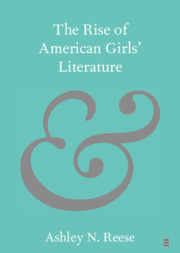
This Element looks at the publishing history of the genre, girls' literature, in the United States spanning 1850–1940. The genre is set in context, beginning with an examination of the early American women's literature that preceded girls' literature. Then the Element explores several sub-genres of girls' literature, the family story, orphan story, school story, as well as African American girls' literature. Underpinning each of these stories is the bildungsroman, which overwhelmingly ends with girls 'growing down' to marry and raise children, following the ideals outlined in the cult of domesticity.
Recommend this
Email your librarian or administrator to recommend adding this to your organisation's collection.