About Boydell Studies in Medieval Art and Architecture
This series aims to provide a forum for debate on the art and architecture of the Middle Ages. It will cover all media, from manuscript illuminations to maps, tapestries, carvings, wall-paintings, and stained glass, and all periods and regions, including Byzantine art.
To save content items to your account,
please confirm that you agree to abide by our usage policies.
If this is the first time you use this feature, you will be asked to authorise Cambridge Core to connect with your account.
Find out more about saving content to .
To save content items to your Kindle, first ensure no-reply@cambridge.org
is added to your Approved Personal Document E-mail List under your Personal Document Settings
on the Manage Your Content and Devices page of your Amazon account. Then enter the ‘name’ part
of your Kindle email address below.
Find out more about saving to your Kindle.
Note you can select to save to either the @free.kindle.com or @kindle.com variations.
‘@free.kindle.com’ emails are free but can only be saved to your device when it is connected to wi-fi.
‘@kindle.com’ emails can be delivered even when you are not connected to wi-fi, but note that service fees apply.
A lavishly illustrated study of the Welles-Ros Bible, exploring its provenance, ownership, design and production.
At some point between c.1366 and 1373, the noblewoman Maud de Ros, widow of the Lincolnshire baron John de Welles, commissioned what is now the earliest surviving entire translated Bible from England. The Welles-Ros Bible contains the most complete edition of the Anglo-Norman Bible - a close, often literal translation of the Vulgate into insular French - as well as 82 narrative, highly personalized illustrations.
As this first long-form study of the manuscript argues, Maud commissioned the Bible to serve as a mirror, guide, family archive, dynastic chronicle, and source of spiritual instruction and consolation for her youthful son, John, 5th Baron Welles (1352-1421). Moreover, Maud played a key role in the production of the text edition and the design of many of the images. This book analyzes the manuscript, its text, and its vivid illuminations in the context of rich traditions of medieval biblical translation, production, and illustration, offering fresh insights into the roles of images in shaping and mediating scripture and religious experience. Adding to our understandings of life among the lower nobility in later fourteenth-century England, this cultural history of a major artefact also expands our picture of the cultural patronage and creative agency of laywomen, as well as medieval strategies of memorialization, responses to the Plague, and ideas about gender, identity, sexuality and the emotions.
Explores the commemoration and memorialisation of the Canterbury martyr in visual and material culture.
In life, and especially in death, Thomas Becket was nothing short of a medieval celebrity, whose significance spanned the European high Middle Ages in to the sixteenth-century. Henry VIII's suppression of his cult in 1536 only served to enhance his popularity elsewhere. Visual depictions of his life, high-profile careers, spectacular demise, and posthumous legacies, are numerous. These images document both the extent, and the efficacy, of his invocation across religious, political and civic agendas. Becket remains the stuff of literature and legend, art, drama and cultural commodification.
This volume explores Becket imagery, both in such traditional media as stained glass and illuminated manuscripts, and less common objects: toys, baptismal fonts, and vernacular almanacs. Its essays provide new interpretations of the archaeological, iconographic, and historiographic spectrum of Becket imagery by, for example, deconstructing religious-secular binaries in the study of pilgrim badges and revising long-established interpretations of Canterbury stained glass. They also expand the Becket visual canon into broader geographic and temporal contexts, from medieval Denmark and Spain to eighteenth- and nineteenth-century Britain and twenty-first-century Boston. Meanwhile, contributions which look at the appropriation and use of Becket imagery in the aftermath of the English Reformation break new ground in scrutinizing a subject well traversed in text, but that has only begun to be explored in visual and material culture.
"This innovative, wide-ranging and erudite book illuminates the sophistication of artistic exchange at this time and place." Costanza Beltrami, Stockholm University.
Sculptors and painters produced exceptional, and sometimes eccentric works of art in the middle decades of the twelfth century in Iberia. The high-level artistic expertise needed to produce such works could be gifted, loaned, and even stolen in the same way as other precious items. It could be moved, like a commodity, across networks forged by reforming churchmen and rulers that traversed the Pyrenees and the Peninsula. Much of this sculpture and wall-painting shows an ability to play with the different repertoires that emerged from these established routes of exchange.
The pilgrimage roads of the Codex Calixtinus have had a strong imaginative pull and even been invoked to explain such artistic production. By contrast, this book argues that the more playful and satirical aspects of that manuscript - the pseudonyms, exaggerated claims, and pointed selections - resonate not only with a wider culture of forged charters and re-invented institutional histories but also with the imaginative, eclectic, and sometimes ludic art of these decades. This art encompasses sculpted church façades, painted interiors, illuminated missals and cartularies, as well as carved Atlas figures that encapsulate the complex status of the artists who made them.
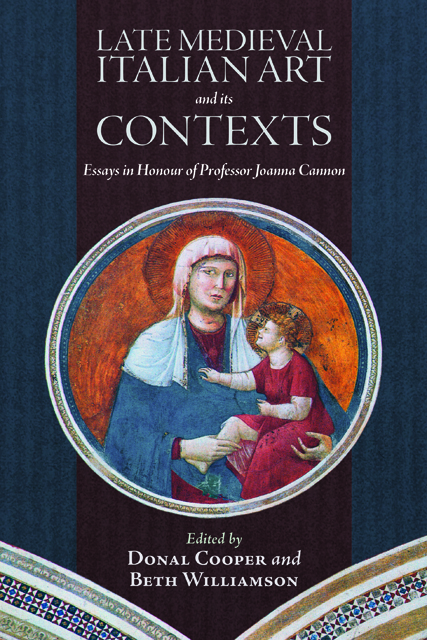
Joanna Cannon's scholarship and teaching have helped shape the historical study of thirteenth- and fourteenth-century Italian art; this essay collection by her former students is a tribute to her work.
Representations of monsters and the monstrous are common in medieval art and architecture, from the grotesques in the borders of illuminated manuscripts to the symbol of the "green man", widespread inchurches and cathedrals. These mysterious depictions are frequently interpreted as embodying or mitigating the fears symptomatic of a "dark age". This book, however, considers an alternative scenario: in what ways did monsters in twelfth-century sculpture help audiences envision, perhaps even achieve, various ambitions? Using examples of Romanesque sculpture from across Europe, with a focus on France and northern Portugal, the author suggests that medieval representations of monsters could service ideals, whether intellectual, political, religious, and social, even as they could simultaneously articulate fears; he argues that their material presence energizes works of art in paradoxical, even contradictory ways. In this way, Romanesque monsters resist containment within modern interpretive categories and offer testimony to the density and nuance of the medieval imagination.
Kirk Ambrose is Associate Professor & Chair, Department of Art and Art History, University of Colorado Boulder.
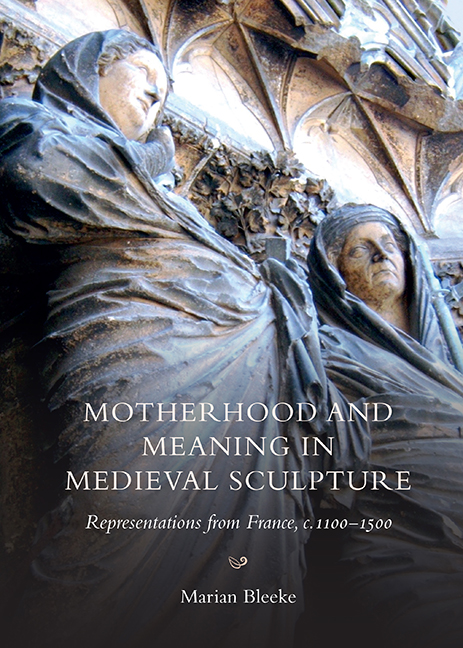
What can medieval sculptural representations of women tell us about medieval women's experiences of motherhood? Presumably the work of male sculptors, working for clerical patrons, these sculptures are unlikely to have been shaped by women's maternal experiences during their production. Once produced, however, their beholders would have included women who were mothers and potential mothers, thus opening a space between the sculptures' intended meanings and other meanings liable to be produced by these women as they brought their own interests and concerns to these works of art.Building on theories of reception and response, this book focuses on interactions between women as beholders and a range of sculptures made in France in the twelfth through sixteenth centuries, aiming to provide insight into women's experiences of motherhood; particular sculptures considered include the Annunciation and Visitation from Reims cathedral, the femme-aux-serpents from Moissac, the transi of Jeanne de Bourbon-Vendome, the Eve from Autun, and a number of French Gothic Virgin and Child sculptures.Marian Bleeke is Associate Professor of Art History and Chair of the Department of Art and Design at Cleveland State University.
Often fragmented and without context, early medieval inscribed and sculpted stone monuments of the fifth to eleventh centuries AD have been mainly studied via their shape, their decoration and the texts a fraction of them bear. This book, investigating stone monuments from Ireland, Britain and Scandinavia (including the important memorials at Iniscealtra, County Clare), advocates three relatively new, distinctive and interconnected approaches to the lithic heritage of the early Middle Ages. Building on recent theoretical trends in archaeology and material culture studies in particular, it uses the themes of materiality, biography and landscape to reveal how carved stones created senses of identity and history for early medieval communities and kingdom. An extensive introduction and eight chapters span the disciplines of history, art-history and archaeology, exploring how shaping stone in turn shaped and re-shaped early medieval societies.Howard Williams is Professor of Archaeology, University of Chester. Joanne Kirton is Project Manager, Big Heritage, Chester. Meggen Gondek is Reader in Archaeology, University of Chester.Contributors: Ing-Marie Back Danielsson, Iris Crouwers, Meggen Gondek, Mark A. Hall, Joanne Kirton, Jenifer Ní Ghrádaigh, Clíodhna O'Leary, Howard Williams.
On the facade of Chartres cathedral serene personifications of the arts of grammar, rhetoric, dialectic, music, arithmetic, geometry and astronomy present passers-by with a vision of education as an improving process leading to greater knowledge of God. The arts proved a popular subject in medieval imagery, and were included in manuscripts, stained-glass and luxury metalwork objects as well as onthe facades of churches. These idealized figures contrast with many textual accounts of education, in which authors recorded the hardships of student poverty and the temptations of drink and women tobe found in the cities where teachers were increasingly establishing themselves. This book considers how and why education was explored in the art and architecture of the twelfth century. Through analysis of imagery in a wide range of media, it examines how teachers and students sought to use images to enhance their reputations and the status of their studies. It also investigates how the ideal models often set out in imagery compared with contemporary practice in an era that saw significant changes, beginning with a shift away from monastic education and culminating in the appearance of the first universities.
Laura Cleaver is Ussher Lecturer in Medieval Art at Trinity College Dublin.