The Church of England Record Society (COERS) was founded in 1991 and aims to promote interest in and knowledge of the Church of England from the sixteenth century onwards. Since 1994, the Society has published volumes illustrating all periods of church history since the Reformation. Their publications are an invaluable resource for British social and political history, church history and religious studies. Publications include editions of primary material of significance for the history of the Church of England, whether in the form of letters, diaries, treatises, visitation articles, or other documents. COERS publishes material of national interest and so is not in competition with local or county record societies.
To save content items to your account,
please confirm that you agree to abide by our usage policies.
If this is the first time you use this feature, you will be asked to authorise Cambridge Core to connect with your account.
Find out more about saving content to .
To save content items to your Kindle, first ensure no-reply@cambridge.org
is added to your Approved Personal Document E-mail List under your Personal Document Settings
on the Manage Your Content and Devices page of your Amazon account. Then enter the ‘name’ part
of your Kindle email address below.
Find out more about saving to your Kindle.
Note you can select to save to either the @free.kindle.com or @kindle.com variations.
‘@free.kindle.com’ emails are free but can only be saved to your device when it is connected to wi-fi.
‘@kindle.com’ emails can be delivered even when you are not connected to wi-fi, but note that service fees apply.
A history of the annual British and Irish state and religious anniversaries and occasions of special worship from the sixteenth century to the present.
Since the sixteenth century, the governments and established churches of Britain and Ireland have summoned their nations to special acts of public worship during crises, wars and times of celebration, or for annual days of commemoration and remembrance. These special prayers, special days of worship and religious anniversaries were national events, reaching into every parish. They had considerable religious, ecclesiastical, political, ideological, moral and social significance, and they produced important texts: proclamations, council orders, addresses and - in England and Wales, and in Ireland - prayers or complete liturgies which temporarily supplemented or replaced the services in the Book of Common Prayer, and most recently in Common Worship. National Prayers. Special Worship since the Reformation in four volumes, provides the edited texts, commentaries and source notes for over 900 occasions of special worship and for each of the annual commemorations.
The final volume, Anniversary Commemorations, Additional Material and Indices, 1533-2023, describes the orders and services for the nine early modern state anniversaries, including Accession day, Gowrie day, Gunpowder Treason day, Restoration day, and commemoration of Charles I's execution and the Great Fire of London, and for the modern state anniversaries of Armistice day and Remembrance Sunday. It includes materials on particular occasions of special worship for 2016-23, including the Covid pandemic, commemoration of Prince Philip, platinum jubilee and funeral of Elizabeth II, and coronation of Charles III. Appendices provide supplementary material for the whole period of the edition, including extensive additions to the list of particular occasions of special worship observed from 1533 to 1660. An index of biblical references and a general index are provided for all four volumes of the edition.
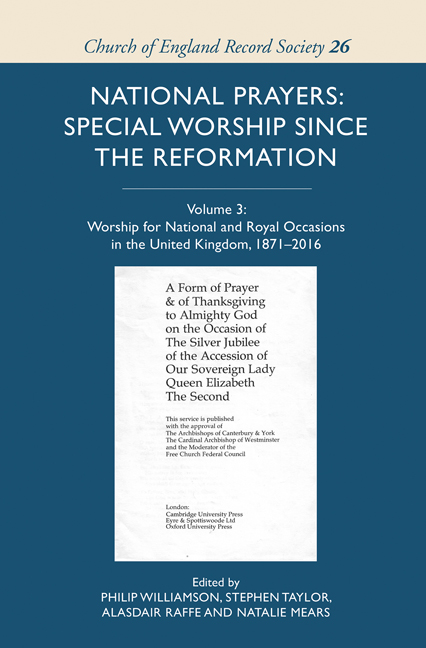
The third of four volumes, containing the edited texts, commentaries and source notes for each of the nearly nine hundred occasions of special worship including the development of national days of prayer during the two world wars, and a proliferation of nation-wide services for royal occasions.
The Right Reverend Llewellyn Gwynne's diaries offer a unique insight into a period of change for the army, chaplains and the Church of England during a critical period of the First World War.
The Speculum compiled by Archbishop Thomas Secker (1758-68) is a major source for our understanding of the position of the Church of England in the mid-eighteenth century. A parish by parish digest of the returns submitted to the archbishop between 1758 and 1761, in the main for the diocese of Canterbury but including several others. It contains very full information on such matters as the size and social structure of the parishes; the names and qualifications of the clergy; their wealth; and their relations with Roman Catholics and protestant dissenters. Part of the significance of the Speculum is its witness of the pastoral pressure applied by Secker, allowing the historian to assess how far an energetic archbishop was able to improve the standards of pastoral provision in the parishes under his care. This edition has attempted to preserve the spelling and capitalisation of the original, and editorial notes give biographical information on the large number of persons mentioned in the text, as well as identifying other textual allusions. JEREMY GREGORY is Lecturer in History at the University of Northumbria.
The correspondence of William Laud, archbishop of Canterbury from 1633 to 1645, provides revealing insights into his mind, methods and activities, especially in the 1630s, as he sought to remodel the church and the clerical estate in the three kingdoms.
This first miscellany volume to be published by the Church of England Record Society contains eight edited texts covering aspects of the history of the Church from the Reformation to the early twentieth century. The longest contribution is a scholarly edition of W.J. Conybeare's famous and influential article on nineteenth-century "Church Parties"; other documents included are the protests against Archbishop Cranmer's metropolitical powers of visitation, the petitions to the Long Parliament in support of the Prayer Book, and Randall Davidson's memoir on the role of the archbishop of Canterbury in the early twentieth century. Stephen Taylor is Professor in the History of Early Modern England, University of Durham. Contributors: PAUL AYRIS, MELANIE BARBER, ARTHUR BURNS, JUDITH MALTBY, ANTHONY MILTON, ANDREW ROBINSON, STEPHEN TAYLOR, BRETT USHER, ALEXANDRA WALSHAM
The English Reformation began as a dispute over questions of canon law, and reforming the existing system was one of the state's earliest objectives. A draft proposal for this, known as the Henrician canons, has survived, revealing the state of English canon law at the time of the break with Rome, and providing a basis for Cranmer's subsequent, and much better known, attempt to revise the canon law, which was published by John Foxe under the title 'Reformatio legum ecclesiasticarum' in 1571. Although it never became law, it was highly esteemed by later canon lawyers and enjoyed an unofficial authority in ecclesiastical courts. The Henrician canons and the 'Reformatio legum ecclesiasticarum' are thus crucial for an understanding of Reformation church discipline, revealing the problems and opportunities facing those who wanted to reform the Church of England's institutional structure in the mid-Tudor period, an age which was to determine the course of the church for centuries to come. This volume makes available for the first time full scholarly editions and translations of the whole text, taking all the available evidence into consideration, and setting the 'Reformatio' firmly in both its historical and contemporary context. GERALD BRAY is Anglican Professor of Divinity at Beeson Divinity School, Samford University.
This is the first of two volumes which reproduce manuscript and printed documents for the years 1603-1642. The articles issued by archbishops, bishops, archdeacons and others exercising ecclesiastical jurisdiction have been frequently used by historians as evidence of the priorities and concerns of church government, but until now there has been no systematic examination of the structure and contents of articles, nor the relationship between sets issued by different archbishops, bishops or archdeacons. These two volumes attempt to fill this gap. Volume 1, centring on the Church of James I, contains no less than sixty-six sets of articles, printed either in full or in collated form and includes injunctions or charges issued during or after visitations. Volume 2 extends the same treatment to the Caroline Church up to the Civil War. KENNETH FINCHAM is lecturer in history at the University of Kent at Canterbury.
'Sets a standard of excellence which will gain the society a high reputation... Documents which have for much too long been inaccessible to ecclesiastical and social historians, and which they cannot afford to ignore.' JOURNAL OF ECCLESIASTICAL HISTORY 'An important sourcebook for research about early seventeenth-century religious and social history.' TIMES LITERARY SUPPLEMENT (Following on from the highly-praised first volume of visitation articles, covering the years 1603-25) This selection of articles and injunctions issued by archbishops, bishops, archdeacons, and other ecclesiastical ordinaries in the early Stuart church concentrates on the church of Charles I, from his accession in 1625 to the outbreak of the Civil War in 1642. The volume traces the impact of Laudian reforms as well as the defensive reaction of the Church hierarchy in 1641-2. The range of churchmanship included is broad, stretching from the articles and injunctions of Laudian enthusiasts such as bishops Wren and Montagu to those issued by Calvinist episcopalians such as Hall and Thornborough. The introduction places these texts in their historical and historiographical contexts, and an appendix lists all surviving sets of visitation articles for the years 1603-1642. The volume will be a valuable work of reference for anyone interested in the government and ideals of the early Stuart church. Dr KENNETH FINCHAM is Senior Lecturer in History at the University of Kent at Canterbury.
Richard Hurd is best known to ecclesiastical historians as one of George III's favourite bishops who was offered, and declined, the archbishopric of Canterbury. These letters, therefore, illuminate the early career of one of the most prominent clerics of the late eighteenth century. The letters begin in 1739, just after Hurd had graduated B.A. at Emmanuel College, Cambridge. They chart his gradual climb up the ladder of ecclesiastical preferment, through his time as Fellow at Emmanuel and end with him settled in the comfortable country rectory of Thurcaston in Leicestershire. Hurd had a wide circle of correspondents. He became a close friend of William Warburton, Bishop of Gloucester, perhaps the most prominent controverialist of the period. He was also a member of a literary circle which included the poets Thomas Gray and William Mason. Indeed, Hurd himself is well-known to students of English literature as the author of Letters on Chivalry and Romance and as a significant figure among the so-called 'pre-romantics'. Hurd's letters reveal the full range of his interests, from theology and university politics, through literature, to painting and sculpture. This edition, therefore, not only tells us about Hurd's early life and career, but also provides a valuable insight into the social life of the Anglican clergy in the eighteenth century.
Between the end of the eighteenth century and the end of the nineteenth evangelicalism came to exercise a profound influence over British religious and social life - an influence unmatched by even the Oxford movement. The four texts published here provide different perspectives on the relationship between evangelicalism and the Church during that time, illustrating the diversity of the tradition. Hannah More's correspondence during the Blagdon controversy illuminates the struggles of Evangelicals at the end of the eighteenth century, as she attempted to establish schools for poor children. The charges of Bishops Ryder and Ryle in 1816 and 1881 respectively reveal the views of Evangelicals who, at either end of the nineteenth century, had a forum for expressing their views from the pinnacle of the church establishment. The major text, the undergraduate diary of Francis Chavasse (1865-8), also written by a future bishop, provides a fascinating insight into the mind of a young Evangelical at Oxford, struggling with his conscience and his calling. Each text is presented with an introduction and notes. Contributors ANDREW ATHERSTONE, MARK SMITH, ANNE STOTT, MARTIN WELLINGS. MARK SMITH teaches at King's College, London; STEPHEN TAYLOR is Reader in Eighteenth Century History, University of Reading.
This volume is a major new scholarly edition of some of the most important sources in the history of the Anglican Church. It includes all the canons produced by the Church of England, from the opening of the Reformation parliament in 1529 to 1947. Most of the material comes from the sixteenth and early seventeenth centuries, among which the canons of 1529, 1603 and 1640, and Cardinal Pole's legatine constitutions of 1556, are of particular importance. But the volume also includes the first scholarly editions of the deposited canons of 1874 and 1879 and the proposed canons of 1947. In addition, it includes both the Irish canons of 1634 and the Scottish canons of 1636. The canons are accompanied by a substantial number of supplementary texts and appendixes, illustrating their sources and development; Latin texts are accompanied by parallel English translations, and the editor provides a full scholarly apparatus, which is particularly valuable for its identification of the sources of the various canons. The texts are preceded by an extended introduction, which provides not only an up-to-date analysis of the framing and significance of each set of canons, but also critical discussions of the origins and development of canon law and the system of ecclesiastical courts. It is an essential work of reference for anyone interested in the history of the Church of England since the Reformation, or in Anglican canon law. GERALD BRAY is Anglican Professor of Divinity at Beeson Divinity School, Samford University.
Samuel Rogers began his diary just before his twenty-first birthday. He was a godly minister from godly stock - his grandfather, father and uncle were all part of the Puritan Movement - and his diary begins as Samuel finishes his education at Emmanuel College, Cambridge. Samuel expresses his intense loneliness as chaplain to the unsatisfactory Dennys of Bishops Stortford, and his efforts to obtain comfort from the nearby godly community - including visits to Wethersfield, where his father was lecturer. His isolation eases, and his diary ends, shortly after he is appointed chaplain to the family of Lady Mary de Vere, whose contacts with prominent members of the godly he details in his pages. The diary's unrivalled view, from a day-to-day puritan perspective, of what the 1630s were like for a godly minister 'in the battlefield' makes it a valuable record. For Rogers, everything is of religious relevance: in addition to the social detail of the diary there is also a real and persuasive revelation of the spiritual meaning of Puritanism.
This book introduces readers to the life of a Victorian religious community, both within the privacy of the convent and in its work in the wider world, based on documents preserved by the Society of All Saints Sisters of the Poor. It begins by using the memoirs of first-generation members of the community, a colourful and human introduction to the Anglican 're-invention' of monastic life in the second half of the nineteenth century. The section on government includes the power struggles between the sisters and the religious establishment, and the community's determination to retain its identity after the death of the mother foundress. The sisters nursed with the newly-formed Red Cross in the Franco-Prussian War, work recorded in a diary which discusses the difficulties and dangers of Victorian front-line nursing. Most of all, the documents reveal the challenges and excitement of the struggle to establish a women's community, to be unfettered in their work with the poor and suffering, and to govern themselves, in a world dominated by men largely hostile to their aspirations. SUSAN MUMM is lecturer in religious studies at the Open University, Milton Keynes.
Throughout the middle years of the twentieth century George Bell, bishop of Chichester 1929-57, was deeply involved in the ecumenical movement and the political life of Europe. His sustained commitment to German affairs was demonstrated by his ten visits to Germany, between 1928 and 1957. They are documented in extensive travel "diaries", some of them purely personal and others circulated confidentially to fellow church leaders at the time. Together with other related sources, they provide extraordinary insights into the struggles of the German churches during and after the Third Reich. Equally, they demonstrate the profound difficulties which English Christians faced in coming to terms with a very different Protestant Christianity, and a disturbingly violent political culture. ANDREW CHANDLER teaches in the Department of History at the University of Birmingham.
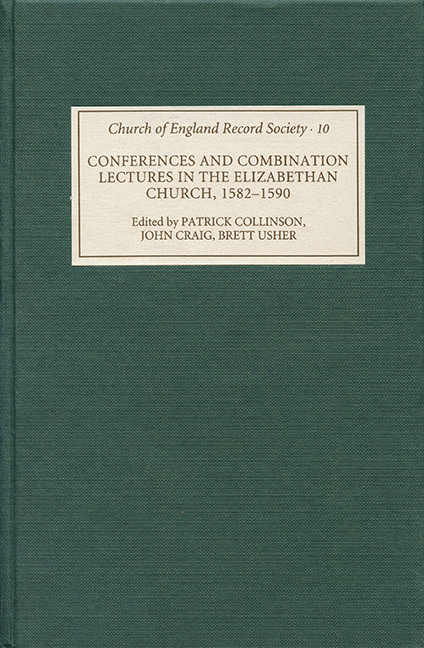
At the heart of Elizabeth I's reign, a secret conference of clergymen met in and around Dedham, Essex, on a monthly basis in order to discuss matters of local and national interest. Their collected papers, a unique survival from the clandestine world of early English nonconformity, are here printed in full for the first time, together with a hitherto unpublished narrative by the Suffolk minister, Thomas Rogers, which throws a flood of light on similar, if more public, clerical activity in and around Bury St Edmunds, Suffolk, during the same period. Taken together, the two texts provide an unrivalled insight into the minds and the methods of that network of 'godly' ministers whose professed aim was to modify the strict provisions of the Elizabethan settlement of religion, both by ceaseless lobbying and by practical example. The editors' introduction accordingly emphasizes the complex nature of the English protestant tradition between the Tudor mid-century and the accession of James I, as well as attempting to plot the politico-ecclesiastical developments of the 1580s in some detail. A comprehensive biographical register of the members of the Dedham conference, of the Bury St Edmunds lecturers, and of many other important names mentioned in the texts, completes the volume. PATRICK COLLINSON is Regius Professor of Modern History, University of Cambridge; JOHN CRAIG is associate professor at Simon Fraser University; BRETT USHER is an expert on Elizabethan clergy.
Recommend this
Email your librarian or administrator to recommend adding this to your organisation's collection.