To save content items to your account,
please confirm that you agree to abide by our usage policies.
If this is the first time you use this feature, you will be asked to authorise Cambridge Core to connect with your account.
Find out more about saving content to .
To save content items to your Kindle, first ensure no-reply@cambridge.org
is added to your Approved Personal Document E-mail List under your Personal Document Settings
on the Manage Your Content and Devices page of your Amazon account. Then enter the ‘name’ part
of your Kindle email address below.
Find out more about saving to your Kindle.
Note you can select to save to either the @free.kindle.com or @kindle.com variations.
‘@free.kindle.com’ emails are free but can only be saved to your device when it is connected to wi-fi.
‘@kindle.com’ emails can be delivered even when you are not connected to wi-fi, but note that service fees apply.
Velvet Curtains and Gilded Frames explores the intermedial context of early cinema. It tackles the first European feature films’ intricate relationship with its sister arts to reveal that the period referred to by historians as the "long nineteenth century" was one in which Bourgeois Realism reigned supreme. The nineteenth-century rise of the middle class coincided with realism becoming the dominant artistic mode in both form and content, leading to a revival of genre painting in the art academies; the supremacy of the social melodrama on the stage; and the advent of Pictorialism in photography. In its quest for artistic legitimacy, European filmmakers sought to win over middle-class audiences with films based on popular works of art - the first "art films" - by employing similar visual and narrative strategies as its artistic counterparts.
Screens and Illusionism explores the effects of illusionism as foundational to contemporary acts of perception and aesthetics. Our point of departure is the acknowledgement that our sensory perception is fundamentally subject to mediation, through a class of objects, techniques, and technologies. We emphasize mediation to consider the loss of optical certainty, and explore illusionism within the register of the uncanny. The volume is divided into three sections: Screens as Perceptual Vehicles (Part I), Mediation and its Avatars (Part II), and Alternative Teleologies of Media (Part III). Overall, the collection resonates with contemporary discussions of screen culture, media materiality and intermediality. It explores an array of pre- and post-cinematic devices and spectacular entertainments, forging links between “old” and “new” media, and across media formats.
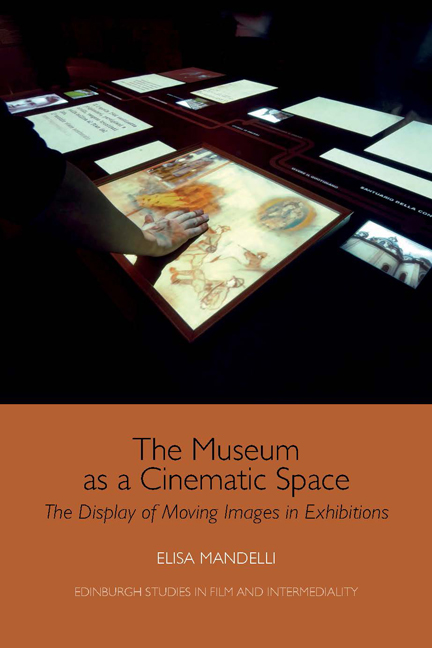
Moving images have become an increasingly common feature in a wide range of museums, which are frequently populated with screens and audio-visual projections. But when did films start to be displayed in museum galleries? And what are the issues at stake when showing moving images in exhibition spaces? With an innovative and strongly interdisciplinary theoretical framework, this book offers an extensive investigation of the use of audio-visuals in exhibition design. Highlighting the continuities and fractures between different periods, contexts and practices, Elisa Mandelli shows the deep influence of audio-visuals on the configuration of the exhibition space, as well as on the relationship between museums and their visitors.
Recommend this
Email your librarian or administrator to recommend adding this to your organisation's collection.