To save content items to your account,
please confirm that you agree to abide by our usage policies.
If this is the first time you use this feature, you will be asked to authorise Cambridge Core to connect with your account.
Find out more about saving content to .
To save content items to your Kindle, first ensure no-reply@cambridge.org
is added to your Approved Personal Document E-mail List under your Personal Document Settings
on the Manage Your Content and Devices page of your Amazon account. Then enter the ‘name’ part
of your Kindle email address below.
Find out more about saving to your Kindle.
Note you can select to save to either the @free.kindle.com or @kindle.com variations.
‘@free.kindle.com’ emails are free but can only be saved to your device when it is connected to wi-fi.
‘@kindle.com’ emails can be delivered even when you are not connected to wi-fi, but note that service fees apply.
Celebrates the centennial of Katherine Mansfield’s Bliss.
This book celebrates the centennial of Bliss’s publication by offering new readings of some of Mansfield’s most well-known stories, revealing not only the depth and innovation of her work but also the extent to which she was instrumental in revisioning the potential of the short story form. It includes the publication of a newly discovered short story potentially by Mansfield, with an explanatory essay. It also presents a selection of new poetry and a new short story by acclaimed New Zealand author Paula Morris, all inspired by Mansfield.
What Virginia Woolf called ‘Childlikeness’ is a facet of Mansfield’s personality which permeates every aspect of her personal and creative life. It is present in her mature fiction, where some of her most well-known and accomplished stories, such as ‘Prelude’ and ‘At the Bay’, have children as protagonists. It is present in her early poetry, which includes a collection of poems for children intended for publication and it is also present in her juvenilia, where many of the stories she wrote from an early age for school magazines and other publications, feature children. Even as an adult, Mansfield’s love of the miniature, her delight in children in general, her fascination with dolls, all feature in her personal writing. Her relationship with John Middleton Murry was characterised by their mutual descriptions of themselves as little children fighting against a corrupt world.
Including a newly discovered short story potentially by Mansfield, with an explanatory essay, this volume engages each of these aspects of the child in Mansfield’s work and life.
Explores the literary connection between Katherine Mansfield and Elizabeth von Arnim.
Elizabeth von Arnim is best remembered as the author of Elizabeth and Her German Garden (1898) and The Enchanted April (1922), as well as being the elder cousin of Katherine Mansfield. Recently, new research into the complex relationship between these writers has extended our understanding of the familial, personal and literary connections between these unlikely friends. We know that they were an influential presence on one another and reviewed each other's work.
By bringing the work of Mansfield and von Arnim together – including on matters of artistry, on mourning, on gardens, on female resistance – this book establishes shared preoccupations in ways that refine and extend our knowledge of writing in the period. It also deepens our understanding of the historical and literary contexts within which both of these extraordinary authors worked.
Fantastic and Gothic readings of Mansfield’s short stories present us with a covert, darker world, alongside seemingly familiar actions and events.
This volume investigates an unexpectedly rich vein of literary gothic motifs and tropes found within Mansfield’s modernist, experimental prose. The essays investigate her development of the fairytale in several stories discloses how the ‘Cinderella’ story underpins ‘Her First Ball’, how ‘Little Red Riding Hood’ lurks beneath ‘The Little Governess’, and how the figure of the changeling inhabits ‘A Suburban Fairy Tale’. Mansfield’s explorations of the conscious and unconscious mind are elucidated through a discussion of Freud’s theory of the uncanny and the unsettling effects of language in Mansfield’s In A German Pension stories. Finally, the term ‘charm’ is revealed as spanning the two extremes of the fantastic and the ordinary which combine in Mansfield’s evocations of the enchantment of domestic interiors.
New analysis of Katherine Mansfield's contribution to modernism, above all her underexplored relationship with D.H. Lawrence. Katherine Mansfield and Modernism is given a distinct focus in this volume by an emphasis on her under-explored relationship with D. H. Lawrence, to whom, both as artist and person, she felt herself uncannily alike. In addition to investigating Mansfield’s literary and biographical relationship with Lawrence, the essays for this volume examine widely varied aspects of Mansfield’s modernism including her modernist revision of fairy-tale motifs, and the aesthetic, psychological and political contexts for her work. Further essays place her within a broader international and cultural framework, analysing her important relationship with modernist ‘little magazines’ and demonstrating how Mansfield and other artists from beyond Europe formed and developed literary modernism. The volume contains a preface and new short stories and poems by internationally-esteemed writers. The relationship between Mansfield and Lawrence is also given dramatic form in an original play-script first published in this volume and based on the period during 1916 when Mansfield and Murry shared a pair of remote cottages with Frieda and D. H. Lawrence at Zennor in Cornwall.
Reveals how Katherine Mansfield's understanding of art and music shaped and inspired her writing.
This volume emphasises the centrality of Katherine Mansfield to the cultural life of her time, illuminating how her love of painting and of music inspired her art. The Fauvist paintings of the Scottish colourist F.D. Fergusson, the music of Debussy, and indeed, of Wagner, all helped to forge a precise aesthetic, founded above all on the intense study and – in the case of music – practice of artistic technique. The essays in this volume explore Mansfield’s relationships with the visual arts and with music, bringing to light the way in which these helped to shape the formal qualities of her writing: its beauty of line and intensely musical effects. Mansfield’s relationship with Woolf is also strongly in the frame. As befits a volume dedicated to the arts, there is an introduction, poetry and a new short story by highly-acclaimed writers who count Mansfield amongst their chief inspirations.
During Katherine Mansfield's life she experienced the effects of abortion, miscarriage, gonorrhoea, peritonitis, rheumatism and tuberculosis, and would take up a peripatetic existence constantly in search of more favourable climates. The First World War of 1914-1918 and the influenza pandemic of 1918-20 informed the zeitgeist of her times. This volume of essays explores the extent to which this resonant context of disease and death shaped Mansfield's literary output and her modes of thinking. Illness both stimulated and limited Mansfield's creativity - she would write to fund her medical care while simultaneously limited by her poor health, writing in 1922: 'The real point is I shall have to make as much money as I can on my next book - my path is so dotted with doctors'. As explored in this volume, her personal writings document the increasing influence of tubercular literary predecessors such as Anton Chekhov and John Keats, while her stories function compellingly as dialogue with loved ones who have been lost - her brother, her mother, her grandmother - endowing them with life in the process.
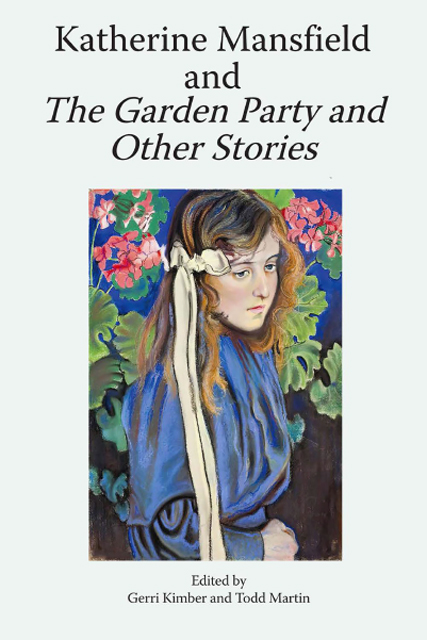
New scholarship on Katherine Mansfield's The Garden Party and Other Stories together with creative work inspired by Mansfield. The last collection of short stories published in her lifetime, The Garden Party and Other Stories would solidify Katherine Mansfield's place as the most prominent modernist short story writer of her generation. Early reviewers of the collection commented on the similarities it shared with her previous collection, Bliss and Other Stories; however, while contemporary reviews were mixed, many emphasised the psychological power of her stories, praising how she was able to bring her characters to life in a way simple action could not. While it contains some of Mansfield's most sophisticated and well-loved stories, several of the stories in The Garden Party initially appeared in the Sphere, and thus were often dismissed as inferior. Mansfield herself felt some of these stories fell short of her desired effect, though recent scholarship has revealed their greater complexity. The essays in this volume, by both seasoned and newer Mansfield scholars, work to continue this conversation. The collection also includes Mansfield-inspired short fiction, two translations of memorial poems dedicated to Mansfield by Chinese and French contemporaries with accompanying notes, and a recently re-discovered book review by Mansfield. In addition, Sydney Janet Kaplan provides a reflection on her personal meeting with Christopher Isherwood, a writer heavily influenced by the life and work of Mansfield.
This volume presents essays that engage with many aspects of Mansfield's response to all things Russian as well as to the Russians she met in England and France. In addition, the volume presents a collection of images of Gurdjieff's Institute at Fontainebleau, several of which have never been seen before.
Recommend this
Email your librarian or administrator to recommend adding this to your organisation's collection.