To save content items to your account,
please confirm that you agree to abide by our usage policies.
If this is the first time you use this feature, you will be asked to authorise Cambridge Core to connect with your account.
Find out more about saving content to .
To save content items to your Kindle, first ensure no-reply@cambridge.org
is added to your Approved Personal Document E-mail List under your Personal Document Settings
on the Manage Your Content and Devices page of your Amazon account. Then enter the ‘name’ part
of your Kindle email address below.
Find out more about saving to your Kindle.
Note you can select to save to either the @free.kindle.com or @kindle.com variations.
‘@free.kindle.com’ emails are free but can only be saved to your device when it is connected to wi-fi.
‘@kindle.com’ emails can be delivered even when you are not connected to wi-fi, but note that service fees apply.
Temporality and Progress in Victorian Literature argues that Victorian literature uses traces of a lingering past to theorize time as non-progressive and discontinuous. For decades, the dominant view in Victorian studies has been that the period’s economic, political, and intellectual developments led to a broad sense that time was defined by continuous improvement—and that this masternarrative of progress was evident across Victorian writings. McAdams contributes to a broader scholarly challenge of this thesis by considering how the irregular life-cycles of individuals and objects undermine Victorian progress. Unfashionable waistcoats, aging courtesans, and remembered conversations in Victorian literature instead reveal numerous alternative conceptions of time theorized against the emerging dominance of a progress narrative. The book uncovers the heterogenous shapes of time imagined by Victorian literature—regress, cyclicality, stasis, and rupture. These shapes are not simply progress’s others, but rather constituent elements of progress’s theorization.
Life Writing and the Nineteenth-Century Literary Market begins from the premise that nineteenth-century life writing circulated in a market, in material and discursive forms determined substantially by the desires of publishers, readers, editors, printers, booksellers and the many other craftsmen and tradesmen who collaborated in transforming first-person narrative into a commodified thing. Studies of nineteenth-century life writing have typically focused on the major autobiographers, or on the formation of ‘genre’, or on the ways in which different class, gender, race and other affiliations shaped particular kinds of exemplary subjectivities. The aim of this collection, on the other hand, is to focus on life writing in terms to of profits and sales, contracts and copyright, printing and illustration—to treat life writing, through particular case studies and through attentive analysis of print and material cultures, as one commodity among many in the vast, complicated literary market of nineteenth-century England.
Queer books, like LGBTQ+ people, adapt heteronormative structures and institutions to introduce space for discourses of queer desire. Queer Books of Late-Victorian Print Culture explores print culture adaptations of the material book, examining the works of Aubrey Beardsley, Michael Field, John Gray, Charles Ricketts, Charles Shannon and Oscar Wilde. It closely analyses the material book, including the elements of binding, typography, paper, ink and illustration, and brings textual studies and queer theory into conversation with literary experiments in free verse, fairy tales and symbolist drama. King argues that queer authors and artists revised the Revival of Printing's ideals for their own diverse and unique desires, adapting new technological innovations in print culture. Their books created a community of like-minded aesthetes who challenged legal and representational discourses of same-sex desire with one of aesthetic sensuality.
The emergence of a mass reading public during the early decades of the nineteenth century sparked a period of creative innovation in the popular press. This collection focuses on the early decades of the nineteenth century as a key period of innovation in the popular press. Steam printing, popular education campaigns, and new technologies of illustration led to new trends in book and periodical production.
Ethical consumption and consumer choice are at the heart of public debates today, but consumer activism has a long history. At the end of the nineteenth century, groups of women activists in different countries weaponised their reputation as consumers to mount campaigns against labour exploitation. By the early twentieth century, they had built an international network of Consumers' Leagues that influenced public opinion and achieved legislative change. Analysing the campaign writing of women activists, including both well-known and recently rediscovered historical figures, Flore Janssen provides new insights into the campaigns that underpinned important developments in the rights of workers and the social position of women. Highlighting the social, economic and political influence of women as activists, this book discusses campaign strategies, but also draws attention to problematic politics within these campaigns. Through its critically contextualised analysis of this specific consumer movement, the book reveals the origins of many consumer campaign strategies that remain familiar today.
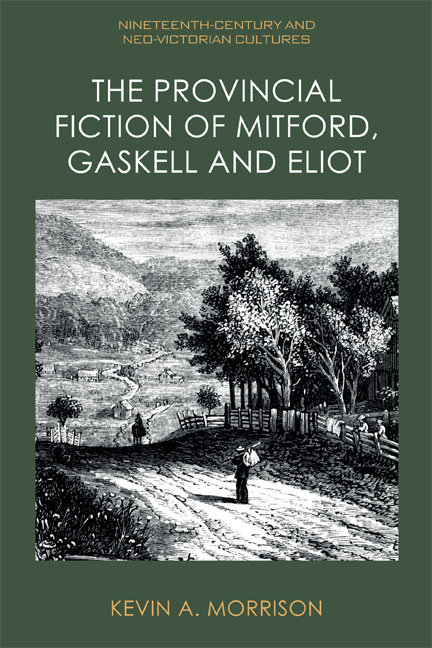
Although Elizabeth Gaskell was influenced by Mary Russell Mitford, and George Eliot by Gaskell, only a small number of scholars have considered the affinities and resemblances among all three writers of provincial fiction, and none have done so in depth. Establishing a chain of influence, this book considers Mitford, Gaskell, and Eliot's interrelated careers, including the challenges they encountered in achieving distinction within the literary sphere, and the various pressures exerted on them by publishers, reviewers, and editors. It also analyses the career-enhancing possibilities afforded by different modes of publication-including periodicals, anthologies, the three-volume novel, and monthly and bimonthly instalments-as well as their concomitant limitations. In so doing, the book offers a reassessment of Mitford's and Gaskell's provincial fiction, which has been frequently derided as a 'minor literature'. It also demonstrates the importance of their work to the development of Eliot's liberalism in the age of high realism.
Narrative, Affect, and Victorian Sensation: Wilful Bodies argues that Victorian sensation novels - long dismissed as plot-driven, silly, and feminine - develop complex theories of narrative affect, our embodied responses to reading, imagining, and even writing a narrative. The popular sensation novel thus should be understood as a key contribution to the novel's assessment of its own workings, especially the ways in which reading and writing figure as affective acts. Additionally, the book radically expands the field of sensation fiction, taking seriously lesser-known female authors, and reading them alongside a range of writers not typically considered sensational. These novels insist that feelings are not bound to a single body and that bodies generate meaning when they are put in relation to other bodies and systems of knowledge.
All authors try to do something new, or tell an old story in a new way; but for Katharine Bradley and Edith Cooper, who wrote as Michael Field and called themselves 'Poets and Lovers', rewriting old stories, history and traditional literary forms with extraordinary innovation was nothing short of high art. Offering new readings of a wide range of Michael Field texts, this book asks: how do ambitious experiments with a joint diary, closet drama, ekphrasis, elegy and nature, devotional and love poetry help these women navigate the paradox of looking backward in order to achieve their goal 'to make all things new'? How do their revisionary poetics help the co-authors, as queer, female Aesthetes, cope with late-Victorian modernity? Through an interdisciplinary approach to their passionate and sometimes eccentric life and work, this book provokes thought about the fin-de-siècle and invites readers, like Michael Field themselves, to engage the past in order to create transtemporal community and to make sense of the present.
Recommend this
Email your librarian or administrator to recommend adding this to your organisation's collection.