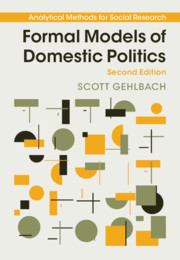
Formal Models of Domestic Politics
2nd edition
, University of Chicago
Online ISBN: 9781108674720
Online publication date:
20 October 2021
Hardback ISBN: 9781108482066
Hardback publication date: 16 December 2021
Paperback ISBN: 9781108741910
Paperback publication date: 16 December 2021
- Textbook
Formal Models of Domestic Politics offers a unified and accessible approach to canonical and important new models of politics. Intended for political science and economics students who have already taken a course in game theory, this new edition retains the widely appreciated pedagogic approach of the first edition. Coverage has been expanded to include a new chapter on nondemocracy; new material on valance and issue ownership, dynamic veto and legislative bargaining, delegation to leaders by imperfectly informed politicians, and voter competence; and numerous additional exercises. Political economists, comparativists, and Americanists will all find models in the text central to their research interests. This leading graduate textbook assumes no mathematical knowledge beyond basic calculus, with an emphasis placed on clarity of presentation. Political scientists will appreciate the simplification of economic environments to focus on the political logic of models; economists will discover many important models published outside of their discipline; and both instructors and students will value the classroom-tested exercises. This is a vital update to a classic text.
Formal Models of Domestic Politics offers a unified and accessible approach to canonical and important new models of politics. Intended for political science and economics students who have already taken a course in game theory, this new edition retains the widely appreciated pedagogic approach of the first edition. Coverage has been expanded to include a new chapter on nondemocracy; new material on valance and issue ownership, dynamic veto and legislative bargaining, delegation to leaders by imperfectly informed politicians, and voter competence; and numerous additional exercises. Political economists, comparativists, and Americanists will all find models in the text central to their research interests. This leading graduate textbook assumes no mathematical knowledge beyond basic calculus, with an emphasis placed on clarity of presentation. Political scientists will appreciate the simplification of economic environments to focus on the political logic of models; economists will discover many important models published outside of their discipline; and both instructors and students will value the classroom-tested exercises. This is a vital update to a classic text.