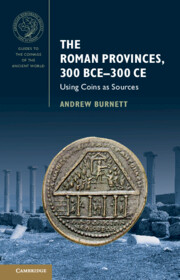
The Roman Provinces, 300 BCE–300 CE
Using Coins as Sources
, British Museum, London
Online ISBN: 9781009420099
Online publication date:
14 November 2024
Hardback ISBN: 9781009420136
Hardback publication date: 14 November 2024
Paperback ISBN: 9781009420105
Paperback publication date: 14 November 2024
- Textbook
Provincial coinage gives us a unique insight into the Roman world, reflecting the values and concerns of the elites of the many hundreds of cities in the Roman empire. Coins offer a very different perspective from written history, which usually represents the views of the senatorial class, and which was usually composed long after the events that are described. The coins, in contrast, provide evidence without hindsight, and uniquely allow a systematic examination across the whole Roman world. This volume makes it possible for instructors and students and scholars to deploy a complex set of material evidence on many historical topics. It includes over two hundred illustrations of coins with detailed captions, so providing a convenient sourcebook of the most important items, and covers topics such as the motivation for Roman conquest, the revolution of Augustus, the world of the Second Sophistic and the crisis of the third century.
Provincial coinage gives us a unique insight into the Roman world, reflecting the values and concerns of the elites of the many hundreds of cities in the Roman empire. Coins offer a very different perspective from written history, which usually represents the views of the senatorial class, and which was usually composed long after the events that are described. The coins, in contrast, provide evidence without hindsight, and uniquely allow a systematic examination across the whole Roman world. This volume makes it possible for instructors and students and scholars to deploy a complex set of material evidence on many historical topics. It includes over two hundred illustrations of coins with detailed captions, so providing a convenient sourcebook of the most important items, and covers topics such as the motivation for Roman conquest, the revolution of Augustus, the world of the Second Sophistic and the crisis of the third century.