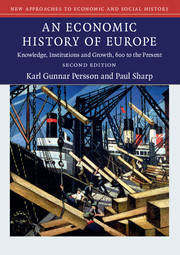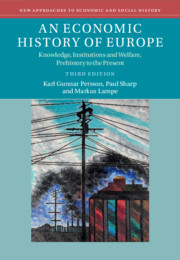
An Economic History of Europe
Knowledge, Institutions and Welfare, Prehistory to the Present
3rd edition
, University of Copenhagen, , University of Southern Denmark, , Wirtschaftsuniversitat Wien, Austria
Online ISBN: 9781009614023
Online publication date:
02 October 2025
Hardback ISBN: 9781009613989
Hardback publication date: 02 October 2025
Paperback ISBN: 9781009614009
Paperback publication date: 02 October 2025
- Textbook
In this revised and updated edition, An Economic History of Europe re-establishes itself as the leading textbook on European economic history. With an expanded scope, from prehistory to the present, it will be invaluable source for students, educators and researchers seeking to better understand Europe's long-run economic development. The authors cover key themes including the rise of institutions, technological advancements, globalization, and the Industrial Revolution, with a fresh emphasis on the wider impact of economic policies on welfare reflecting a broader understanding of societal well-being. The chronological structure, clear explanations, case studies, and minimal use of complex mathematics make this an accessible approach that allows students to apply economic theories in historical practice. The new edition also connects historical development to urgent contemporary issues such as modern-day sustainability goals. This comprehensive guide provides students with both a historical narrative of Europe's economic transformation, and the essential tools for analysing it.
In this revised and updated edition, An Economic History of Europe re-establishes itself as the leading textbook on European economic history. With an expanded scope, from prehistory to the present, it will be invaluable source for students, educators and researchers seeking to better understand Europe's long-run economic development. The authors cover key themes including the rise of institutions, technological advancements, globalization, and the Industrial Revolution, with a fresh emphasis on the wider impact of economic policies on welfare reflecting a broader understanding of societal well-being. The chronological structure, clear explanations, case studies, and minimal use of complex mathematics make this an accessible approach that allows students to apply economic theories in historical practice. The new edition also connects historical development to urgent contemporary issues such as modern-day sustainability goals. This comprehensive guide provides students with both a historical narrative of Europe's economic transformation, and the essential tools for analysing it.