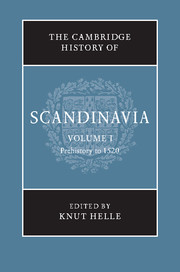
Book contents
- Frontmatter
- Introduction
- PART ITHE GEOGRAPHY AND PREHISTORY OF SCANDINAVIA
- 1The Scandinavian Landscape and its Resources
- 2The Stone and Bronze Ages
- 3The Iron Age
- 4Languages and ethnic groups
- PART IIFROM VIKINGS TO KINGS
- PART IIIMATERIAL GROWTH (to c. 1350)
- PART IVTHE HIGH MEDIEVAL KINGDOMS
- PART VHIGH AND LATE MEDIEVAL CULTURE
- PART VILATE MEDIEVAL SOCIETY (c. 1350–1520)
- PART VIISCANDINAVIAN UNIONS (1319–1520)
- Conclusion
- Select bibliography: primary sources, general surveys and secondary works arranged by part
- Index
- Plate Section"
- References
2 - The Stone and Bronze Ages
from PART I - THE GEOGRAPHY AND PREHISTORY OF SCANDINAVIA
Published online by Cambridge University Press: 28 March 2008
Edited by

Book contents
- Frontmatter
- Introduction
- PART ITHE GEOGRAPHY AND PREHISTORY OF SCANDINAVIA
- 1The Scandinavian Landscape and its Resources
- 2The Stone and Bronze Ages
- 3The Iron Age
- 4Languages and ethnic groups
- PART IIFROM VIKINGS TO KINGS
- PART IIIMATERIAL GROWTH (to c. 1350)
- PART IVTHE HIGH MEDIEVAL KINGDOMS
- PART VHIGH AND LATE MEDIEVAL CULTURE
- PART VILATE MEDIEVAL SOCIETY (c. 1350–1520)
- PART VIISCANDINAVIAN UNIONS (1319–1520)
- Conclusion
- Select bibliography: primary sources, general surveys and secondary works arranged by part
- Index
- Plate Section"
- References
Summary
The early hunters
The first inhabitants of Scandinavia migrated from the south, south-east and east following the retreating continental ice margin. In southern Scandinavia – i.e. present-day Denmark, southern Sweden and southern Norway – the late Palaeolithic hunters of the northern continental plains extended their hunting trips northwards in pursuit of the reindeer herds. On the Baltic plains, east of the Baltic Ice Lake, the vanguard settlement came from the south, from the eastern territories of the central European reindeer hunters. On the emerging southern Finnish coasts and in the Karelian zone these hunters met with people advancing from the south-east and east. In the north there was probably migration eastwards through the Arctic zone, although there is no clear archaeological evidence for this.
In Denmark and on the southern coasts of the Scandinavian peninsula the reindeer hunters belonged, archaeologically, to the so-called Hamburg, Ahrensburg and Federmesser cultures, which were already well established in the northern European lowlands. The most typical material manifestation of these cultures is the tanged point made of a long flint blade. Characteristic of the early Hamburg culture is also the so-called ‘Zinken’ artefact, a blade with a peculiar curved peak on one or both ends which was obviously used to produce points and harpoons from the long bones of reindeer. The northernmost finds of these tools derive from a complex of sites in the Finjasjö area in Skåne which demonstrate the northern limit of the Hamburg reindeer hunters’ trips about 14,000 years ago. During a warm spell in about 9000 BC (Allerød) within the generally still cold Late Glacial Period (Dryas) (see Chapter 1), elk were roaming the open forests of southern Scandinavia and were hunted, together with reindeer, by the people whose culture has been named after the finds at Bromme in Skåne; this was a northern extension of the Hamburg culture.
Keywords
Information
- Type
- Chapter
- Information
- The Cambridge History of Scandinavia , pp. 43 - 59Publisher: Cambridge University PressPrint publication year: 2003
References
et al., Naturgeografisk indelning av Norden, Helsingfors, 1977.
, ‘Background to the boat graves of the Mälaren valley’, in and (eds.), Vendel Period Studies, Statens Historiska Museum Studies, 2, Stockholm, 1983.Google Scholar
, A Concise Grammar of Older Runic Inscriptions, Tübingen, 1975.
, ‘How “common” was Common Scandinavian?’, in et al. (eds.), Germanic Studies in Honor of Anatoly Liberman, NOWELE, 31/32, Odense, 1997.Google Scholar
, Norrlands Forntid – ett historiskt perspektiv, Wiken, 1992.
and , Ribe Excavations 1970–76, 4, Esbjerg, 1990.
, Lofoten og Vesterålens historie fra den eldste tida til ca. 1500 e.Kr., Tromsø, 1984.
et al., ‘Arkeologiske undersøkelser i Nyset-Steggjavassdragene 1981–1987’, Arkeologiske rapporter fra Historisk Museum, Universitetet i Bergen, 16, Bergen, 1993.Google Scholar
and , Fosie IV: Bebyggelsen under brons- och järnålder, Malmö, 1993.
, ‘Traditional reindeer hunting and social change in the local communities surrounding Hardangervidda’, Norwegian Archaeological Review, 6:2, 1973.Google Scholar
et al., Eketorp: Fortification and Settlement on Öland/Sweden. The Monument, Stockholm, 1976.
, ‘Interaction between ethnical groups in the Baltic region in the Late Iron Age’, in and (eds.), Contacts across the Baltic Sea, Lund, 1992.Google Scholar
, Kulturlandskapets utveckling på Gotland: En studie av jordbruks- och bebyggelsesförändringar under järnåldern, Visby, 1979.
(ed.), The Age of Sutton Hoo, Woodbridge, 1992.
, ‘Kjøpe, selge, bytte, gi: Vareutveksling og byoppkomst i Norge ca. 800–1000, en modell’, in (ed.), Medeltidens födelse, Lund, 1989.Google Scholar
and (eds.), Samfundsorganisation og regional variation: Norden i romersk jernalder og folkevandringstid, Århus, 1991.
, and , ‘Undersøkelser på Heglesvollen: Tidlig jernproduksjon i Trøndelag’, Viking, 48, 1985.Google Scholar
, ‘Fra stammeret til statbegreb’, in and (eds.), Fra stamme til stat i Danmark, 2: Høvdingesamfund og kongemagt, Århus, 1991.Google Scholar
(ed.), National Atlas of Sweden: Geology, Stockholm, 1994.
, Runene på Tunesteinen, Oslo, 1981.
, Römischer Import im Norden, København, 1987.
, The Scandinavian Languages. An Introduction to their History, London, 1976.
, ‘Europe in the Migration Period: The formation of a political mentality’, in (ed.), Ritual and Power from Late Antiquity to the Early Middle Ages, Leiden, 1997.Google Scholar
, Danernes land. Fra ca. år 200 f.Kr.–700 e.Kr., (ed.), Gyldendal og Politikens Danmarkshistorie, 2, København, 1988.Google Scholar
, Danmarks jernalder: Mellom stamme og stat, Århus, 1990.
, Iron Age Societies: From Tribe to State in Northern Europe, Oxford, 1992.
and , ‘The Germanic languages’, in , and (eds.), The Germanic Languages, London, 1994.Google Scholar
et al., Arkeologi på Slettnes: Dokumentasjon av 11.000 års bosetning, Tromsø, 1996.
, ‘Tidlig kontakt over Nordsjøen, og de bakenforliggende årsaker’, in and , (eds.), Nordsjøen: Handel, religion og politikk. Karmøyseminaret
94/95, Stavanger, 1996.Google Scholar
, Järnets och järnmetallurgins introduktion i Sverige, Uppsala, 1993.
, ‘Charlemagne’s elephant and the beginning of commodisation in Europe’, Acta Archaeologica, 59, 1989.Google Scholar
and (eds.), Da klinger i muld … 25 års arkæologi i Danmark, Århus, 1993.
and , Dokkfløys historie: Dokkfløy fra istid til kraftmagasin, Lillehammer, 1992.
and (eds.), Danmarks runeindskrifter, København, 1941–2.
, I begyndelsen: Fra de ældste tider til ca. år 200 f.Kr., (ed.) Gyldendal og Politikens Danmarkshistorie, 1, København, 1992.Google Scholar
, Ribes Vikinger, Ribe, 1991.
, Synspunkter på jernalderens jordbrukssamfunn i Nord-Norge, Tromsø, 1990.
and (eds.), Military Aspects of Scandinavian Society in a European Perspective, AD 1–1300. Publications from The National Museum, Studies in Archaeology & History, 2, Copenhagen, 1997.
, ‘Archaeological material and ethnic identification: A study of Lappish material from Varanger, Norway’, Norwegian Archaeological Review, 10:1–2, 1977.Google Scholar
and (eds.), Die Runeninschriften im älteren Futhark, Göttingen, 1966.
, Hus och gård i Hälsingland: En studie av agrar bebyggelse och bebyggelsesutveckling i norra Hälsingland Kr.f.–600 e.Kr., Umeå, 1992.
, Fra jeger til bonde – inntil 800 e.Kr., (ed.), Aschehougs Norgeshistorie, 1, Oslo, 1994.Google Scholar
and , Gene: En stormannsgård från äldre järnålder i Mellom Norrland, Umeå, 1993.
, ‘The development of the agrarian landscape on Gotland during the early Iron Age’, Norwegian Archaeological Review, 7:1, 1974.Google Scholar
, Indo-European Philology, 3rd printing, London, 1977.
, ‘Bygg fra fortiden: Forsand i Rogaland. Bebyggelsessentrum gjennom 2000 år’, Ams-Småtrykk, 21, Stavanger, 1988.Google Scholar
(ed.), Thirteen Studies on Helgö, The Museum of Antiquities, Stockholm Studies, 7, Stockholm, 1988.
and , ‘The concept “Immigration” in archaeological contexts illustrated by examples from west Norwegian and north Norwegian early Iron Age’, Norwegian Archaeological Review, 5:1, 1972.Google Scholar
and , Forhistorien: Fra jegergrupper til høvdingsamfunn, (ed.), Norges historie, 1, Oslo, 1976.Google Scholar
, ‘Iron Age exploitation and high mountain resources in Sogn’, Norwegian Archaeological Review, 19:1, 1986.Google Scholar
, ‘Lågteknisk järnhandtering i Jämtlands län’, Jernkontorets Bergshistoriska Skriftserie, 22, Stockholm, 1986.Google Scholar
and (eds.), Språkene i Norden, Oslo, 1983.
and (eds.), Fra stamme til stat i Danmark, 1–2. Århus, 1988–91.
, Sirkas: ett samiskt fångstsamhälle i förändring Kr.f.–1600. e.Kr., Umeå, 1994.
, ‘Hus og hall: En høvdinggård på Borg i Lofoten’, in (ed.), Nordisk hedendom: et symposium, Odense, 1991.Google Scholar
, ‘Beregning av folketall på Jæren i yngre romertid og folkevandringstid’, in (ed.), Hus, gård och bebyggelse, Reykjavík, 1983.Google Scholar
, ‘Boathouses as indicators of political organization’, Norwegian Archaeological Review, 18:1–2, 1985.Google Scholar
, ‘Chieftains’ graves and chiefdom territories in South Norway in the Migration Period’, Studien zur Sachsenforschung, 6, 1987.Google Scholar
, ‘Rogaland forut for Hafrsfjordslaget’, in Rikssamlingen og Harald Hårfagre: Historisk seminar på Karmøy 10. og 11. juni 1993, Karmøy, 1993.Google Scholar
, ‘The beginning of the Viking Age – some current archaeological problems’, in and (eds.), Viking Revaluations, London, 1993.Google Scholar
and , Folkevandringstiden i Norden: En krisetid mellem ældre og yngre jernalder, Århus, 1988.
Natur- og kulturlandskapet i planleggingen, 1, Regioninndeling av landskap, Nordisk Ministerråd, Miljørapport
3, 1987.
, ‘Beowulf and the East Anglian royal pedigree’, in (ed.), The Age of Sutton Hoo, Woodbridge, 1992.Google Scholar
, ‘On the dialectal split of Ingveonic West Germanic from the early runic language of Scandinavia’, in (ed.), Runische Schriftkultur in kontinental-skandinavischer und -angelsächsischer Wechselbeziehung, Berlin, 1994.Google Scholar
, The Germanic Languages. Origins and Early Dialectal Interrelations, Tuscaloosa, 1989.
(ed.), Finlands historia, 1, Helsingfors
1993.
, ‘Finner og Terfinner: Etniske prosesser i nordre Fenno-Skandinavia’, Occasional Papers in Social Anthropology, 9, Oslo, 1983.Google Scholar
, ‘Comments on Saami (Lapps), Finns and Scandinavians in history and prehistory’, Norwegian Archaeological Review, 18, 1985.Google Scholar
, Bosetning og samfunn i Finnmarks forhistorie, Oslo, 1994.
, ‘New runic finds in England’, in Runor och runinskrifter, Kungl. Vitterhets Historie och Antikvitets Akademien. Konferenser, 15, Stockholm, 1987.Google Scholar
, Gene: On the Origin, Function and Development of Sedentary Iron Age Settlement in Northern Sweden, Umeå, 1983.
, Archaeology and Language. The Puzzle of Indo-European Origins, 2nd edn, London, 1989.
(ed.), Produksjon og samfunn: Om erverv, spesialisering og bosetning i Norden i 1. årtusen e.Kr., Oslo, 1995.
, ‘Da Danmark blev Danmark’, in (ed.), Gyldendal og Politikens Danmarkshistorie, 3, København, 1988.Google Scholar
, När Sverige blev Sverige, Occasional Papers on Medieval Topics, 5, Alingsås, 1981.
(ed.), National Atlas of Sweden: Sea and Coast, Stockholm, 1992.
(ed.), A Geography of Norden, Oslo, 1960.
, ‘Helm und Ringschwert: Prunkbewaffnung und Rangabzeichen germanischer Krieger’, Studien zur Sachsenforschung, 6, 1987.Google Scholar
, Stallo-boplasser: Spor etter de første fjellsamer? Oslo, 1993.
, Scadinavia und Scandia: Lateinisch-nordische Namenstudien, Acta Societatis Litterarum Humaniorum Regiae Upsaliensis, 44:1, Uppsala, 1963.
, The Unaccented Vowels of Proto-Norse, NOWELE Supplement, 11, Odense, 1994.
, Houses, Farmsteads, and long-term Change: A Regional Study of Prehistoric Settlements in the Köpinge Area, in Skåne, Southern Sweden, Uppsala, 1993.
The Nordic Environment – Present State, Trends and Threats, Nordic Council of Ministers, Nord, 12, Copenhagen, 1993.
, Settlement and Farming Systems in the Early Iron Age: A Study of Fossil Agrarian Landscapes in Östergötland, Sweden, Stockholm, 1983.
, Helgelands historie, 1, Mosjøen, 1985.
et al., Möten i gränsland: Samer och germaner i Mellanskandinavien, Stockholm, 1997.
, ‘Comments on Saamis (Lapps), Finns and Scandinavians in history and prehistory’, Norwegian Archaeological Review, 18:1–2, 1985.Google Scholar
Accessibility standard: Unknown
Why this information is here
This section outlines the accessibility features of this content - including support for screen readers, full keyboard navigation and high-contrast display options. This may not be relevant for you.Accessibility Information
Accessibility compliance for the PDF of this chapter is currently unknown and may be updated in the future.