


%20--%3e%3c!DOCTYPE%20svg%20PUBLIC%20'-//W3C//DTD%20SVG%201.0//EN'%20'http://www.w3.org/TR/2001/REC-SVG-20010904/DTD/svg10.dtd'%3e%3csvg%20version='1.0'%20id='Layer_1'%20xmlns='http://www.w3.org/2000/svg'%20xmlns:xlink='http://www.w3.org/1999/xlink'%20x='0px'%20y='0px'%20width='64px'%20height='64px'%20viewBox='5.5%20-3.5%2064%2064'%20enable-background='new%205.5%20-3.5%2064%2064'%20xml:space='preserve'%3e%3cg%3e%3ccircle%20fill='%23FFFFFF'%20fill-opacity='0'%20cx='37.785'%20cy='28.501'%20r='28.836'/%3e%3cpath%20fill='%23595959'%20d='M37.441-3.5c8.951,0,16.572,3.125,22.857,9.372c3.008,3.009,5.295,6.448,6.857,10.314%20c1.561,3.867,2.344,7.971,2.344,12.314c0,4.381-0.773,8.486-2.314,12.313c-1.543,3.828-3.82,7.21-6.828,10.143%20c-3.123,3.085-6.666,5.448-10.629,7.086c-3.961,1.638-8.057,2.457-12.285,2.457s-8.276-0.808-12.143-2.429%20c-3.866-1.618-7.333-3.961-10.4-7.027c-3.067-3.066-5.4-6.524-7-10.372S5.5,32.767,5.5,28.5c0-4.229,0.809-8.295,2.428-12.2%20c1.619-3.905,3.972-7.4,7.057-10.486C21.08-0.394,28.565-3.5,37.441-3.5z%20M37.557,2.272c-7.314,0-13.467,2.553-18.458,7.657%20c-2.515,2.553-4.448,5.419-5.8,8.6c-1.354,3.181-2.029,6.505-2.029,9.972c0,3.429,0.675,6.734,2.029,9.913%20c1.353,3.183,3.285,6.021,5.8,8.516c2.514,2.496,5.351,4.399,8.515,5.715c3.161,1.314,6.476,1.971,9.943,1.971%20c3.428,0,6.75-0.665,9.973-1.999c3.219-1.335,6.121-3.257,8.713-5.771c4.99-4.876,7.484-10.99,7.484-18.344%20c0-3.543-0.648-6.895-1.943-10.057c-1.293-3.162-3.18-5.98-5.654-8.458C50.984,4.844,44.795,2.272,37.557,2.272z%20M37.156,23.187%20l-4.287,2.229c-0.458-0.951-1.019-1.619-1.685-2c-0.667-0.38-1.286-0.571-1.858-0.571c-2.856,0-4.286,1.885-4.286,5.657%20c0,1.714,0.362,3.084,1.085,4.113c0.724,1.029,1.791,1.544,3.201,1.544c1.867,0,3.181-0.915,3.944-2.743l3.942,2%20c-0.838,1.563-2,2.791-3.486,3.686c-1.484,0.896-3.123,1.343-4.914,1.343c-2.857,0-5.163-0.875-6.915-2.629%20c-1.752-1.752-2.628-4.19-2.628-7.313c0-3.048,0.886-5.466,2.657-7.257c1.771-1.79,4.009-2.686,6.715-2.686%20C32.604,18.558,35.441,20.101,37.156,23.187z%20M55.613,23.187l-4.229,2.229c-0.457-0.951-1.02-1.619-1.686-2%20c-0.668-0.38-1.307-0.571-1.914-0.571c-2.857,0-4.287,1.885-4.287,5.657c0,1.714,0.363,3.084,1.086,4.113%20c0.723,1.029,1.789,1.544,3.201,1.544c1.865,0,3.18-0.915,3.941-2.743l4,2c-0.875,1.563-2.057,2.791-3.541,3.686%20c-1.486,0.896-3.105,1.343-4.857,1.343c-2.896,0-5.209-0.875-6.941-2.629c-1.736-1.752-2.602-4.19-2.602-7.313%20c0-3.048,0.885-5.466,2.658-7.257c1.77-1.79,4.008-2.686,6.713-2.686C51.117,18.558,53.938,20.101,55.613,23.187z'/%3e%3c/g%3e%3c/svg%3e)
%20--%3e%3c!DOCTYPE%20svg%20PUBLIC%20'-//W3C//DTD%20SVG%201.0//EN'%20'http://www.w3.org/TR/2001/REC-SVG-20010904/DTD/svg10.dtd'%3e%3csvg%20version='1.0'%20id='Layer_1'%20xmlns='http://www.w3.org/2000/svg'%20xmlns:xlink='http://www.w3.org/1999/xlink'%20x='0px'%20y='0px'%20width='64px'%20height='64px'%20viewBox='5.5%20-3.5%2064%2064'%20enable-background='new%205.5%20-3.5%2064%2064'%20xml:space='preserve'%3e%3cg%3e%3ccircle%20fill='%23FFFFFF'%20fill-opacity='0'%20cx='37.637'%20cy='28.806'%20r='28.276'/%3e%3cg%3e%3cpath%20fill='%23595959'%20d='M37.443-3.5c8.988,0,16.57,3.085,22.742,9.257C66.393,11.967,69.5,19.548,69.5,28.5c0,8.991-3.049,16.476-9.145,22.456%20C53.879,57.319,46.242,60.5,37.443,60.5c-8.649,0-16.153-3.144-22.514-9.43C8.644,44.784,5.5,37.262,5.5,28.5%20c0-8.761,3.144-16.342,9.429-22.742C21.101-0.415,28.604-3.5,37.443-3.5z%20M37.557,2.272c-7.276,0-13.428,2.553-18.457,7.657%20c-5.22,5.334-7.829,11.525-7.829,18.572c0,7.086,2.59,13.22,7.77,18.398c5.181,5.182,11.352,7.771,18.514,7.771%20c7.123,0,13.334-2.607,18.629-7.828c5.029-4.838,7.543-10.952,7.543-18.343c0-7.276-2.553-13.465-7.656-18.571%20C50.967,4.824,44.795,2.272,37.557,2.272z%20M46.129,20.557v13.085h-3.656v15.542h-9.944V33.643h-3.656V20.557%20c0-0.572,0.2-1.057,0.599-1.457c0.401-0.399,0.887-0.6,1.457-0.6h13.144c0.533,0,1.01,0.2,1.428,0.6%20C45.918,19.5,46.129,19.986,46.129,20.557z%20M33.042,12.329c0-3.008,1.485-4.514,4.458-4.514s4.457,1.504,4.457,4.514%20c0,2.971-1.486,4.457-4.457,4.457S33.042,15.3,33.042,12.329z'/%3e%3c/g%3e%3c/g%3e%3c/svg%3e)
%20--%3e%3c!DOCTYPE%20svg%20PUBLIC%20'-//W3C//DTD%20SVG%201.0//EN'%20'http://www.w3.org/TR/2001/REC-SVG-20010904/DTD/svg10.dtd'%3e%3csvg%20version='1.0'%20id='Layer_1'%20xmlns='http://www.w3.org/2000/svg'%20xmlns:xlink='http://www.w3.org/1999/xlink'%20x='0px'%20y='0px'%20width='64px'%20height='64px'%20viewBox='5.5%20-3.5%2064%2064'%20enable-background='new%205.5%20-3.5%2064%2064'%20xml:space='preserve'%3e%3cg%3e%3ccircle%20fill='%23FFFFFF'%20fill-opacity='0'%20cx='36.924'%20cy='28.403'%20r='28.895'/%3e%3cpath%20fill='%23595959'%20d='M37.442-3.5c8.99,0,16.571,3.085,22.743,9.256C66.393,11.928,69.5,19.509,69.5,28.5c0,8.992-3.048,16.476-9.145,22.458%20C53.88,57.32,46.241,60.5,37.442,60.5c-8.686,0-16.19-3.162-22.513-9.485C8.644,44.728,5.5,37.225,5.5,28.5%20c0-8.762,3.144-16.343,9.429-22.743C21.1-0.414,28.604-3.5,37.442-3.5z%20M12.7,19.872c-0.952,2.628-1.429,5.505-1.429,8.629%20c0,7.086,2.59,13.22,7.77,18.4c5.219,5.144,11.391,7.715,18.514,7.715c7.201,0,13.409-2.608,18.63-7.829%20c1.867-1.79,3.332-3.657,4.398-5.602l-12.056-5.371c-0.421,2.02-1.439,3.667-3.057,4.942c-1.622,1.276-3.535,2.011-5.744,2.2%20v4.915h-3.714v-4.915c-3.543-0.036-6.782-1.312-9.714-3.827l4.4-4.457c2.094,1.942,4.476,2.913,7.143,2.913%20c1.104,0,2.048-0.246,2.83-0.743c0.78-0.494,1.172-1.312,1.172-2.457c0-0.801-0.287-1.448-0.858-1.943l-3.085-1.315l-3.771-1.715%20l-5.086-2.229L12.7,19.872z%20M37.557,2.214c-7.276,0-13.428,2.571-18.457,7.714c-1.258,1.258-2.439,2.686-3.543,4.287L27.786,19.7%20c0.533-1.676,1.542-3.019,3.029-4.028c1.484-1.009,3.218-1.571,5.2-1.686V9.071h3.715v4.915c2.934,0.153,5.6,1.143,8,2.971%20l-4.172,4.286c-1.793-1.257-3.619-1.885-5.486-1.885c-0.991,0-1.876,0.191-2.656,0.571c-0.781,0.381-1.172,1.029-1.172,1.943%20c0,0.267,0.095,0.533,0.285,0.8l4.057,1.83l2.8,1.257l5.144,2.285l16.397,7.314c0.535-2.248,0.801-4.533,0.801-6.857%20c0-7.353-2.552-13.543-7.656-18.573C51.005,4.785,44.831,2.214,37.557,2.214z'/%3e%3c/g%3e%3c/svg%3e)
%20--%3e%3c!DOCTYPE%20svg%20PUBLIC%20'-//W3C//DTD%20SVG%201.1//EN'%20'http://www.w3.org/Graphics/SVG/1.1/DTD/svg11.dtd'%3e%3csvg%20version='1.1'%20id='Layer_1'%20xmlns='http://www.w3.org/2000/svg'%20xmlns:xlink='http://www.w3.org/1999/xlink'%20x='0px'%20y='0px'%20width='64.000977px'%20height='64px'%20viewBox='0%200%2064.000977%2064'%20enable-background='new%200%200%2064.000977%2064'%20xml:space='preserve'%3e%3cg%3e%3ccircle%20fill='%23FFFFFF'%20fill-opacity='0'%20cx='32.064453'%20cy='31.788086'%20r='29.012695'/%3e%3cg%3e%3cpath%20fill='%23595959'%20d='M31.943848,0C40.896484,0,48.476562,3.105469,54.6875,9.314453C60.894531,15.486328,64.000977,23.045898,64.000977,32%20s-3.048828,16.457031-9.145508,22.513672C48.417969,60.837891,40.779297,64,31.942871,64%20c-8.648926,0-16.152832-3.142578-22.513672-9.429688C3.144043,48.286133,0,40.761719,0,32.000977%20c0-8.723633,3.144043-16.285156,9.429199-22.68457C15.640137,3.105469,23.14502,0,31.943848,0z%20M32.060547,5.771484%20c-7.275391,0-13.429688,2.570312-18.458496,7.714844C8.381836,18.783203,5.772949,24.954102,5.772949,32%20c0,7.125,2.589844,13.256836,7.77002,18.400391c5.181152,5.181641,11.352051,7.770508,18.515625,7.770508%20c7.123047,0,13.332031-2.608398,18.626953-7.828125C55.713867,45.466797,58.228516,39.353516,58.228516,32%20c0-7.3125-2.553711-13.484375-7.65625-18.513672C45.504883,8.341797,39.333984,5.771484,32.060547,5.771484z%20M44.117188,24.456055%20v5.485352H20.859863v-5.485352H44.117188z%20M44.117188,34.743164v5.481445H20.859863v-5.481445H44.117188z'/%3e%3c/g%3e%3c/g%3e%3c/svg%3e)
Earlier this year, I asked a sample of approximately 1,000 US inhabitants to indicate their belief in the following statements: “Lizard aliens hybridized with humans who now occupy positions of power around the globe”; “The observation that water surfaces on earth are flat proves that our planet is flat”; “The United Nations had a secret plan termed ‘Agenda 21’ to force Americans from suburbs into cities and implement mandatory contraception to curb population growth”; and “The US government has in the past used chemtrails – a toxic cocktail of aluminum, strontium and barium sprayed from planes – to control the weather, the population, and our food supply.” Even though none of these statements has been verified empirically and most are debunked by all the available scientific evidence, on a scale of 1 (definitely false) to 5 (definitely true), the average truth ratings were approximately 2, with the rating of “chemtrails” being highest at 2.46 (SD = 1.35). Even more notably, these patently false facts were only slightly less believable than true facts, including “The current human genome reveals a hybridization of modern humans with other species of humans such as Neanderthals”; “The Moon was initially part of the Earth”; “China has a current population growth policy that allows couples to have a maximum of two children”; and “Regional governments in the US have allowed contamination of the water supply with lead.” Specifically, these true facts had average truth ratings of between 2.42 (SD = 1.43) and 3.58 (SD = 1.22).
The line between belief and knowledge is blurry. Knowledge is information we can classify as “true” or “false,” but a statistical distribution with an M of 2.42 and an SD of 1.43 is hardly a true–false dichotomy. Instead, we move around the world and make social, health, and financial judgments armed with much shakier beliefs. Beliefs are probability judgments (Reference Albarracín, Sunderrajan, Dai and WhiteAlbarracín et al., 2019; Reference Eagly and ChaikenEagly & Chaiken, 1993; Reference Wyer, Albarracín, Albarracín, Johnson and ZannaWyer & Albarracín, 2005). They can describe the probability that an object (i.e., a referent) has an attribute (Reference FishbeinFishbein, 1963). “John is smart” and “The Chicago River is green today” are two such beliefs. They can also describe the probability that a behavior has an outcome (Ajzen & Fishbein, 1980; Fishbein & Ajzen, 2011). “Quitting smoking reduces risk of lung cancer” is one such belief (Reference Ajzen and FishbeinAjzen & Fishbein, 1980; Fishbein & Ajzen, 2011). Beliefs can also represent certainty that an object or event is real, as in the case of “I believe in God” and “He believed what she told him.” “Expectations” are beliefs that describe what an object or behavior will be like in the future.
According to the expectancy-value formulation (Reference Ajzen, Fishbein, Lohmann, Albarracín, Albarracín and JohnsonAjzen et al., 2019; Fishbein & Ajzen, 2011), one’s attitude toward an object is a function of both outcome beliefs and evaluations. Presenting vaccination as promoting desirable (vs. undesirable) outcomes will lead people to favor vaccines (Reference Albarracín and WyerAlbarracín & Wyer, 2001; Reference Johnson, Smith-McLallen, Killeya and LevinJohnson, Smith-McLallen, Killeya, & Levin, 2004). Persuading others that a talc pill will cure a physical disease can reduce symptoms (Reference Geers, Brinol and PettyGeers, Brinol, & Petty, 2019), and the expectation that alcohol makes people social increases sociability among drinkers (Reference Darkes and GoldmanDarkes & Goldman, 1998; Reference Davis, Smith and BrileyDavis, Smith, & Briley, 2017). In this chapter, I consider effects of beliefs about objects and experiences and, later, specify the role of beliefs about the antecedents and consequences of behavior. Finally, I turn to the important issue of how to change behavior by changing beliefs and expectations.
Beliefs about Objects and Experiences
Actual experience with an object or behavior is an important belief determinant. For example, experience teaches us what objects are soft, what places are warm, and what behaviors lead to danger. Therefore, we can extract beliefs such as “Florida is warm” and “Wearing leather-sole shoes when it’s icy will make you fall.” Likewise, seeing miniature deer on Victoria Island in Bariloche, Argentina, will lead to the belief that “Miniature deer exist in some areas of the globe.”
Experiences often involve emotional feelings and thus create beliefs about feelings we might experience in the future (i.e., affective expectations). Research in the domain of breastfeeding nicely illustrates the power of affective experiences (Reference DiGirolamo, Thompson, Martorell, Fein and Grummer-StrawnDiGirolamo et al., 2005). In this area, a large amount of evidence supports the benefits of breastfeeding for both infants and mothers. This feeding practice boosts the immunological defenses of the infant and accelerates maternal recovery from childbirth (Reference Gartner, Morton, Lawrence, Naylor, O’Hare, Schanler and EidelmanGartner et al., 2005). Thus, before the child is born, mothers often intend to breastfeed their infants. However, many abandon their attempts to breastfeed, sometimes days after the infant is born. The beliefs based on affective experiences are thus at the basis of breastfeeding discontinuation.
A study on the contribution of the affective beliefs associated with breastfeeding (Reference DiGirolamo, Thompson, Martorell, Fein and Grummer-StrawnDiGirolamo et al., 2005) included measures of breastfeeding intentions prior to delivery, emotional comfort during breastfeeding (i.e., affective experience), and frequency and duration of breastfeeding. As one might expect (Reference Albarracín, Johnson, Fishbein and MuellerleileAlbarracín, Johnson, Fishbein, & Muellerleile, 2001), intentions to breastfeed predicted breastfeeding. However, so did the emotional experience of breastfeeding. Among the women who discontinued before 20 weeks, 19 percent reported feeling emotionally uncomfortable. In contrast, less than 1 percent of the women who continued beyond 20 weeks manifested discomfort.
Mere expectations can also drive judgments of affective experience (see also Reference BrunerBruner, 1957; Reference ForgasForgas, 1995). People who expect an object to be pleasant will experience the object as pleasant. Naturally, however, expectations color the experience more when people fail to attend to potential discrepancies between the beliefs and the object (for related issues, see Reference Fazio, Maio and OlsonFazio et al., 2000).
The placebo effect is an interesting case of how expectations bias experience and judgments. Beliefs about the effects of substances, drugs, and medical treatments affect reactions to them. People who expect that alcohol will make them more sociable are indeed more sociable when they drink (Reference Lau-Barraco, Braitman, Leonard and PadillaLau-Barraco et al., 2012). However, placebo effects are more likely to occur if, in addition to an expectation, an individual has a goal that is compatible with the expectation (Reference Geers, Helfer, Kosbab, Weiland and LandryGeers et al., 2005). For example, expecting that a drug (actually inert) will make a person feel less nauseous and also having the goal (consciously or nonconsciously) of feeling less nauseous lead to the placebo effect.
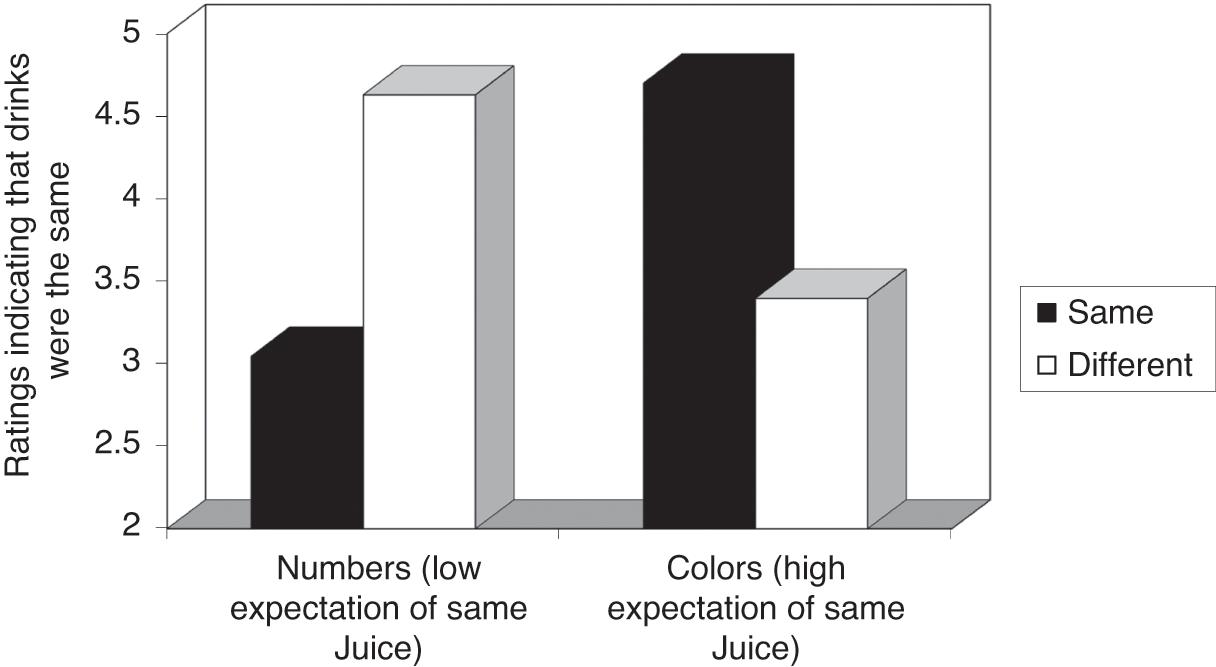
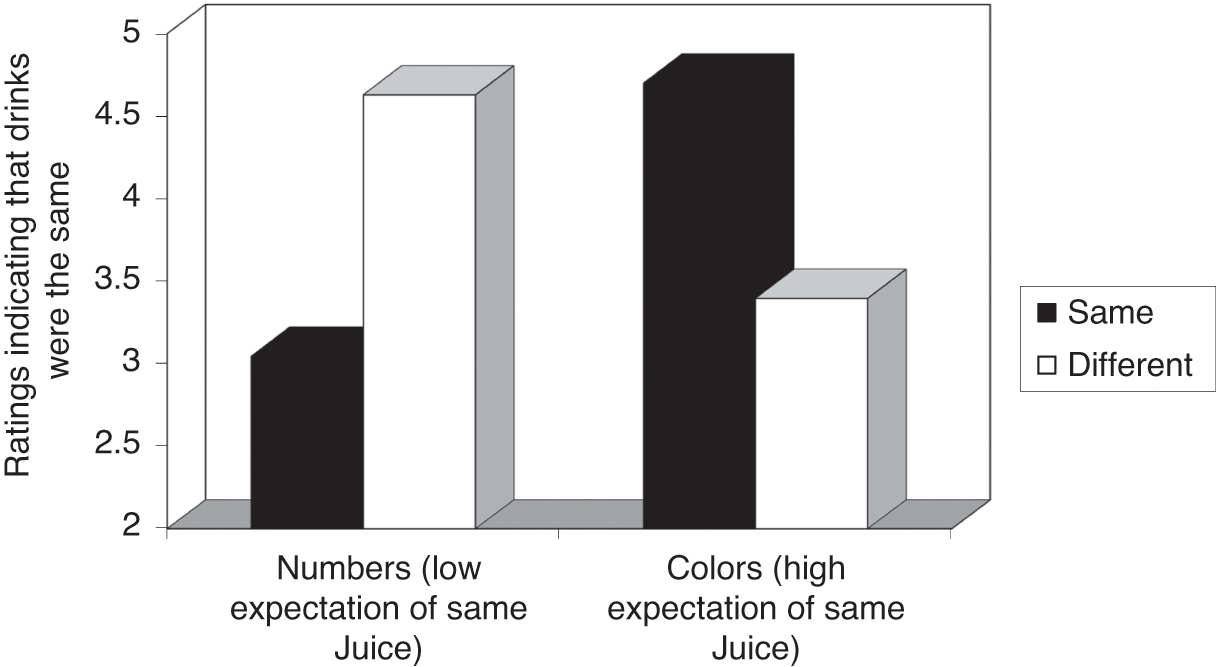
A study by Reference Hoegg and AlbaHoegg and Alba (2006) demonstrated the curious influence of beliefs in the domain of taste. Participants in a series of studies were asked to compare the tastes of three samples of orange juice. Pairs could contain either the same juice or a different juice and were presented either numbered from 1 to 4 or differentiated with artificial coloring. Coloring was used as a way of creating the expectation that juices of the same color were the same juice. In all conditions, participants were allowed to taste the samples, and then they rated how different the two samples were. Figure 2.1 presents the results, with higher numbers indicating greater perceived differences across the samples. As can be seen, when the samples were simply numbered (control), participants accurately perceived different types of juice as different. However, when the samples were grouped by color, samples with different colors were judged to be more different than samples with different numbers. In other words, the color created expectations that overrode taste perceptions.
Effects of expectations on reported taste.
Under what conditions do people notice inconsistencies between expectations and reality? Reference Geers, Helfer, Kosbab, Weiland and LandryGeers, Helfer, Kosbab, Weiland, and Landry (2005) have argued that people who notice inconsistencies between their beliefs and experiences might be negatively influenced by their beliefs (i.e., experience a contrast effect). People who are motivated and able to examine an object may judge the experience as less in line with the expectation (Reference Geers and LassiterGeers & Lassiter, 1999). For example, believing that a movie will induce positive feelings may backfire when the movie actually induces negative feelings.
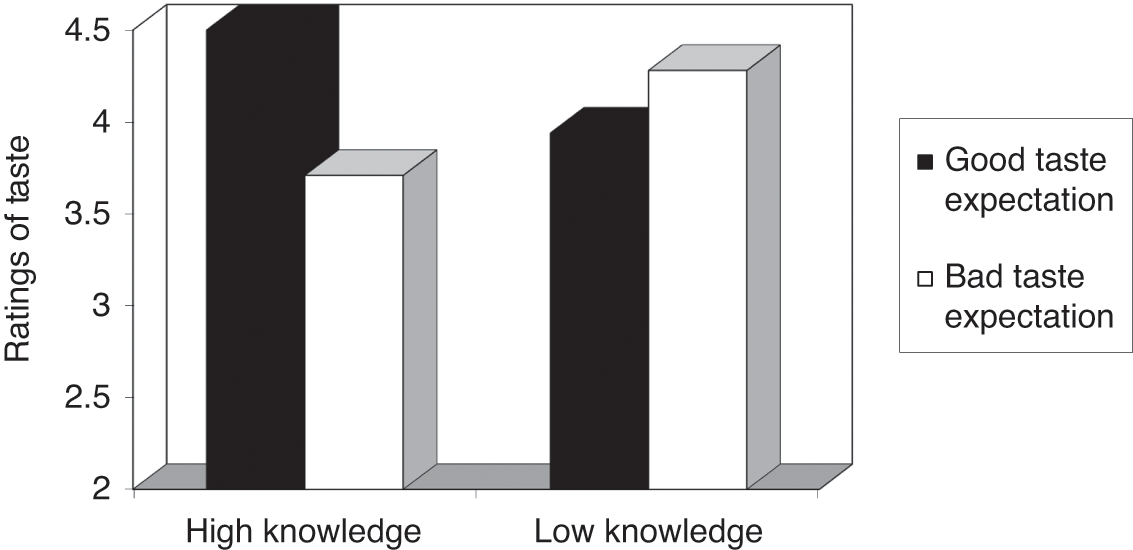
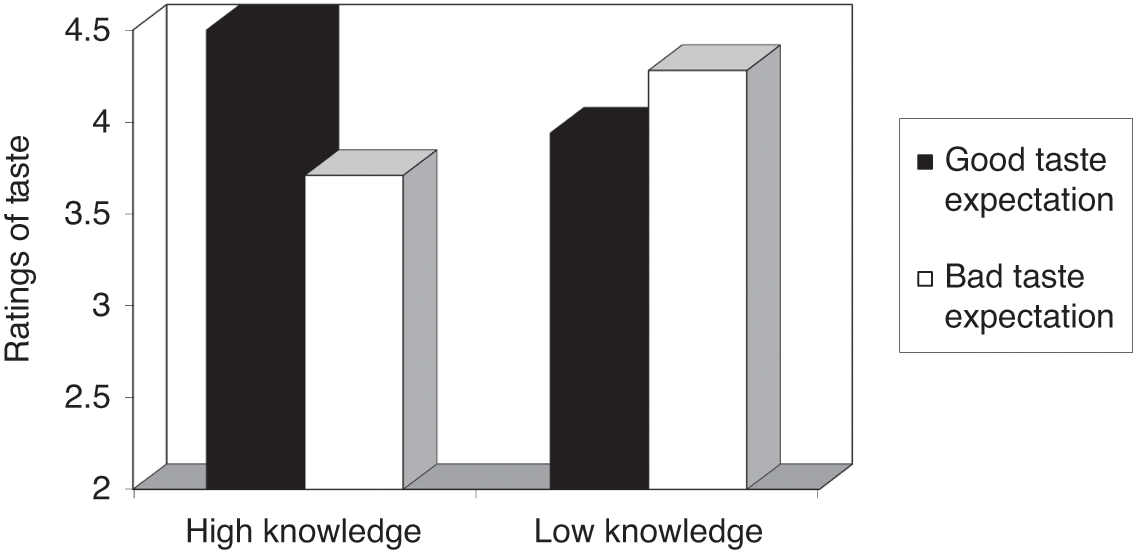
Importantly, Reference ChangChang (2004) adopted a more explicit stand on the processes underlying disconfirmation of affective experiences (see also Reference Boulding, Kalra, Staelin and ZeithamlBoulding, Kalra, Staelin, & Zeithaml, 1993; Reference Hoch and DeightonHoch & Deighton, 1989; Reference Kopalle and LehmannKopalle & Lehmann, 1995, Reference Kopalle and Lehmann2001; Reference Olson and DoverOlson & Dover, 1979). According to Chang, contradictory experiences reverse the effects of beliefs by producing more careful thinking when people have high knowledge about a product. Participants in this research had either high or low knowledge about fruit juices. They were given an advertisement describing the appealing taste of a new type of juice, which they later sampled. Half of the participants received a good-tasting drink and the other a bad-tasting drink. The findings from this study appear in Figure 2.2. As shown, when participants had high knowledge, they reported the product as worse when the taste was bad than when it was good. However, when knowledge was low, the two taste conditions did not differ. If anything, in the low-knowledge conditions, the product was judged as better when its taste was bad than when it was good.
Also within the consumer-behavior domain, research by Reference OliverOliver (1977) uncovered interesting effects of forming beliefs about positive or negative attributes of a product. Discovering that a product’s qualities fall short of expectations (e.g., not enough positive qualities or too many negative qualities) produces dissatisfaction. In contrast, discovering that a product’s qualities exceed expectations (e.g., fewer negative or more positive qualities) produces satisfaction. Similarly, Reference Mellers, Schwartz, Ho and RitovMellers, Schwartz, Ho, and Ritov (1997) propose that consumers engage in counterfactual thinking and compare the actual outcome to the expected outcome. If the outcome and the expectation match, affect is commensurate with the outcome. People feel bad if the outcome is negative but good if the outcome is positive. However, if the outcome is better (worse) than expected (e.g., people win $100 when they expected to win $50 vs. losing $50 when they expected to lose $100), people experience highly positive (negative) affect resulting from a contrast with the expected outcome.
The ironic effects of disconfirming beliefs, however, can be attributed to more than one type of process. According to our research (Reference Handley, Albarracín, Brown, Li, Kumkale and KumkaleHandley et al., 2009), there are inferential and perceptual comparative processes, both of which require paying attention to one’s affective reactions. That is, people must direct attention or identify their feelings for those feelings to have an influence (Reference Albarracín, Cohen and KumkaleAlbarracín & Kumkale, 2003). Also, having a naive theory that affective beliefs influence affective experiences calls further attention to affect and leads to correcting attitudes for the presumed effects of the expectation (Reference Handley, Albarracín, Brown, Li, Kumkale and KumkaleHandley et al., 2009).
To test this hypothesis, we (Reference Handley, Albarracín, Brown, Li, Kumkale and KumkaleHandley et al., 2009) conducted a series of laboratory experiments. In this series, participants first received either a positive or a negative expectation about either a new alcohol-like beverage or a photography book. The results showed that a positive expectation was worse when affect identification was normal or high. Presumably, either normal or high affect identification allows people to infer that the product seemed better because they expected it to be good. However, high affect identification is necessary to elicit the same effect in a perceptual way, that is, in the absence of a theory. In addition, perceptual, belief-consistent effects occurred when affect identification was normal and participants had no naive theory about the influence of affect.
Beliefs about Behavioral Outcomes
Experience both influences beliefs and is influenced by beliefs, but the research I just reviewed is insufficient to understand the critical role of beliefs about the outcomes and antecedents of a behavior. In making behavioral decisions, people wonder whether they would personally like to perform the behavior. In doing so, they consider if the consequences of that behavior are desirable (Reference Ajzen and FishbeinAjzen & Fishbein, 1980). For example, when purchasing a car, people often form their attitudes toward a car by judging the car’s attributes and the desirability of each attribute. They may find out that the car has efficient gas mileage, is compact, and is blue and evaluate each attribute of the car. They may also find out that buying the car will not allow for family trips and will increase their current debt. In this case, the attitude toward the car depends on the evaluations of having efficient gas mileage, being compact, and being blue, combined with the strength of the car-attribute associations. Correspondingly, the attitude toward the behavior depends on the evaluations of “not being able to make family trips” and “increasing one’s debt,” combined with the probability that buying the car will yield those outcomes.
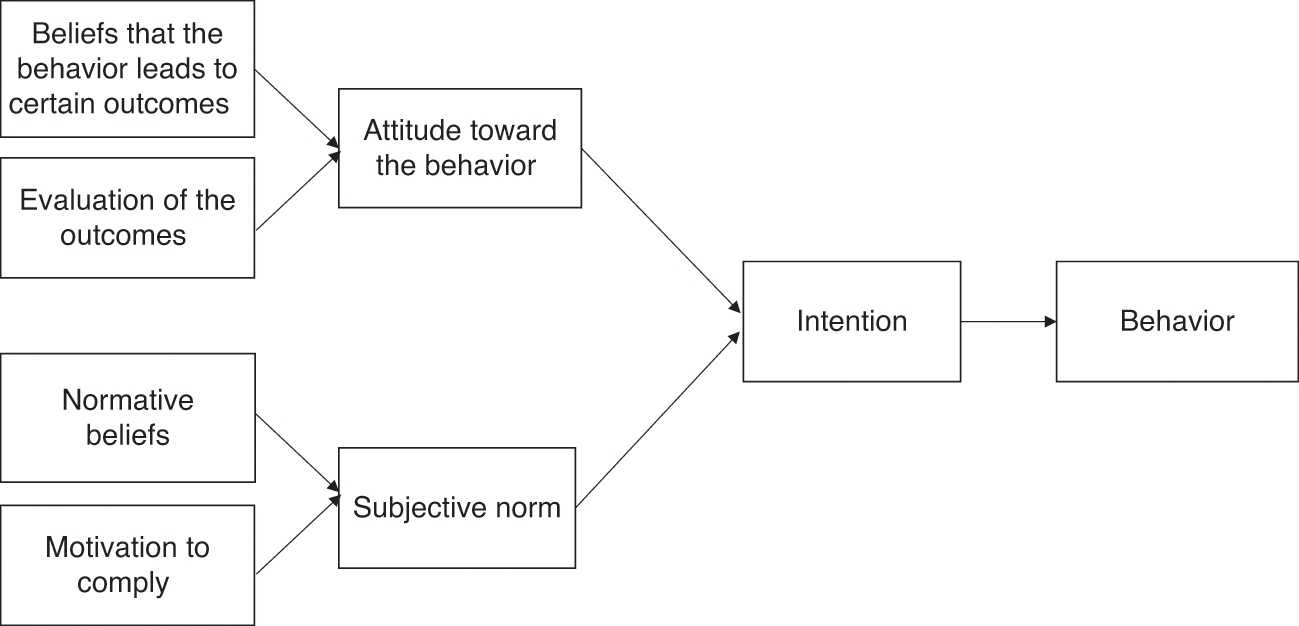
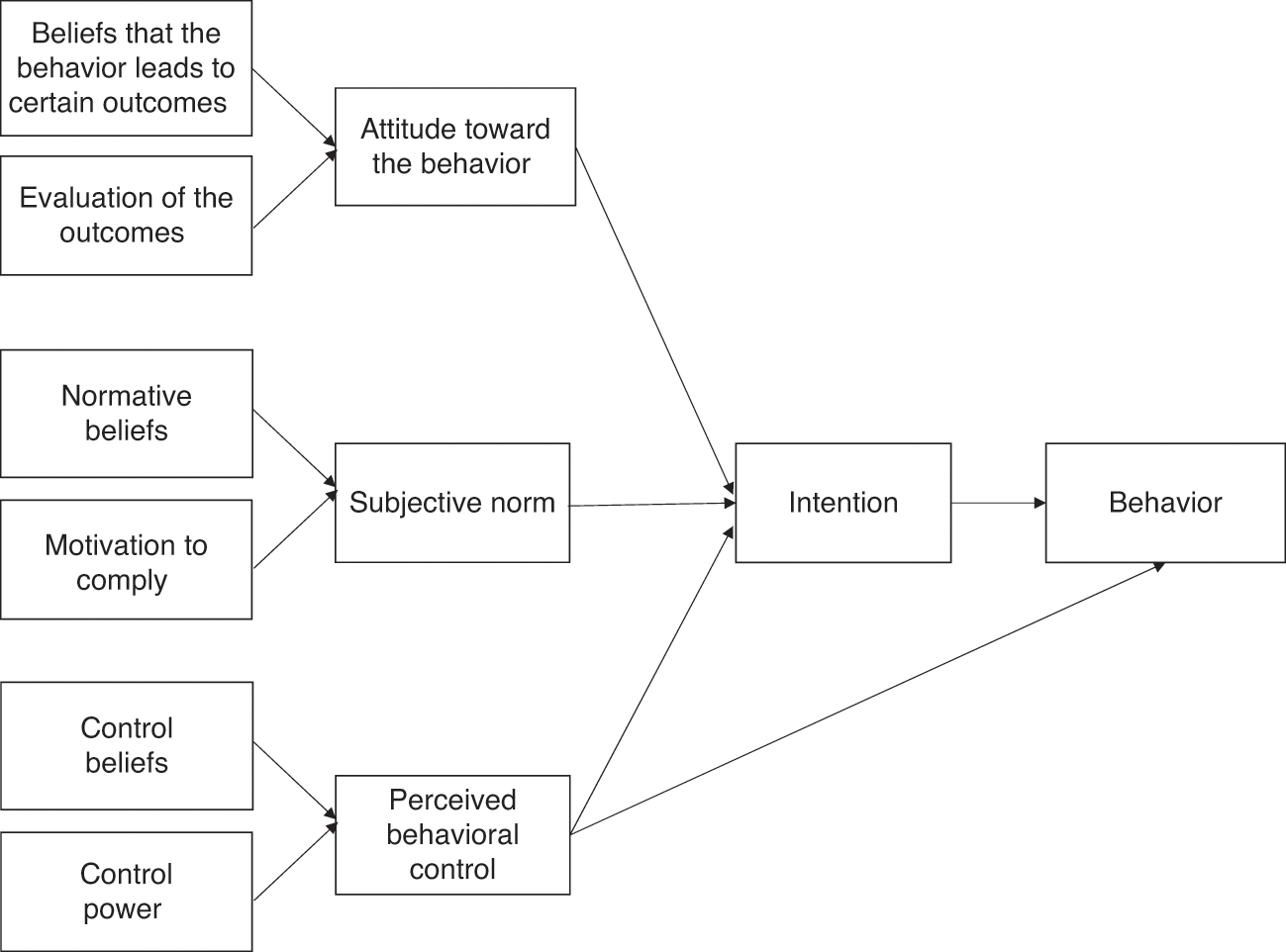
Fishbein and Ajzen (Reference Ajzen and FishbeinAjzen & Fishbein, 1980; Reference Fishbein and AjzenFishbein & Ajzen, 1975, 2010) were the first to introduce the belief–attitude–intention–behavior sequence to social psychology. Their theory, which appears in the top panel of Figure 2.3, posits that a person’s overt action is a function of the intention or willingness to perform the behavior. For example, researchers may ask, “How likely is it that, in the next six months, you will [would] use a condom the next time you have vaginal sex with her?” (Albarracín, Johnson, Fishbein, & Muellerleile, 2001). If the theory of reasoned action is correct, respondents should be likely to use condoms when they intend to use them. Intentions, in turn, are influenced by the attitude toward performing the behavior and the subjective norm. Attitude is the degree to which one has a positive versus a negative evaluation of the behavior and is typically measured by a set of semantic differential (e.g., bad/good) scales. The subjective norm is the perception that important others think that one should or should not perform the behavior in question (see Chapter 5 for my discussion of normative influences) and is typically measured by items such as “people who are important to me think I should use condoms” (see, e.g., Reference Fisher, Fisher and RyeFisher, Fisher, & Rye, 1995). In most studies, however, intention is driven by attitudes to a greater extent than by subjective norms (Albarracín, Johnson, Fishbein, & Muellerleile, 2001; Reference Eagly and ChaikenEagly & Chaiken, 1993).
Theory of reasoned action.
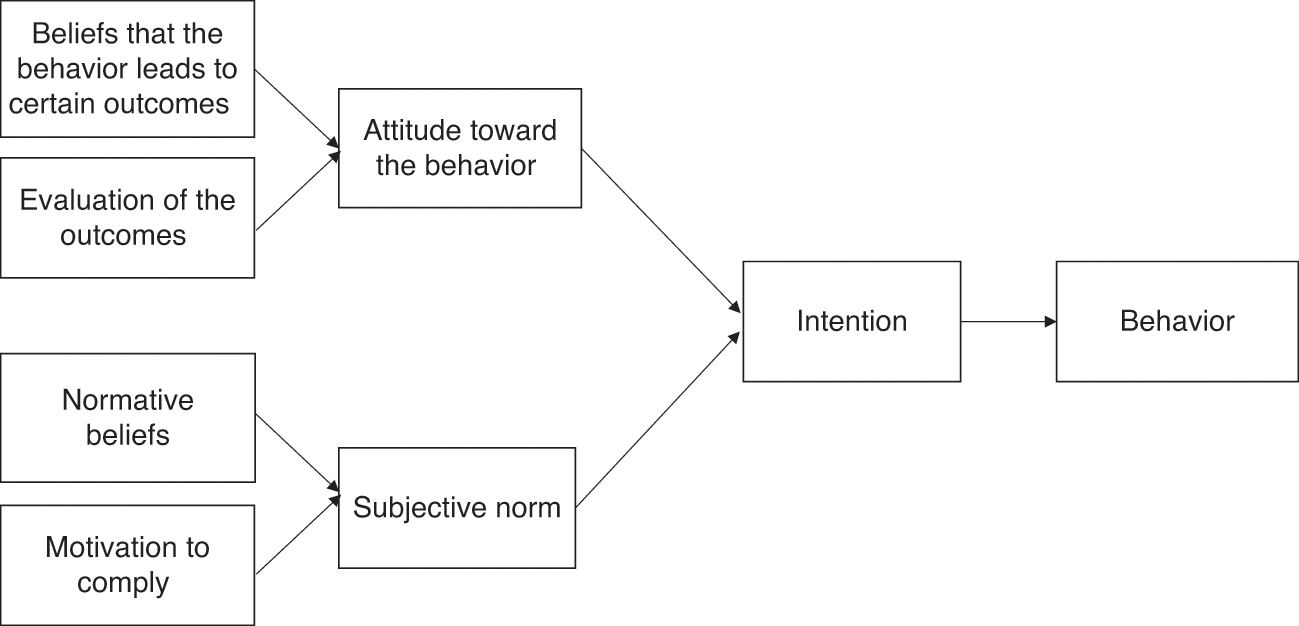
The attitude toward the behavior is assumed to be a function of one’s beliefs that performing the behavior in question will lead to various outcomes and the evaluative aspects of those beliefs (i.e., the evaluations of the outcomes). An expectancy-value estimate of attitude is obtained by subjectively weighting each salient belief that the outcome will occur (bi, i = 1, …, p) by the evaluative implications of that outcome (ei, i = 1, …, p). Thus, one is more likely to have a positive attitude toward using condoms if one believes that using a condom will lead to positive outcomes (e.g., “will make sex more fun”) and prevent negative outcomes (e.g., “may help prevent HIV”). Formally,
where AB is the attitude toward performing behavior B, bi is the strength of the belief that performing behavior B leads to outcome i, ei is the evaluation of outcome i, and i is the number of salient outcomes. This component of the model is critical when researchers are interested in modifying attitudes since it assumes that attitudes are formed on the basis of an analysis of behavioral outcomes.
The subjective norm is also influenced by a set of salient beliefs about the normative prescriptions of specific referents, weighted by the motivation to comply with each of those referents. For example, a man may perceive social pressure to use condoms if he believes that his partner thinks that he should use condoms and he is motivated to comply with him or her. Thus,
where SNB is the subjective norm toward behavior B, nbj is the normative belief that referent j thinks the respondent should or should not perform the behavior, mj is the motivation to comply with referent j, and j is the number of referents. Normative beliefs are typically measured by bipolar probability statements about the opinion of a specific referent (e.g., “Does your main partner think that you should or should not get him to use a condom every time you have vaginal sex with him?”; Reference Kamb, Fishbein, Douglas, Rhodes, Rogers, Bolan and PetermanKamb et al., 1998, p. 12), whereas motivations to comply are measured by means of unipolar items (e.g., “In general, I want to do what my partner wants me to do”). The use of the Σnbjmj component to predict subjective norms assumes that people’s subjective norms can be changed by changing either the perceived positions of important referents or one’s motivation to comply with those referents.
In Reference Fishbein and AjzenFishbein and Ajzen’s (1975) model, AO is the attitude toward the object, bi is the strength of the belief that the object has attribute i, ei is the evaluation of attribute i, and the sum is over all salient attributes (Reference Fishbein and AjzenFishbein & Ajzen, 1975). AO is the attitude toward the object, bi is the strength of the belief that the behavior will lead to outcome i, ei is the evaluation of outcome i, and the sum is over all salient outcomes (Reference Fishbein and AjzenFishbein & Ajzen, 1975). The equation for the attitude toward the object is as follows:
Beliefs about Behavioral Antecedents
We (Reference Albarracín, Johnson, Fishbein and MuellerleileAlbarracín et al., 2001) meta-analyzed a large number of empirical studies examining the relation between attitudes toward condom use and the Σbiei concerning condom use. We found that the association between condom use attitudes and Σbiei was positive and strong. However, when people decide whether or not to perform a behavior, they also think about the antecedents to the behavior, that is, the conditions that are necessary for the behavior to take place. Exercise, for example, requires purchasing athletic shoes and finding an appropriate location. In addition, for adults who have not exercised in a long time, exercise requires a medical exam to rule out health risks. If one can estimate the likelihood that these preconditions will be met, one should be equally likely to estimate any person’s ability to perform the action in question. Likewise, people who try to gauge their own ability to perform a behavior should go through a similar process of estimating what Reference AjzenAjzen (1991) refers to as “control beliefs.” According to him, perceptions of control are contingent on control beliefs and control power, that is, the belief in an antecedent to the behavior (e.g., having condoms available) and the degree to which that event facilitates the behavior. Similar to AB = Σbiei, PBC = Σcbkcpk, where PBC is perceived behavioral control, cbk is the control belief concerning event k, and cpk is the control power of event k to promote or prevent the behavior, all summed over the number of events (k).
Ajzen and colleagues (Reference Ajzen, Kuhl and BeckmannAjzen, 1985; Reference Ajzen and DriverAjzen & Driver, 1990; Reference Ajzen and MaddenAjzen & Madden, 1986; Reference Fishbein and AjzenFishbein & Ajzen, 2010) added the variable of perceived behavioral control in an effort to predict intentions and behaviors that are not completely under volitional control (Figure 2.4). Perceived behavioral control refers to one’s perception of control over the behavior and is assumed to reflect the obstacles that one encountered in past behavioral performances. With the inclusion of this new factor, Ajzen’s theory of planned behavior proposes that perceived behavioral control can influence behavior directly. Thus,
Theory of planned behavior.
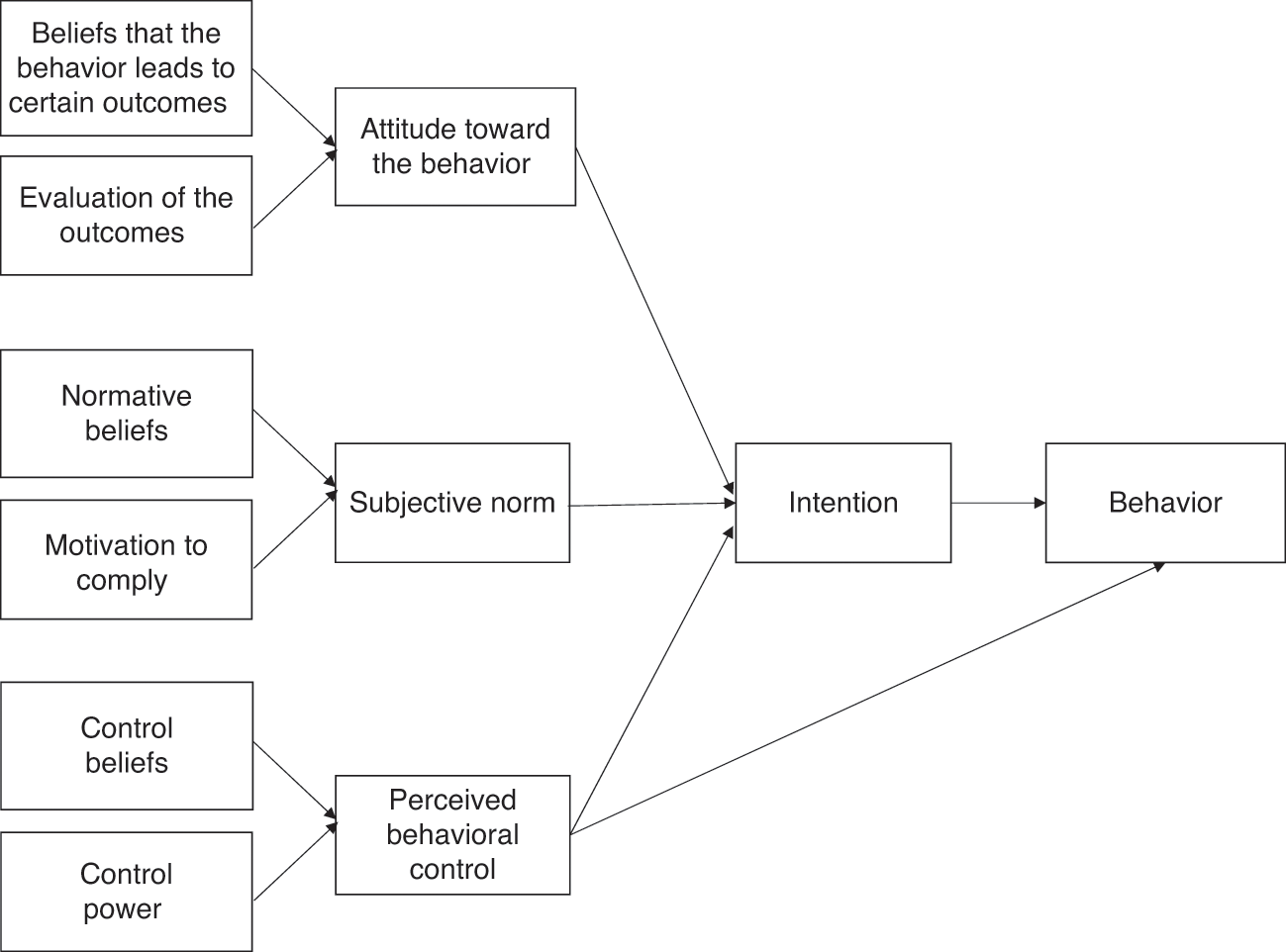
where B is the behavior, I is intention, and PBC is perceived behavioral control. In addition to contributing to behavioral prediction, perceived behavioral control is assumed to influence a person’s intention to use condoms over and above attitudes and norms. That is, people with higher perceived control are more likely to form intentions to perform a particular action than those who perceive that they have little or no control. Formally,
where I, AB, SNB, and PBC have been previously defined. Generally, perceived behavioral control is measured as an aggregate of perceptions that (a) one can or cannot perform the behavior if one wants to, (b) performing the behavior is or is not up to oneself, and (c) performing the behavior is easy or difficult (see Reference Ajzen, Kuhl and BeckmannAjzen, 1985; Reference Ajzen and DriverAjzen & Driver, 1990; Reference Ajzen and MaddenAjzen & Madden, 1986; Reference Fishbein and AjzenFishbein & Ajzen, 2010). The theory has performed very well in many domains (Reference ArmitageArmitage, 1995; Reference Bamberg, Ajzen and SchmidtBamberg, Ajzen, & Schmidt, 2003; Reference Davis, Ajzen, Saunders and WilliamsDavis et al., 2002; Reference De Leeuw, Valois, Ajzen and SchmidtDe Leeuw et al., 2015; Reference FishbeinFishbein, 2008; Reference Fraser, Johnson, Hebert, Ajzen, Copeland, Brown and ChanFraser et al., 2010; Reference Glasman and AlbarracínGlasman & Albarracín, 2003; Reference Hagger and ChatzisarantisHagger & Chatzisarantis, 2014; Reference Weingarten, Chen, McAdams, Yi, Hepler and AlbarracínHassan, Shiu, & Parry, 2016b; Reference Heim, Ajzen, Schmidt and SeddigHeim et al., 2018; Reference HoltgraveHoltgrave, 2007; Reference Hornik, Ajzen and AlbarracínHornik, Ajzen, & Albarracín, 2007; Reference Perkins, Jensen, Jaccard, Gollwitzer, Oettingen, Pappadopulos and HoagwoodPerkins et al., 2007; Reference Stecker, Fortney, Hamilton, Sherbourne and AjzenStecker et al., 2010; Reference Zemore and AjzenZemore & Ajzen, 2014).
What Reference AjzenAjzen’s (1991) model does not take into account, however, is that evaluations of the antecedents of the behavior can also contribute to the desirability of the behavior. According to McGuire and McGuire (1991), the desirability of an event’s antecedent may affect the overall evaluation of the event. For example, to judge if developing an HIV vaccine is favorable, some people may wish to know how many animals will suffer or die in the process of testing the vaccine (Reference McGuire and McGuireMcGuire & McGuire, 1991). Others, however, will focus on the number of lives the vaccine will likely save, as in Reference Fishbein and AjzenFishbein and Ajzen’s (1975) model.
The influence of the behavioral antecedents can be conceptualized as the combined influence of the ability of a given event to promote the behavior (i.e., likelihood that a possible antecedent will trigger the behavior) and the perceived desirability of this event. If people believe that performing the behavior involves preparatory actions or events that they find desirable, their attitude is likely to be positive. Moreover, if they believe that performing the behavior does not involve preparatory actions or events that they find desirable, their attitude is likely to be negative (for further details on the double-negative logic, see Reference Ajzen and FishbeinAjzen & Fishbein, 1980).
Although both consequences and antecedents are likely to be important, their relative weights may vary. As a case in point, people with little prior experience with a behavior are more likely to first consider how to get to perform it than are people with more experience. Thus, inexperienced ones may think about the likelihood and desirability of the antecedents more than experienced ones may. For example, young adults without sexual experience may evaluate condom use on the basis of not only its outcomes but also its antecedents. In contrast, young adults with sexual experience may evaluate the behavior on the basis solely of the outcomes.
I conducted a study with 438 introductory psychology students to examine the role of antecedents and consequences in attitudes. The questionnaire measured (a) attitudes, (b) beliefs in and evaluations of the antecedents of condom use, (c) beliefs in and evaluations of the outcomes of condom use, and (d) sexual experience. Attitudes were measured with semantic differential scales (unsafe vs. safe, something I don’t like vs. something I like). Condom use antecedents were elicited in a qualitative questionnaire previously administered to an independent sample of 30 students. Specifically, the earlier participants were asked to describe the “good and bad things that would need to happen for you to use a condom correctly every time you have sex in the next year” and the “events that would facilitate or hinder your correct condom use every time you have sex in the next year.” Five events were mentioned by at least 10 percent of the earlier participants: (a) “having condoms available,” (b) “being careful,” (c) “being in a monogamous relationship,” (d) “being sexually excited when a condom is not around,” and (e) “having a partner who does not want to use a condom.” In the main study, we measured antecedent beliefs by asking participants to “judge the extent to which each of the following events would lead to using condoms correctly every time you have sex during the next year” on a scale of −3 (unlikely) to +3 (likely). Similarly, we measured antecedent evaluations by asking participants to rate each situation (e.g., “having condoms available”) using a scale ranging from −3 (bad) to +3 (good). As a summary measure of cognitions about behavioral antecedents, we multiplied the likelihood that each antecedent would promote condom use by the desirability of the corresponding antecedent and summed over the five antecedents in the scale.
We also measured judgments of the consequences of condom use. These consequences were elicited following Reference Ajzen and FishbeinAjzen and Fishbein’s (1980) procedures. Specifically, participants reported the “advantages and disadvantages” and “good and bad results” of their using a condom correctly in the next year. Consequences mentioned by at least 10 percent of the participants were considered modally salient and used in the study questionnaire. To measure outcome beliefs, participants were asked to use a scale from −3 (unlikely) to +3 (likely) to rate the likelihood that “using condoms correctly every time you have sex during the next year will:” (a) “prevent HIV,” (b) “prevent sexually transmitted diseases,” (c) “prevent pregnancy,” (d) “make me feel safe,” and (e) “reduce my sexual pleasure.” To measure outcome evaluations, participants rated the desirability of the outcomes on a scale from −3 (bad) to +3 (good). As with antecedent cognitions, we weighted the likelihood that the behavior would lead to each consequence by the perceived desirability of the consequence. Next, we summed the resulting scores as an overall index of cognitions about outcomes.
If behavioral experience moderates the implications of behavior antecedents for attitudes toward the behavior, we might observe stronger correlations with antecedent cognitions when participants had no sexual experience. As expected, the attitudes of sexually inexperienced participants correlated with antecedents of condom use more highly than did the attitudes of sexually experienced ones. However, the correlation with outcome perceptions was similar across the two groups.
Changing Cognitions about Outcomes and Antecedents
Changing an attitude toward a behavior often requires changing beliefs and evaluations of outcomes. For example, interventions that discuss the outcomes of implementing condom use (Reference Albarracín, Gillette, Earl, Glasman, Durantini and HoAlbarracín et al., 2005; Reference Albarracín, McNatt, Klein, Ho, Mitchell and KumkaleAlbarracín, McNatt et al., 2003) increase positive outcome beliefs and evaluations of these outcomes. As a result, these interventions are generally more effective than those that do not discuss outcomes (Reference Albarracín, Johnson and ZannaAlbarracín et al., 2005; Reference Albarracín, McNatt, Klein, Ho, Mitchell and KumkaleAlbarracín, McNatt et al., 2003). Furthermore, programs to change behavior are often successful if they increase the probability of events that causally precede the target behavior. To begin, verbal arguments may teach people to gather resources for and sort obstacles to a behavior like condom use (what we have called behavioral skills arguments; Reference Albarracín, Johnson and ZannaAlbarracín et al., 2005; Reference Albarracín, McNatt, Klein, Ho, Mitchell and KumkaleAlbarracín, McNatt et al., 2003). In addition, a widely accepted behavioral intervention strategy is to have individuals role-play behavioral skills like condom application or negotiation in the case of condom use (i.e., behavioral skills training). These two strategies offer an ideal opportunity to examine how to induce critical antecedents that facilitate or hinder a behavior.
We investigated the effects of behavioral skills arguments and training in a meta-analysis of the effects of HIV-prevention interventions designed to promote condom use. As part of this project (Reference Albarracín, Cohen and KumkaleAlbarracín et al., 2003, Reference Albarracín, Gillette, Earl, Glasman, Durantini and Ho2005), we selected over 350 interventions and around 100 control groups comprising a large number of countries, US states, and years. For each of these groups or conditions, we calculated amount of change in behavior over time (e.g., increases in condom use frequency from the pretest to the posttest). We also coded for presence of behavioral skills arguments (e.g., describing how carrying condoms around is beneficial), as well as training in condom use skills (e.g., practice with unwrapping and applying condoms), interpersonal skills (e.g., role-playing interpersonal conflict over condom use and initiation of discussions about protection), and self-management skills (e.g., practice in decision-making while intoxicated, avoidance of risky situations). We also calculated change in various psychological variables including behavioral skills (knowing how to obtain and apply condoms and knowing how to negotiate condom use with a partner).
The results of comparing interventions that did and did not include behavioral skills arguments and training appear in Table 2.1. They show that including behavioral skills arguments as well as self-management behavior-skills training in the interventions led to positive change.
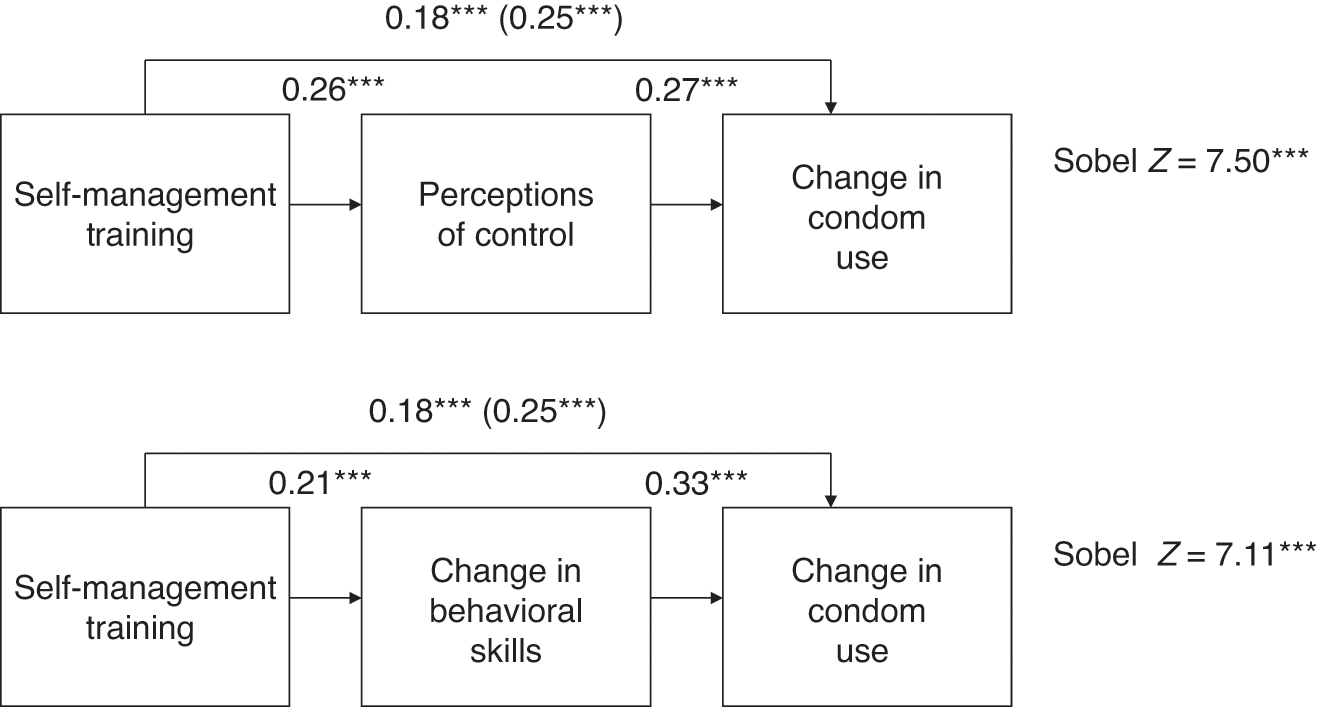
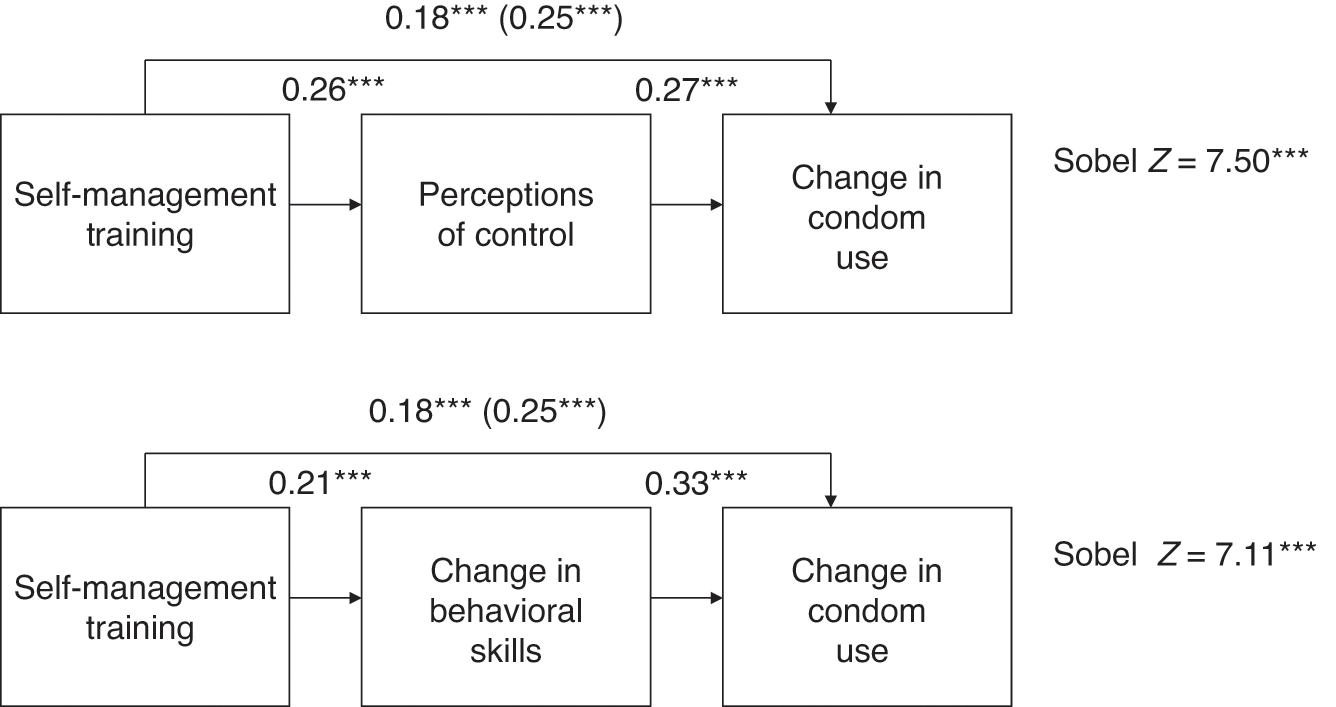
Nonetheless, the finding that a behavioral skill strategy influences behavior change is not sufficient to conclude that behavioral skills mediate the effect. To investigate that possibility, we (Reference Albarracín, Gillette, Earl, Glasman, Durantini and HoAlbarracín, Gillette et al., 2005) conducted path analyses using a dummy code to signal the use of self-management skills training, a measure of change in perceptions of control or behavioral skills as the mediator, and change in condom use as the outcome. The analyses for perceptions of control and self-management skills training appears in Figure 2.5. As shown, the effect of self-management skills training on behavior change was mediated by changes in perceptions of control and behavioral skills.
Effects of behavioral skills training on condom use change.
| Was strategy included in intervention? | |||
|---|---|---|---|
| Yes | No | QB1 | |
| Behavioral skills arguments | 0.33 | 0.16 | 44.49*** |
| Behavioral skills training | |||
| Condom use skills training | 0.31 | 0.30 | 0.71 |
| Interpersonal skills training | 0.25 | 0.36 | 10.14** |
| Self-management skills training | 0.51 | 0.10 | 251.08*** |
Note: All factors were dummy coded (strategy included 1; strategy not included 0). Entries are fixed-effects weighted model means adjusted for all other effects. Control groups (d. 0.08, confidence interval 0.06 to 0.10) were excluded. Threat-inducing arguments, normative arguments, attitudinal arguments, informational arguments, counseling and testing, and condom use provision were included in the analysis, as was condom provision. QB homogeneity coefficient for the difference across levels of a factor, distributed as a chi-square with degrees of freedom equal to the number of factor levels.
**p < 0.01. ***p < 0.001.
Despite positive effects of self-management skills training, the other two skills training were much less promising. As shown in Table 2.1, including condom use skills training had no effect, and including interpersonal skills training had a negative effect, leading to less change with it than without it. However, we need to consider that each of these training strategies is gender specific. Condom use skills training is geared toward men who can actually apply the male condom, and behavioral skills training is geared toward women who must persuade their partners to use the male condom. Therefore, we analyzed if the impact of behavioral skills strategies was moderated by gender and found partial support for our hypothesis. Condom use skills training was efficacious for predominantly male samples but counterproductive for predominantly female samples, and interpersonal skills training had no effect for predominantly female samples but was counterproductive for predominantly male samples. In addition, even when self-management skills training (e.g., not to drink around sex) was efficacious across genders, its impact was stronger for females than males.
But do behavioral skills strategies, which are designed to increase actual ability to promote antecedents that are preconditions to a behavior, have differential effects as a function of experience with a behavior? Do these strategies work better for people who have less experience with the antecedents of a behavior like condom use? My earlier analyses predicting attitudes toward condom use from beliefs and evaluations about antecedents and outcomes suggested that outcomes mattered regardless of sexual experience, whereas antecedents mattered more for the inexperienced. Thus, behavioral skills arguments and training could also matter more for the inexperienced.
In the meta-analysis of condom use interventions, we (Reference Albarracín, Cohen and KumkaleAlbarracín et al., 2003, Reference Albarracín, Gillette, Earl, Glasman, Durantini and Ho2005) (see Table 2.2) examined whether intervention efficacy depends on the level of sexual experience. Condom use interventions are generally applied to populations with sexual experience, except for school interventions, which naturally capture adolescents and young adults, who typically have less experience. We also compared recipients over and under 21 years of age. Interestingly, condom use skills, which are essential for somebody without experience to be able to use condoms, were more influential both for school interventions and for samples under 21 in average. In contrast, looking at the effects of attitudinal arguments, which typically describe the outcomes of condom use, showed no difference in efficacy across school versus nonschool interventions or younger versus older samples.
In the domain of condom use, sexual experience is probably a proxy for having the most basic skills necessary to begin practicing the behavior. However, another important issue is the degree to which discussions about antecedents and outcomes have different effects depending on the degree to which people have already been practicing the recommended behavior (in this case, condom use). The transtheoretical model (Reference Prochaska, DiClemente and NorcrossProchaska, DiClemente, & Norcross, 1992) has described a sequence of stages that go from behavior initiation, to adoption, to maintenance. According to this model (Reference Prochaska, Redding, Harlow, Rossi and VelicerProchaska et al., 1994), people who are aware that their behavior is problematic but do not intend to change it are in the precontemplation stage. People who consider performing the behavior at some point in their lives but have no actual plans to change it are in the contemplation stage (Reference Prochaska, Redding, Harlow, Rossi and VelicerProchaska et al., 1994). People who are committed to changing their behavior within the next month and engage in the behavior occasionally are in the preparation stage (Reference Prochaska, Redding, Harlow, Rossi and VelicerProchaska et al., 1994). People who engage in the behavior on a regular basis for less than 6 months are in the action stage (Reference Prochaska, Redding, Harlow, Rossi and VelicerProchaska et al., 1994). People who engage in a behavior on a regular basis for 6 months or more are in the maintenance stage (Reference Prochaska, Redding, Harlow, Rossi and VelicerProchaska et al., 1994). Presumably, earlier stages require motivational interventions and later stages require behavioral skills training.
We analyzed the effects of self-management training and information in combination with the level of past condom use of the audience. According to the transtheoretical model, people who are not yet using condoms may become motivated if they are presented with an attitudinal or informational appeal. Later on, however, a focus on behavioral skills should facilitate movement toward the more consistent implementation of the recommended behavior (Reference BanduraBandura, 1997, Reference Bandura2001; Reference Bandura and WoodBandura & Wood, 1989). We found that intervention strategies varied in their effectiveness for people who had lower and higher levels of condom use prior to the intervention. Consistent with Reference Prochaska, DiClemente and NorcrossProchaska et al.’s (1992) predictions, the beneficial effects of self-management skills training were greater among higher condom users than lower condom users. However, contrary to Reference Prochaska, Redding, Harlow, Rossi and VelicerProchaska et al.’s (1994) predictions, the influence of attitudinal arguments was the same across levels of past condom use. If anything, attitudinal arguments had a greater effect among higher than lower condom users, which is opposite to Prochaska et al.’s hypothesis.
All in all, changing beliefs and evaluations concerning both outcomes and antecedents can produce changes in attitudes toward the behavior and ultimately the behavior as well. This is summarized in the following principle:
Principle 8. Impact of beliefs on attitudes. Changing beliefs about the outcomes and antecedents of a behavior generally changes attitudes.
Beliefs about Actions and Inactions
Another important dimension of beliefs is whether they pertain to action or inaction. Movement attracts attention in most living beings, including humans. Likewise, action may attract more attention than inaction even if movement is not involved. One preliminary indication that people are more interested in action than inaction comes from Google searches for action and inaction, as well as the adjectives active, passive, and inactive. This analysis showed that interest in action is also between 70 and 100 times higher than interest in inaction. Similarly, interest in “active” is about twice as strong as is interest in “passive” and “inactive.”
If people pay more attention to action than inaction, they should have more beliefs about action than inaction. For that reason, I asked a group of participants to describe advantages of “action” and “inaction,” disadvantaged of “action” and “inaction,” and antecedents of “action” and “inaction.” As shown in Table 2.3, general action produces more associations than general inaction. In fact, there are between about one and three more associations for action than inaction, representing between 30 percent and 100 percent more beliefs about action than beliefs about inaction. This finding supports the following principle:
| Action | Inaction | t-Testa | |
|---|---|---|---|
| What are the advantages of action/inaction (in whatever way you understand it)? | 6.70 | 3.45 | 19.60*** |
| What are the disadvantages of action/inaction (in whatever way you understand it)? | 5.33 | 3.17 | 13.78*** |
| What does it take (need to happen) for action/inaction (in whatever way you understand it) to be possible? | 4.34 | 2.98 | 19.60*** |
aN = 407.
***p < .001
Principle 9. Relative numerosity of beliefs about action and inaction. There are more beliefs about general action than about general inaction.
General action and general inaction are both abstract concepts. Naturally, to exert an effect, these concepts need to be applicable to specific behaviors. We argue that general action concepts will shape beliefs about any behavior that can be construed as an action. Correspondingly, general inaction concepts will shape beliefs about any behavior that can be construed as an inaction.
Principle 10. Influence of beliefs about action and inaction on specific beliefs. Beliefs about action and inaction can influence beliefs about any specific behavior that can be construed as action or inaction.
For example, in the same study presented in Table 2.3, I asked participants to describe advantages, disadvantages, and antecedents of two specific behaviors, run and sleep. Naturally, these specific concepts map onto the general notion of action and inaction and had the same pattern of numerosity. Table 2.4 shows the number of associations for run and sleep. The pattern of number of associations found for specific concepts was the same as the one found for the general category, although the differences were weaker. Thus, even though the formation of beliefs about specific actions and inaction were likely driven by various factors, the relation to the category remained strong.
| Run | Sleep | t-Testa | |
|---|---|---|---|
| What are the advantages of action/inaction (in whatever way you understand it)? | 3.20 | 2.69 | 6.36*** |
| What are the disadvantages of action/inaction (in whatever way you understand it)? | 2.74 | 2.27 | 5.22*** |
| What does it take (need to happen) for action/inaction (in whatever way you understand it) to be possible? | 2.74 | 2.30 | 6.36*** |
aN = 406.
***p < 0.001.
Summary
This chapter covered the role of beliefs, including beliefs about objects and behaviors and expectations about experiences or objects not yet encountered. Beliefs exert powerful effects on our attitudes and experiences and combine with experiences in ways that amplify discrepancies. For example, expecting that a drug will have positive (vs. negative) effects can lead to a more negative evaluation if the experience is negative. This chapter also identified two types of cognitions relevant for analyzing attitudes and behaviors. To estimate the desirability of the event, people can refer to the expected value of the event’s outcomes. Alternatively, they may refer to the desirability of an event’s antecedents. Interestingly, when reflecting about a behavior, people without experience in the domain think about the conditions that will facilitate the behavior more than those with experience. Moreover, verbal arguments and forms of training designed to change perceptions about the behavior’s desirability and control have critical effects when the right conditions are met. Finally, this chapter describes beliefs about actions and inactions, how they are represented, and how action and inaction are subjective concepts that serve to organize thoughts at the most general level.

 Open access