Book contents
- Frontmatter
- Contents
- List of figures
- Acknowledgments
- List of abbreviations
- 1Background and methodology
- 2Authorial data: seams and summaries
- 3Authorial criteria: Greek prose compositional conventions
- 4Authorial unity: analysis results and probabilities
- 5Final considerations and future directions
- Appendix
- Bibliography
- Index of Biblical and Other Ancient Sources
- Index of Modern Authors and Subjects
- References
4 - Authorial unity: analysis results and probabilities
Published online by Cambridge University Press: 24 June 2009

Book contents
- Frontmatter
- Contents
- List of figures
- Acknowledgments
- List of abbreviations
- 1Background and methodology
- 2Authorial data: seams and summaries
- 3Authorial criteria: Greek prose compositional conventions
- 4Authorial unity: analysis results and probabilities
- 5Final considerations and future directions
- Appendix
- Bibliography
- Index of Biblical and Other Ancient Sources
- Index of Modern Authors and Subjects
- References
Summary
Using, then, as my main criterion simply that the speeches of Lysias are composed in a pleasing style, I have come to suspect many of the speeches which have been commonly regarded as genuine. I put them to the test and found them spurious, not because there was anything wrong with them in a general way, but because they did not strike me with that characteristic Lysianic charm or with the euphony of that style.
(Dion. Hal. Lys. 12)Dionysius was concerned incidentally with problems of ascription and chronology throughout his career as a literary critic. In the early Lysias he shows how, in the absence of internal chronological or other evidence, a developed literary taste could be called into service as the final judge of authorship.
Although the once solid theological, thematic, generic, structural, and narrative unity of Luke and Acts has been challenged as to the extent of the two books' interwoven textuality, authorial unity has remained virtually closed to scholarly scrutiny. The paucity of modern inquiry into the single authorship hypothesis is worrisome at best, ill-considered at worst.
Both ancient and modern literary critics are intrigued by authorship issues. On the one hand, modern critics are at a disadvantage. We cannot possess the same “developed literary taste” as the ancient critics, because the Greek of the classical and post-classical eras is decidedly remote from modern linguistic sensibilities.
Information
- Type
- Chapter
- Information
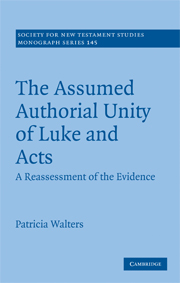
- The Assumed Authorial Unity of Luke and ActsA Reassessment of the Evidence, pp. 137 - 189Publisher: Cambridge University PressPrint publication year: 2009
References
, “Learning Greek History in the Ancient Classroom: The Evidence of the Treatises on Progymnasmata”Classical Philology 99 (2004), 103fCrossRefGoogle Scholar
, Luke: Storyteller, Interpreter, Evangelist (Peabody, Mass.: Hendrickson Publishers, 2007)Google Scholar
, “The Unity of the Lukan Writings: Rethinking the Opinio Communis,” in (ed.), With Steadfast Purpose: Essays on Acts in Honor of Henry Jackson Flanders, Jr. (Waco, Tex.: Baylor University Press, 1990)Google Scholar
“Who Wrote the Gospel of Luke?”Bible Review 17 (2001), 12–21, 54–55
, The New Testament Among the Writings of Antiquity, (ed.), trans. (Sheffield: Sheffield Academic Press 1998)Google Scholar
, “Plutarch's Language and Style,” in Principat, Part 2, vol. 33.6, (ed.), Aufstieg und Niedergang der römischen Welt (Berlin: Walter de Gruyter, 1992)Google Scholar
, “Caractère et structure du Commentaire Philonien” in Le Commentaire de l’Écriture chez Philon d'Alexandrie: son caractère et sa portée: observations philologiques (Leiden: Brill, 1977), pp. 170–235Google Scholar
, Rhetorical Argumentation in Philo of Alexandria (Atlanta, Ga.: Scholars Press, 1999)Google Scholar
and , “Philo's Style and Diction” in and (eds.), Two Treatises of Philo of Alexandria: Commentary on De gigantibus and Quod Deus sit immutabilis, Brown Judaic Studies 25 (Chico, Calif.: Scholars Press, 1983)Google Scholar
, Josephus in Galilee and Rome: His Vita and Development as a Historian (Leiden: Brill, 1979)Google Scholar
, “The Semitisms of Acts,”Journal of Theological Studies n. s., 1 (1950), 16–28CrossRefGoogle Scholar
, The Gospel according to St. Luke: The Greek Text with Introduction, Notes, and Indices (London: Macmillan & Co., 1930), p. lxxviGoogle Scholar
, “The Acts of the Apostles” in and (eds.), Introduction to the New Testament (New York: Desclée, 1965), p. 366Google Scholar
, Lukas als hellenistischer Schriftsteller (Göttingen: Vandenhoeck & Ruprecht, 1972), pp. 51, 63–64, 67–69, 72–78Google Scholar
and (eds.), A Grammar of New Testament Greek, vol. Ⅱ (Edinburgh: T. & T. Clark, 1920; reprint 1968), pp. 7f
, Dating Acts: Between the Evangelists and the Apologists (Santa Rosa, Calif.: Polebridge Press, 2006), p. 343Google Scholar
, SPSS 11.0: Guide to Data Analysis (Upper Saddle River, N.J.: Prentice Hall, 2002), pp. 240ffGoogle Scholar
, Accent and Rhythm: Prosodic Features of Latin and Greek: A Study in Theory and Reconstruction (Cambridge: Cambridge University Press, 1973)Google Scholar
, Studien zur griechischen Wortstellung, Göteborgs Högskolas Årsskrift 39 (Gothenburg: Wettergren & Kerbers Förlag, 1933), pp. 16fGoogle Scholar
, Griechische Grammatik: auf der Grundlage von Karl Brugmanns griechischer Grammatik, vol. Ⅱ (Munich: C. H. Beck'sche Verlagsbuchhandlung, 1950), pp. 695fGoogle Scholar
, “Eine hebraisierende Sonderquelle des Lukas,”Theologische Zeitschrift 6 (1950), 166 note 18Google Scholar
Accessibility standard: Unknown
Why this information is here
This section outlines the accessibility features of this content - including support for screen readers, full keyboard navigation and high-contrast display options. This may not be relevant for you.Accessibility Information
Accessibility compliance for the PDF of this chapter is currently unknown and may be updated in the future.